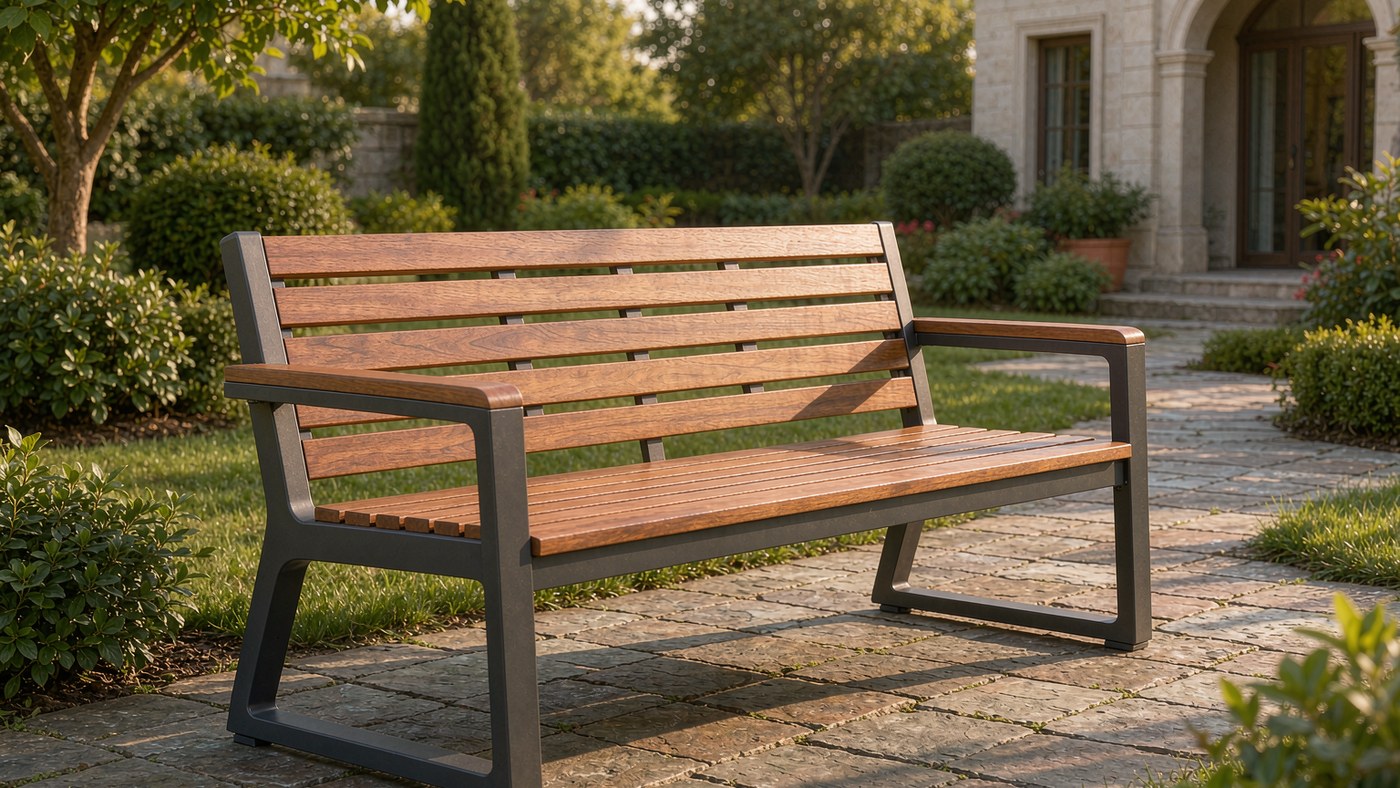
Outdoor Garden Bench Buying Guide: Teak, Aluminium and the Spec That Matters
A garden bench looks simple, and that is exactly why buyers underestimate it. The piece that sits on a hotel garden path, a villa terrace or a restaurant patio for five seasons has to survive sun, rain, salt air and constant use while still looking like the day it arrived. This guide walks commercial and wholesale buyers through the decisions that actually change lifespan and landed cost: frame material, sizing, finish, contract-grade checks, and the procurement maths that keeps a container order on budget.
Why the garden bench is the quiet workhorse of outdoor spaces
The bench is the most flexible outdoor bench for garden paths, terraces and patios you can specify. Unlike a sun lounger that commits a guest to lying down, or a dining set that locks a space into one function, a bench fits where nothing else does: the end of a garden path, the foot of a pool steps, a rooftop terrace edge, a hotel lobby forecourt. For hotel and resort buyers it is the highest-traffic, lowest-complaint item in the catalogue, which is why getting the spec right pays back faster than any hero piece.
From a sourcing view the bench is also forgiving on freight: it nests and stacks better than bulky sofas, so a 40HQ can carry far more bench units than lounge suites. That makes it a smart anchor product for a first MOQ order with a factory-direct OEM partner.
Teak vs aluminium: which bench frame to specify
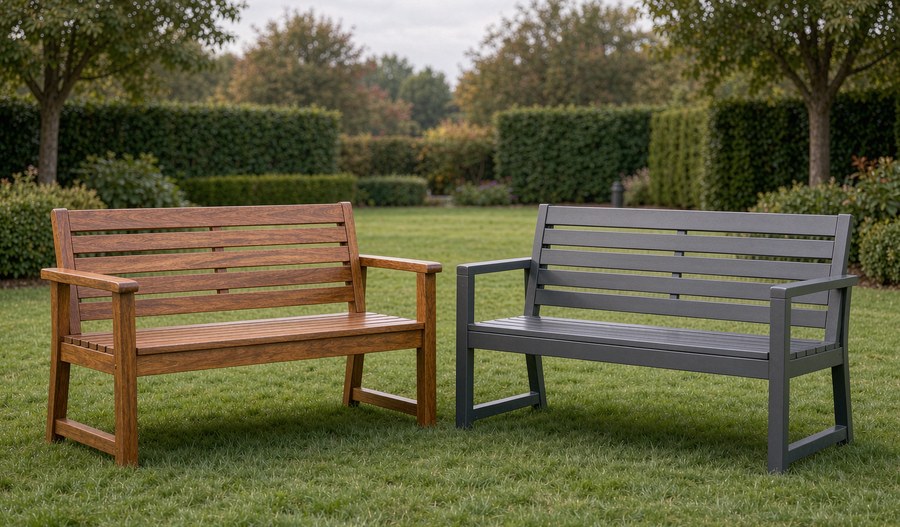
The two materials we build benches in are solid teak and powder-coated aluminium, and they serve different buyers. Teak brings warmth and a natural grain that reads as premium in a villa or boutique hotel setting; left untreated it silvers to a soft grey, or you keep the honey tone with annual oil. Aluminium brings near-zero maintenance and a lighter weight that matters on rooftop decks with load limits and on balconies.
| Factor | Solid teak bench | Powder-coated aluminium bench |
|---|---|---|
| Typical weight (1.5 m) | 22–30 kg | 9–14 kg |
| Maintenance | Oil 1×/year or let silver | Wash with mild soap, 0 coating work |
| Best climate | All, star in temperate & tropical | Coastal, poolside, rooftop |
| Visible joints | Mortise-and-tenon, no metal | Seamless welded one-piece frame |
| Unit price band | Higher | Mid |
Neither should ever arrive as a flat-pack carton of sticks. Our benches ship fully assembled: teak in glued mortise-and-tenon joints, aluminium as a fully welded one-piece frame with smooth seamless joints. That is what keeps them stable under public use and what keeps your assembly labour at zero.
On colourfastness, the two materials age differently and you should set client expectations up front. Teak left untreated reaches its silvered look in roughly 9–12 months in full sun; if the client wants to hold the honey tone, a single coat of teak oil each spring resets it. Aluminium powder coat, by contrast, keeps its colour for the life of the coating as long as the substrate pre-treatment was right — which is exactly why the salt-spray hour rating matters more than the showroom gloss when you are specifying for a coastal or poolside site.
Sizing and spacing: how many benches fit a terrace or garden path
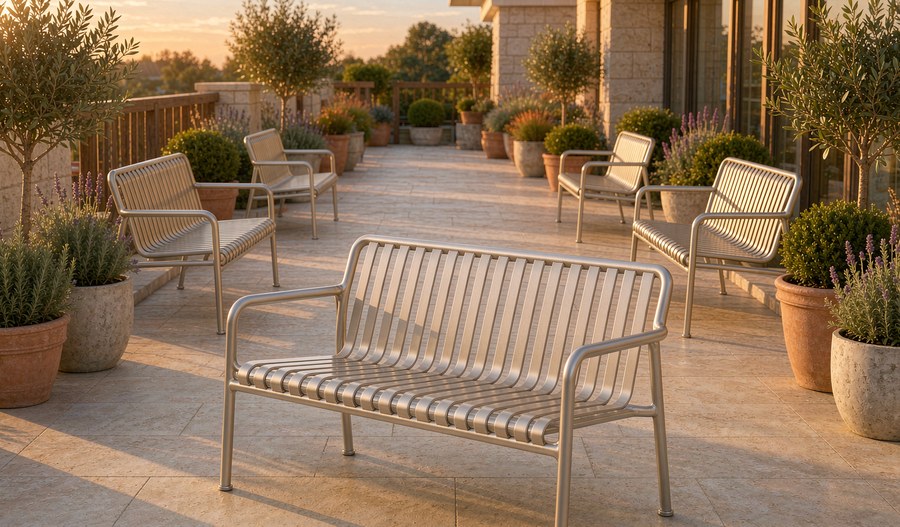
Bench length splits into three commercial bands: 1.2 m (2-seat), 1.5 m (2–3 seat) and 1.8 m (3-seat). For a garden path or a terrace against a wall, plan 0.6–0.9 m of clear circulation space in front of the bench so guests are not squeezing past. On a 40HQ, a 1.5 m aluminium bench with a slim profile typically loads 180–240 units depending on whether you carton them or stretch-wrap in stacks; teak benches, being heavier and often crated, land closer to 90–140 units. Always ask the manufacturer for the actual carton dimensions and CBM per unit rather than trusting a generic cube calculator, because cushion thickness and leg style swing the number hard.
Finish and weather resistance: what survives five seasons outside
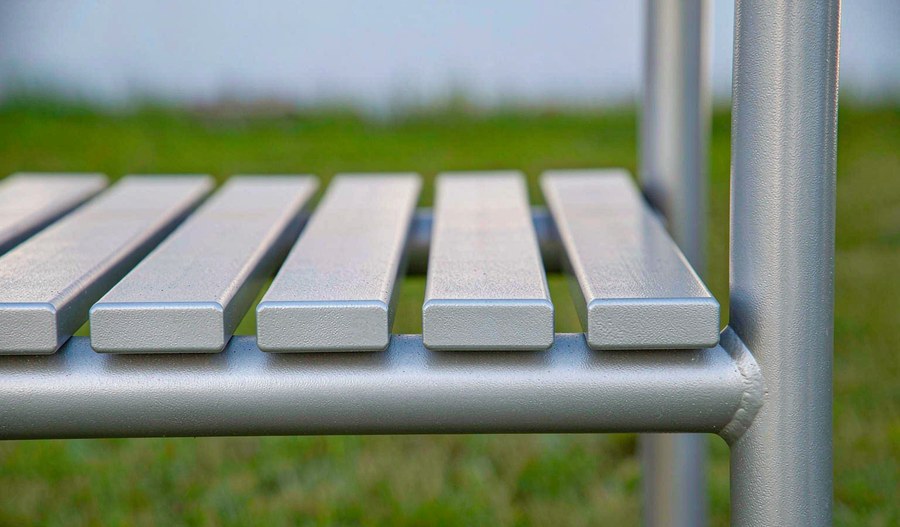
For aluminium, the only number that matters is the powder-coat specification. Specify a minimum 60–80 micron polyester powder coat; for coastal or poolside sites ask for a marine-grade system rated to 1,000+ hours salt-spray. A thin or single-stage coat is the single most common reason a bench looks tired after one summer. For teak there is no coating to fail, which is the whole point: the wood is the finish. If a supplier offers "teak-coloured" aluminium instead of real teak, confirm it is powder-coated aluminium with a wood-grain transfer, not a dipped finish that will chip at the edges.
Commercial vs residential spec: what contract buyers must check
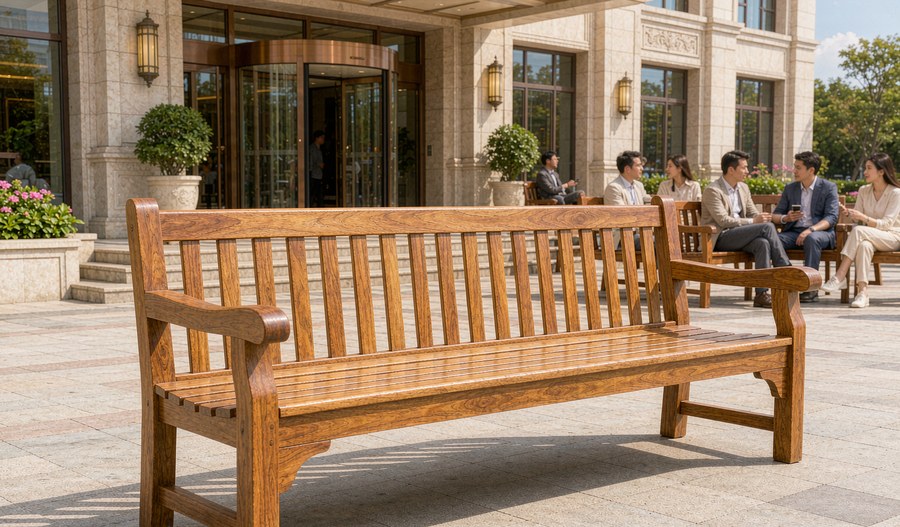
Residential benches are built to be pretty; a commercial garden bench is built to be sat on by strangers 200 times a day. The checks that separate them: weld continuity on aluminium frames (no porosity at the corners), slat fixing that cannot work loose, and a weight rating you can put in writing. Ask the factory for a load test report and a sample you can stand on. For teak, confirm the joints are glued and draw-bored, not just screwed, because a screw-only joint is where benches start to rock after a season outdoors.
Procurement maths: MOQ, container loading and lead time
For garden bench wholesale, benches are a friendly first order because the MOQ is usually achievable: aluminium benches often start around 50–100 units per style, teak around 20–50. They also mix well in a mixed container with chairs and tables to hit a full 40HQ without over-committing to one SKU. Lead time runs 25–40 days for aluminium and 35–55 days for teak after deposit; if you are buying for a seasonal opening, lock the production slot 10 weeks out and confirm the sample lead time first so the bulk matches what you approved.
Backrest, armrest and style choices for different venues
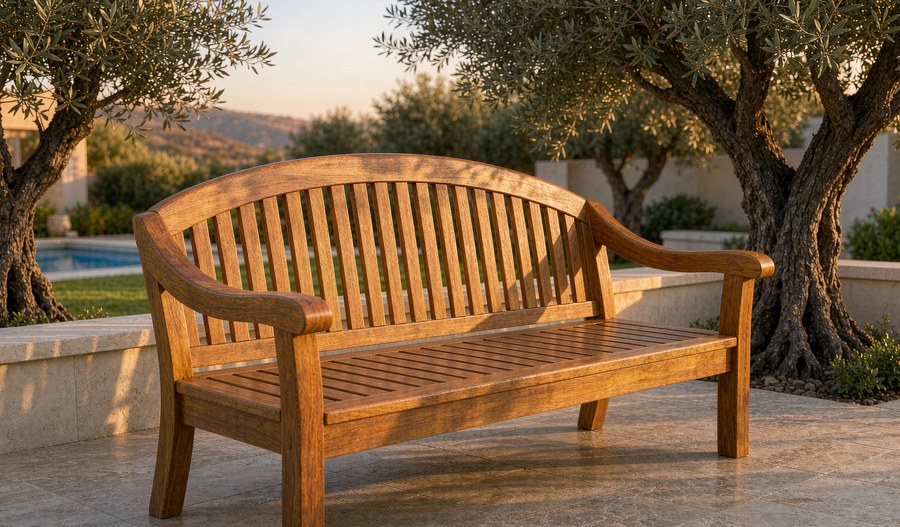
The bench shape should follow the venue, not the showroom. A backless bench reads as sculpture and suits a garden path or a wall edge where you do not want to block the view; a low curved back invites someone to pause and stay, which is what you want on a hotel terrace or outside a restaurant. Armrests add comfort and a place to set a drink but cost circulation width, so skip them where space is tight. For a villa or boutique property, a teak bench with a gently curved slatted back photographs better and ages into the planting; for a high-turnover beach club or pool deck, a simple aluminium bench is easier to hose down and stack at close. Match the style to the labour you actually have, not to how it looked staged.
Colour is the other lever. Natural teak needs no colour decision. Aluminium benches take any RAL powder-coat colour, and for a branded venue that is an advantage: match the bench to the parasol, the planter or the building and the space reads designed rather than assembled. Just confirm the supplier can hold the same RAL across a reorder, because a bench that arrives a shade off breaks the clean line of a terrace and you will notice it every day.
A 10-point buyer checklist before you place the order
Before sending the deposit, run this list with your supplier:
- 1. Confirm fully assembled delivery (welded one-piece aluminium or glued teak joints, no flat-pack).
- 2. Get the powder-coat micron thickness and salt-spray hours in writing for aluminium.
- 3. Ask for real carton dimensions and CBM per unit, not a generic estimate.
- 4. Request a load-test report and stand on the sample yourself.
- 5. Match the bulk finish to the approved sample under the same light.
- 6. Confirm teak grade (heartwood) if you are paying for teak.
- 7. Lock the production lead time and a penalty for slippage.
- 8. Clarify private label and carton labelling if you are a distributor.
- 9. Agree the sample cost credit against the first order.
- 10. Verify the factory can show you the same bench in a real hotel or resort project, not just a studio shot.
Get those ten right and the garden bench stops being a commodity and becomes the most reliable seat on the property. If you want trade pricing on teak or aluminium benches, the fastest route is to send your spec and target volume to the factory and ask for a quotation breakdown before you commit a container.