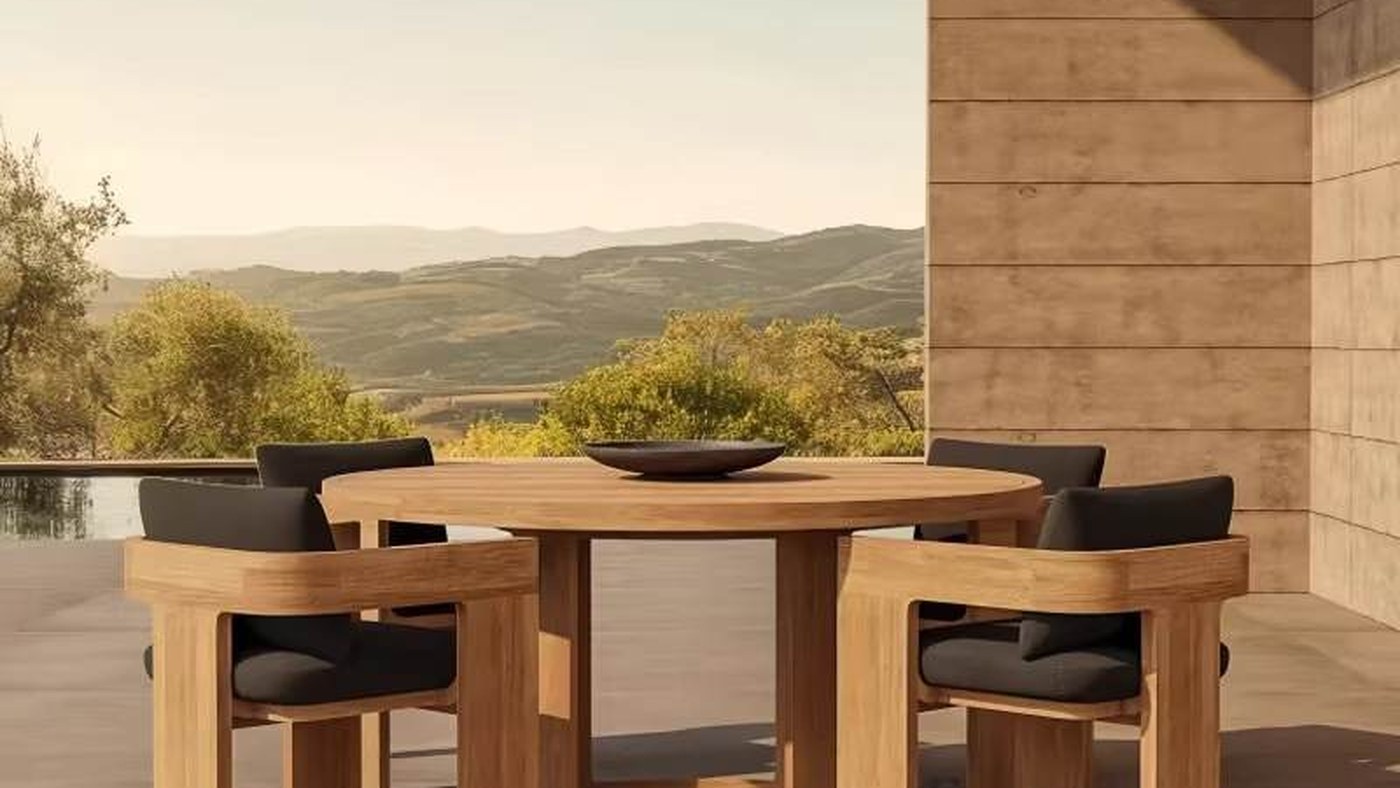
Dining sets are the highest-volume outdoor category in hotel, restaurant and villa projects — and the category where the most complaints originate. Almost none of those complaints are about how the furniture looked in the showroom. They are about tables that were the wrong length for the space, chairs that loosened in their first season, slats that cupped and splintered, and container plans that were guessed instead of calculated. This guide covers the specification points that decide whether a teak dining set earns its place on a terrace: sizing, construction, duty cycle, hybrid frames and container planning.
Getting the size right before anything else
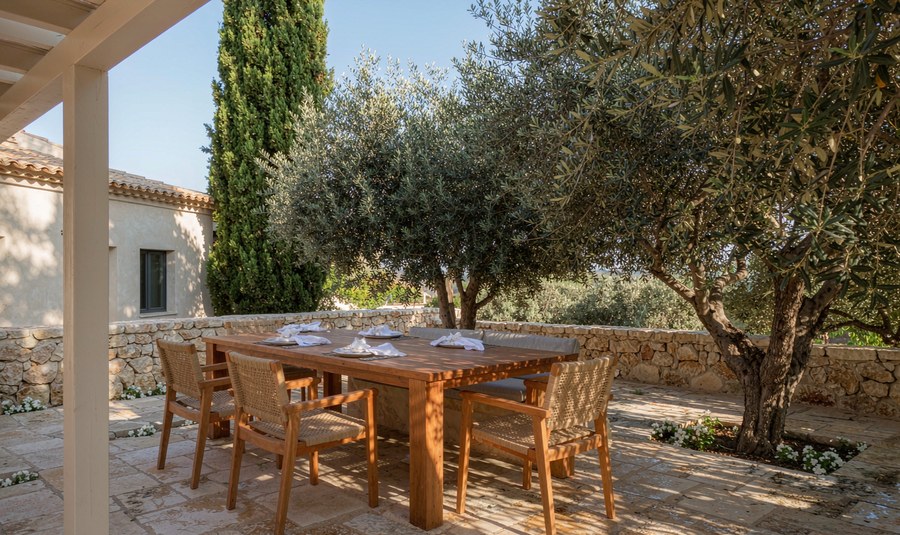
Size errors are the most expensive mistake in this category, because they are discovered on site, after the deposit. The math is simple enough to do at the quotation stage:
| Table shape | Dimensions | Comfortable seating | Notes |
|---|---|---|---|
| Rectangular | ~60 cm of length per adult | 180 cm → 6 seats; 220 cm → 8; 260 cm → 10 | Add corner seats only if the apron allows knees underneath |
| Round | 120 cm → 4 seats; 150 cm → 6; 180 cm → 8 | Round tables suit circulation-heavy terraces | No corners to catch passing trays or chair backs |
| Extension | 220–300 cm mechanisms are common | 6 seats closed, 10 open | Confirm the extension leaf is teak too, not a hidden composite |
Two standard heights to hold the drawings against: table tops sit at 74–76 cm and dining chair seats at 44–46 cm. Deviations outside those ranges get noticed immediately by guests and staff. Also check the usable knee space — apron depth and leg placement matter more than overall table depth, and a deep table with a central stretcher seats fewer people than its length suggests.
What the price is actually made of: construction
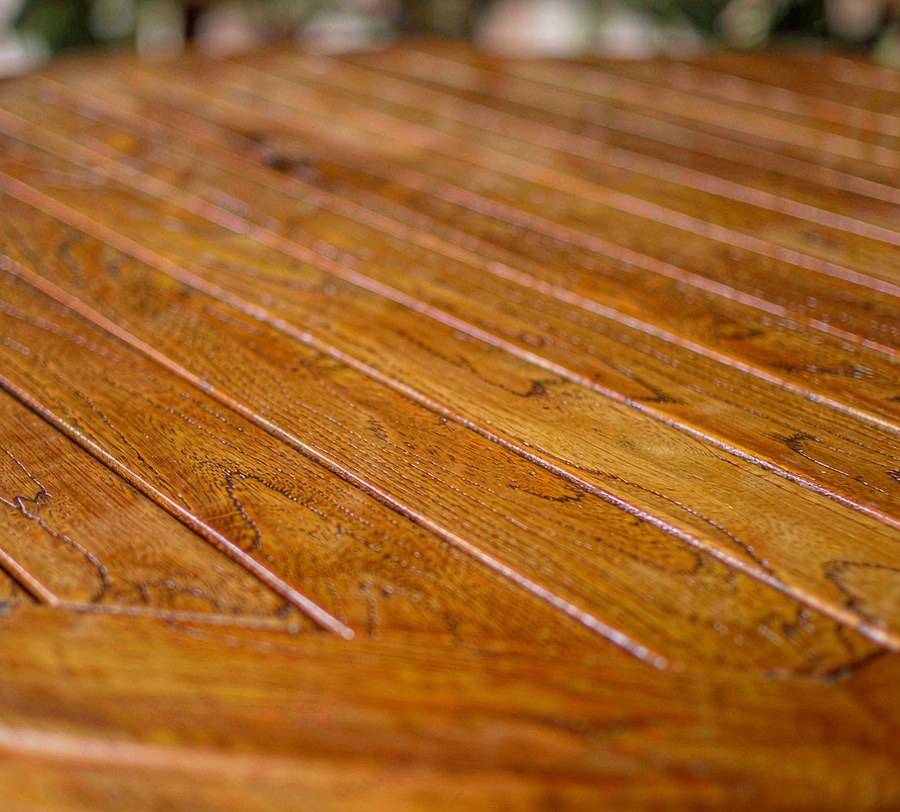
Two teak dining sets can look identical in a product photo and differ by a factor of three in expected service life. The difference is in the details below — and every one of them is a question you can ask in an email.
- Heartwood, not just "teak". The durable part of the log is the heartwood; sapwood is lighter, less oily and less stable. Ask whether frames and slats are heartwood throughout or heartwood with sapwood edges.
- Slat thickness and width. Commercial table tops are commonly built from solid slats 2 cm or thicker. Thin slats on a busy terrace cup, crack and shed splinters within a couple of seasons.
- Joinery method. Mortise-and-tenon joints pinned with stainless dowels outlast plain dowelled or screwed joints, especially on chairs, where the joint takes the whole load every time someone sits down.
- Hardware grade. Stainless fasteners as standard; on coastal or poolside projects, 316 stainless. Ferrous fixings bleed rust stains down teak legs that no amount of cleaning removes.
- Finish honesty. Oiled teak will silver — that is a surface patina, not a defect. A supplier promising permanent golden colour is selling you a marketing story, not a finish.
Commercial duty cycle: what changes versus residential
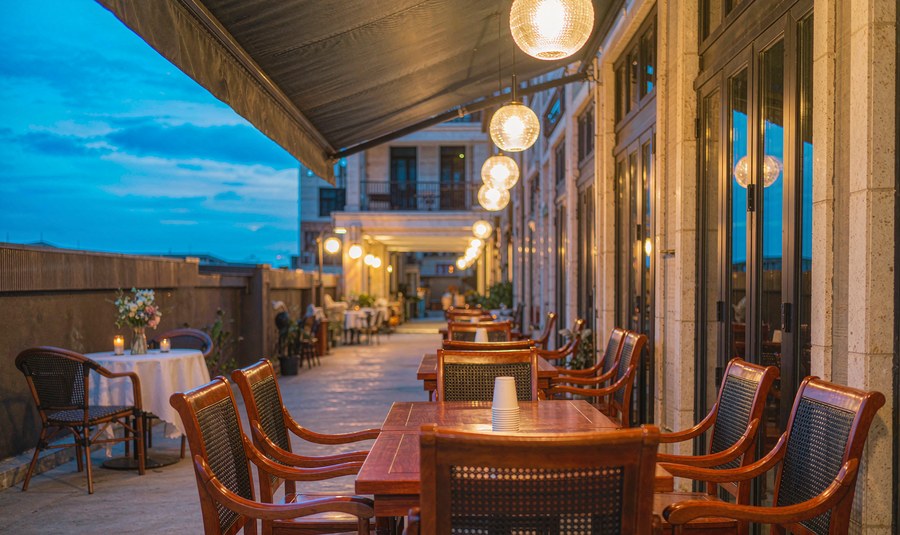
A restaurant terrace seating 80 covers a night is a different product from a villa dining set used twice a month. The specification deltas are small but decisive:
| Detail | Residential spec | Commercial spec |
|---|---|---|
| Slat thickness | 1.5–2 cm acceptable | 2 cm+ solid, replaceable slats preferred |
| Chair joinery | Dowel or screwed | Mortise-and-tenon, pinned |
| Stacking / nesting | Optional | Specified where staff reset tables daily |
| Spares | Rarely stocked | Spare slats and fasteners shipped with the order |
| Finish maintenance | Owner's discretion | Defined in the handover care schedule |
Stackability deserves a specific mention. On terraces where staff clear and reset tables every service, nesting or stacking chairs cut labour and — just as important — cut the damage that happens when chairs are dragged instead of lifted. If your operation resets tables daily, make stacking a specification line, not an option.
Aluminium frames with teak tops: when the hybrid wins
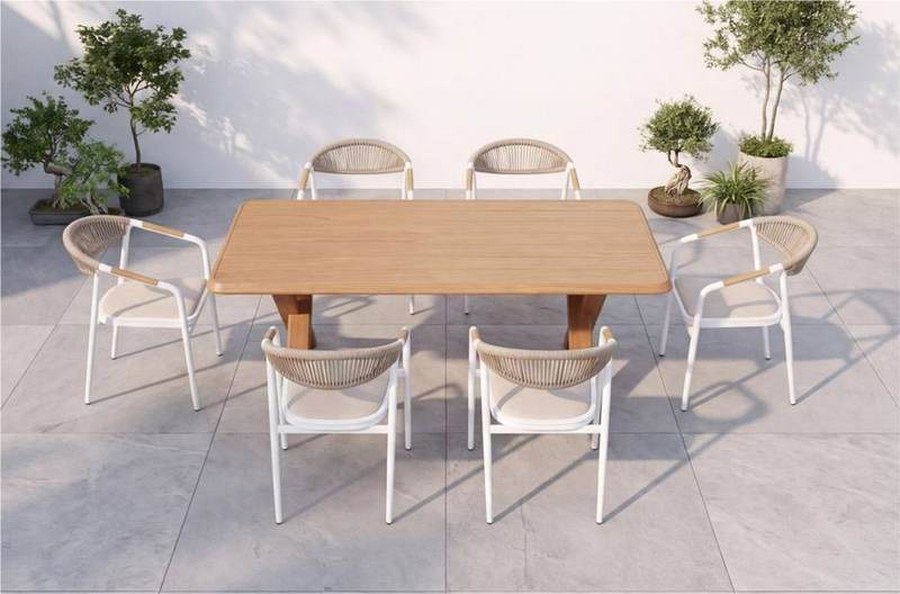
Not every project needs solid teak throughout. Aluminium frames with teak or teak-look tops have become the workhorse specification for three situations: load-limited terraces, where the weight saving matters; windy exposed positions, where lighter chairs are moved properly by staff instead of badly; and reorder-heavy operations, where powder-coated aluminium re-colours more consistently than a new teak batch. The trade-off is presence — aluminium reads lighter and more contemporary, teak reads warmer and more permanent. Many projects run both: solid teak in the premium zones, hybrid sets on the high-traffic edges. Our teak vs aluminium guide covers the material comparison in depth.
Container planning for dining sets
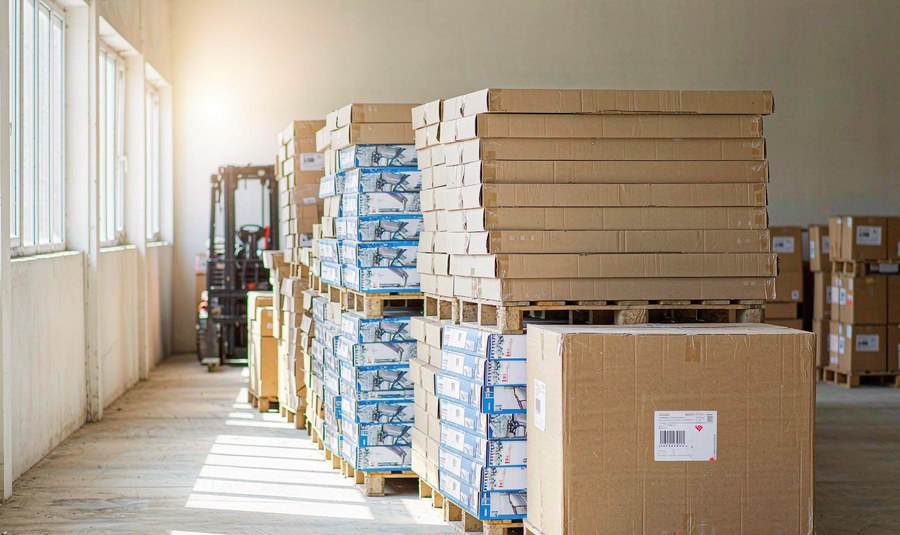
Dining sets are among the most freight-efficient outdoor categories: tables and chairs flat-pack into comparatively dense, stackable cartons. But "efficient" is not a number — get the carton dimensions and weights per model before you plan, because the binding constraint flips between projects:
| Constraint | When it binds | What to ask the factory for |
|---|---|---|
| Volume (a 40HQ holds ~67–68 CBM) | Usually the binding constraint for dining sets | CBM per set, flat-packed, tables and chairs together |
| Weight | Mixed loads with dense timber; check payload limits with your forwarder | Gross weight per carton, not per set |
| Assembly labour on site | Where skilled labour is scarce, non-KD seating can be cheaper delivered despite higher cube | Both packing options quoted side by side |
As a planning rule of thumb only — always replaced by real carton data — a flat-packed six-seat teak dining set commonly occupies something in the 1.5–2.5 CBM range, which puts a full 40HQ in the broad region of 25–40 sets depending on models and packing. Treat that as a sanity check on the factory's loading plan, not as a substitute for it. The full method, including mixed-load planning, is in our container loading guide, and the non-KD trade-off is covered here.
Care, spares and reordering
Teak dining tabletops take the most direct abuse of any outdoor surface: hot plates, spilled wine, sunscreen and knife marks. Three habits keep them alive: wipe spills promptly, keep the finish honest (oiling is optional — silvering is acceptable), and re-tighten chair hardware every season, because wood movement loosens joints long before it breaks them. The full year-round routine is in our commercial maintenance schedule.
One procurement tip that pays for itself: order spare table slats and a touch-up kit with the original container, sized to about 2–3% of the order value. A splintered slat replaced the same week is a non-event; the same slat ordered six months later from a different production batch is a colour-matching problem.
Questions to ask any supplier before you order
- Are the slats solid teak heartwood, and what thickness are the table top slats?
- What joinery do the chairs use — mortise-and-tenon or dowel — and what fastener grade?
- What are the carton dimensions and gross weights per model, flat-packed?
- Can extension leaves be ordered separately, and do later batches colour-match?
- Can you supply a loading plan with CBM per set for a mixed container?
- Do you offer non-KD packing for chairs, and what does it do to the cube?
A factory that answers all six in one email is telling you it ships dining sets to commercial projects routinely.
Getting a quotation for your project
PatioHue is a Foshan factory-direct manufacturer of teak and aluminium outdoor furniture, supplying hotels, restaurants, resorts and distributors across Europe, the Middle East, North America and West Africa. If you send the terrace dimensions, seat counts, destination port and a note on how exposed the site is, we will come back with model recommendations sized to your floor plan, the specification points above applied to your order, carton dimensions for the freight plan and trade pricing — usually within one working day.