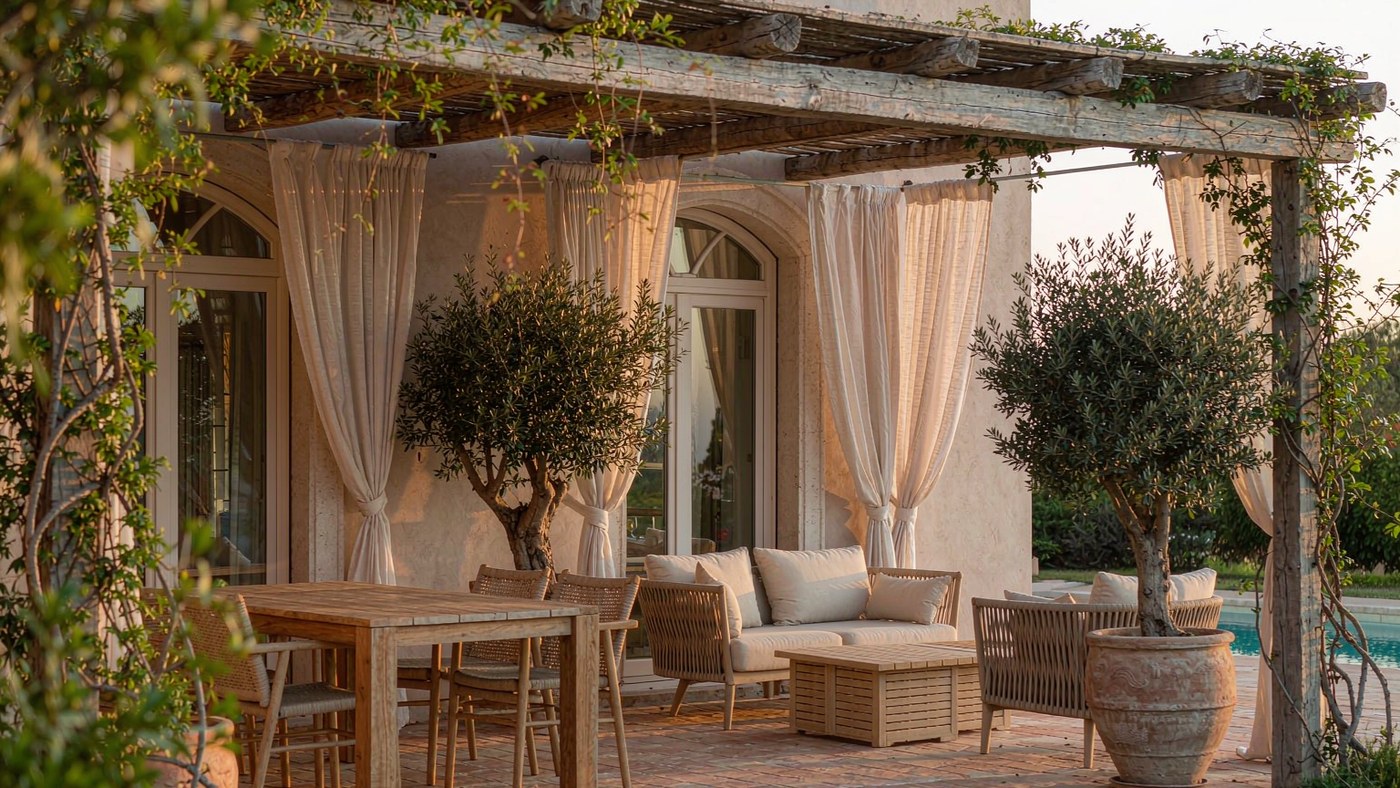
Villa terrace furniture is bought differently from hotel furniture, and the difference is not budget. A resort buyer specifies against a duty cycle; a villa owner buys a way of living — and the order is usually placed by an architect, developer or distributor translating that living into a purchase order. This guide covers how to specify villa garden furniture owners actually use, and how to order it from a factory without the usual private-site surprises.
Inside: the planning numbers that decide a villa terrace, material choice when the owner owns the upkeep, shade options, how villa-scale orders and MOQs work, and what delivery and handover look like on a private site.
Why a villa is not a small hotel
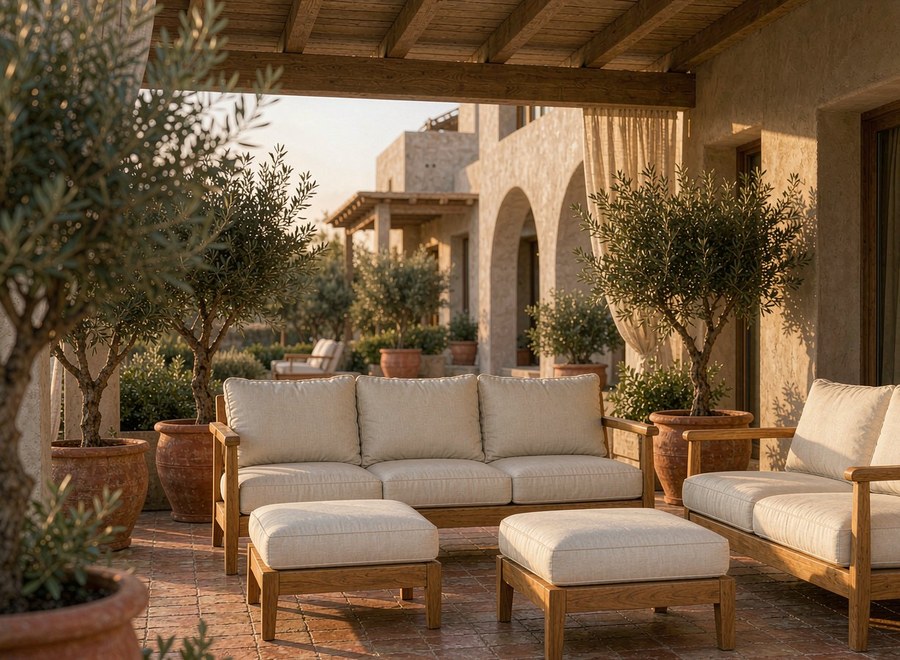
A hotel pool deck is specified around turnover: hundreds of guest cycles a week, staff handling, spares on site. A villa terrace is the opposite — two to eight people, gentle daily use, an owner who notices every detail. Three consequences follow for anyone specifying outdoor furniture for villas:
- Taste outranks the catalogue. The owner decides by look and feel, so your job is to make the specification invisible. Solid teak reads warm and residential; powder-coated aluminium with rope weave reads coastal and modern. Both are legitimate villa materials; the choice follows the architecture.
- Maintenance has an owner. A resort runs a schedule; a villa has one person who may or may not oil a table. Specify materials the owner will genuinely maintain — or accept silvered teak as the finish, and say so up front.
- Volumes are small and phased. A villa project is often four to twenty residences delivered in phases — a programme, not a container dump.
Plan the villa outdoor living space before the catalogue
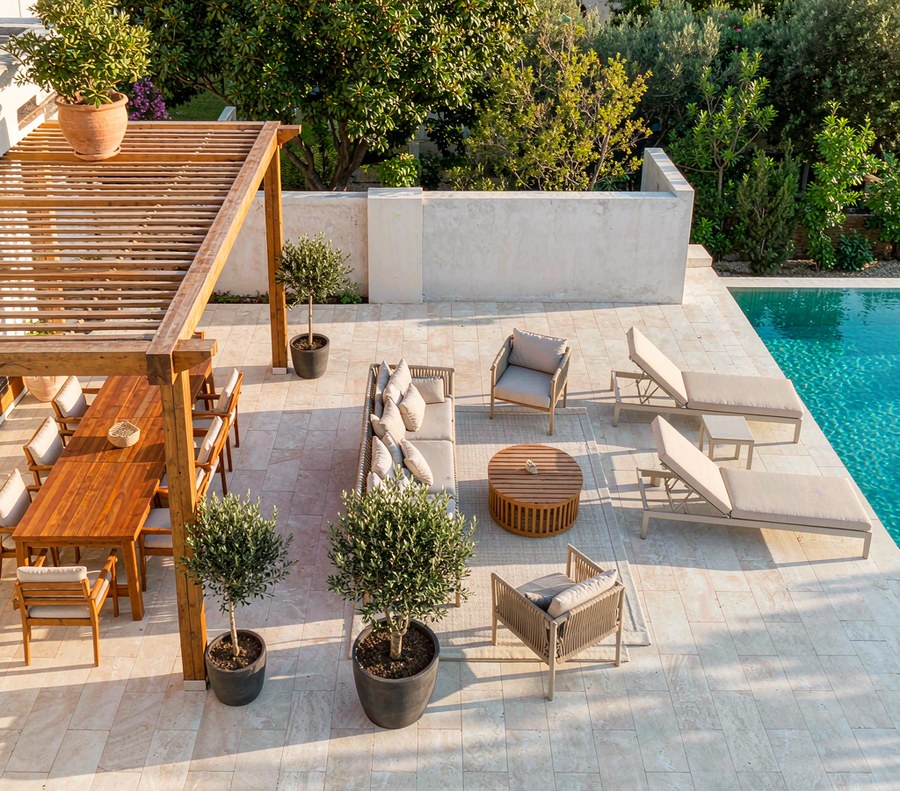
Most disappointing terraces are furniture dumped on a surface; the ones owners love are zoned. A villa outdoor living space needs three zones, each with its own sizing math:
| Zone | Typical furniture | Space to allow |
|---|---|---|
| Dining | Teak dining set, 6–10 seats | Table plus 90–100 cm clearance behind every chair; 1.2 m service gap to walls |
| Lounge | Sofa set, two chairs, coffee table | Roughly 4 × 4 m; 75–90 cm between coffee table and seats |
| Sun / poolside | Sun loungers, daybed, side table | 2.0–2.4 m of frontage per reclined lounger |
Dining-zone math: allow about 60 cm of table edge per chair. A 180 × 90 cm teak table seats six to eight; 240 × 105 cm seats eight to ten; a butterfly-leaf table closed at 220 cm and open at 300 cm covers six to twelve seats in one piece — the most useful specification in villa garden furniture, because occupancy swings between a couple and a dinner party. In the lounge zone, a 200–210 cm sofa set, two chairs and a 100–120 cm coffee table fill a 4 × 4 m area with circulation left over. By the pool, a lounger measuring 200 × 75 cm wants a 50 cm side table within arm's reach.
Material choice for private residences
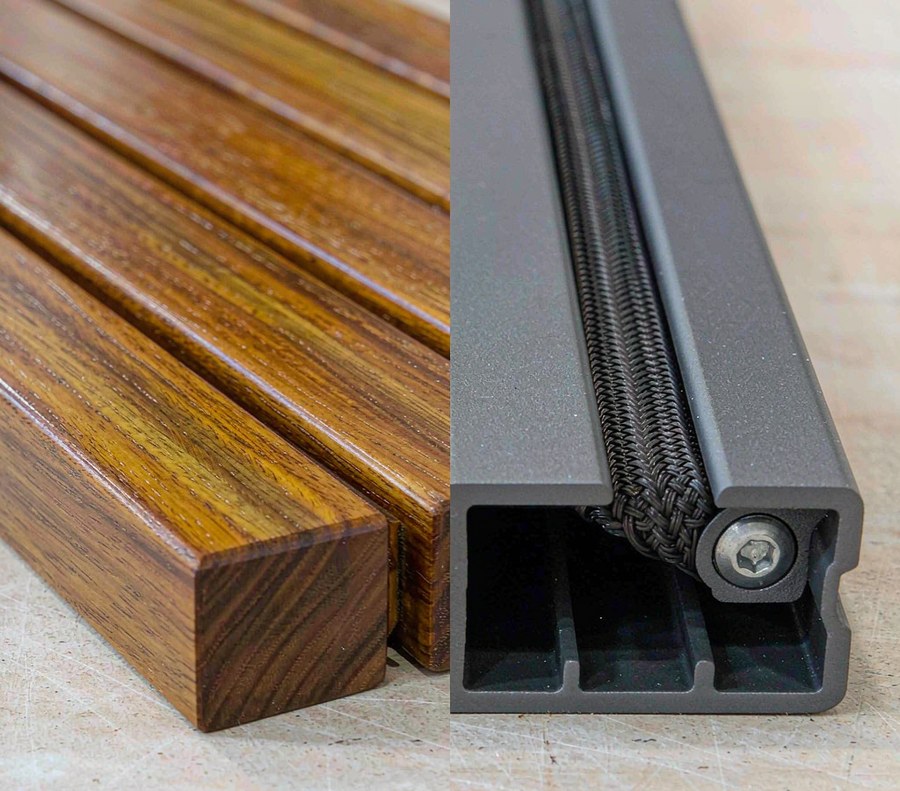
Villa terraces sit closer to pools and irrigation than hotel terraces, and the owner lives with the material for a decade. The decision lands on one of three specifications:
| Specification | Reads as | Upkeep the owner must accept | Reorder note |
|---|---|---|---|
| Solid teak, oiled | Warm, classic, ages to silver-grey | Clean and light oil once or twice a season, or accept weathering | New wood batches tone slightly — order spares with the first batch |
| Powder-coated aluminium with rope weave | Coastal, modern, light to move | Hose-down; no oiling, no sanding | Colour lot matters; keep the powder reference from batch one |
| Aluminium with textilene sling | Clean, contract-grade, quick-dry | Hose-down; a damaged sling replaces in minutes | Sling and frame colours are stocked lines |
Two poolside rules apply to any frame. First, hardware: chlorinated water and salt air attack fixings long before frames, so every metal detail on a poolside spec should be 316 or 316L stainless — cheaper grades are the most common premature failure we see returned. Second, drainage: quick-dry foam cores (8–10 cm is the catalogue standard) dry in hours, and frames that shed water off the seat stay usable after a swim-party afternoon. The teak vs aluminium guide works through the wider trade-off.
Shade, parasols and the canopy daybed
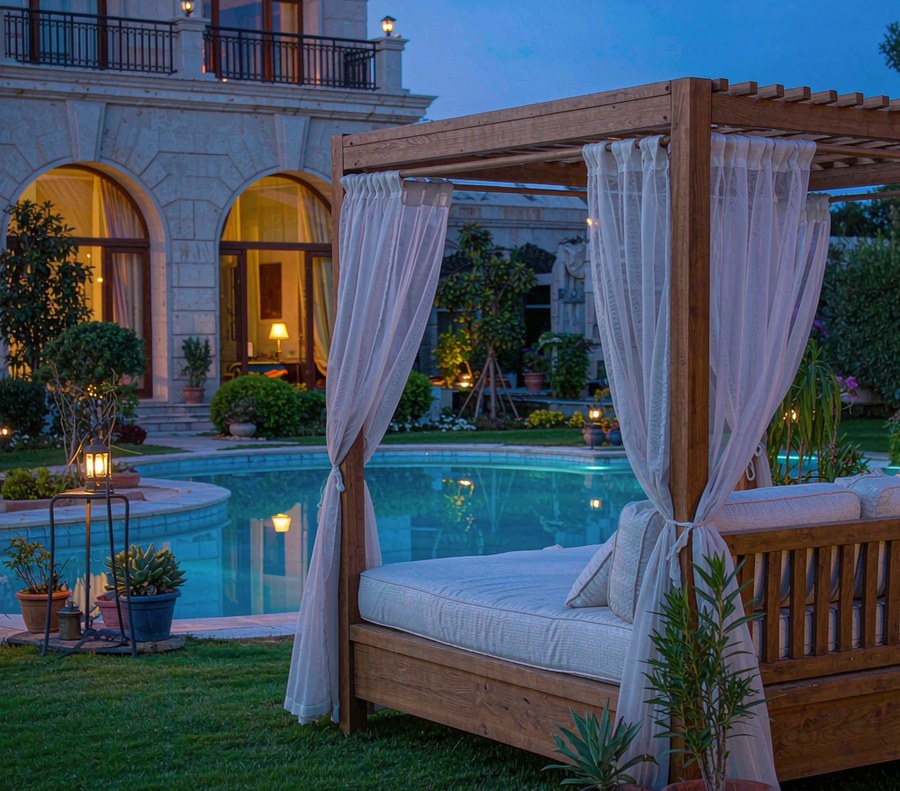
Shade is what makes a villa terrace usable between 11 a.m. and 4 p.m., and it is cheapest designed in than retrofitted. A parasol through the table's Ø50 mm umbrella hole is the simplest answer — every teak dining table in our range carries one. A cantilever parasol shades a lounge zone without a mast in the seating; size the base against canopy area and wind exposure, because an unballasted parasol is a wind sail, not shade.
For a dedicated retreat, the canopy daybed is the villa piece with the highest owner satisfaction per square metre: a curtained frame in teak or aluminium to the same design, marine-grade quick-dry cushions in solution-dyed acrylic, and stainless fittings, made to the dimensions the terrace allows — custom villa garden furniture at a catalogue-scale MOQ. It turns a garden corner or poolside lawn into the most used spot on the property, and at five sets MOQ it is one of the few bespoke pieces a villa programme can order without a dedicated run.
Ordering for a villa project: scale, MOQ and phasing
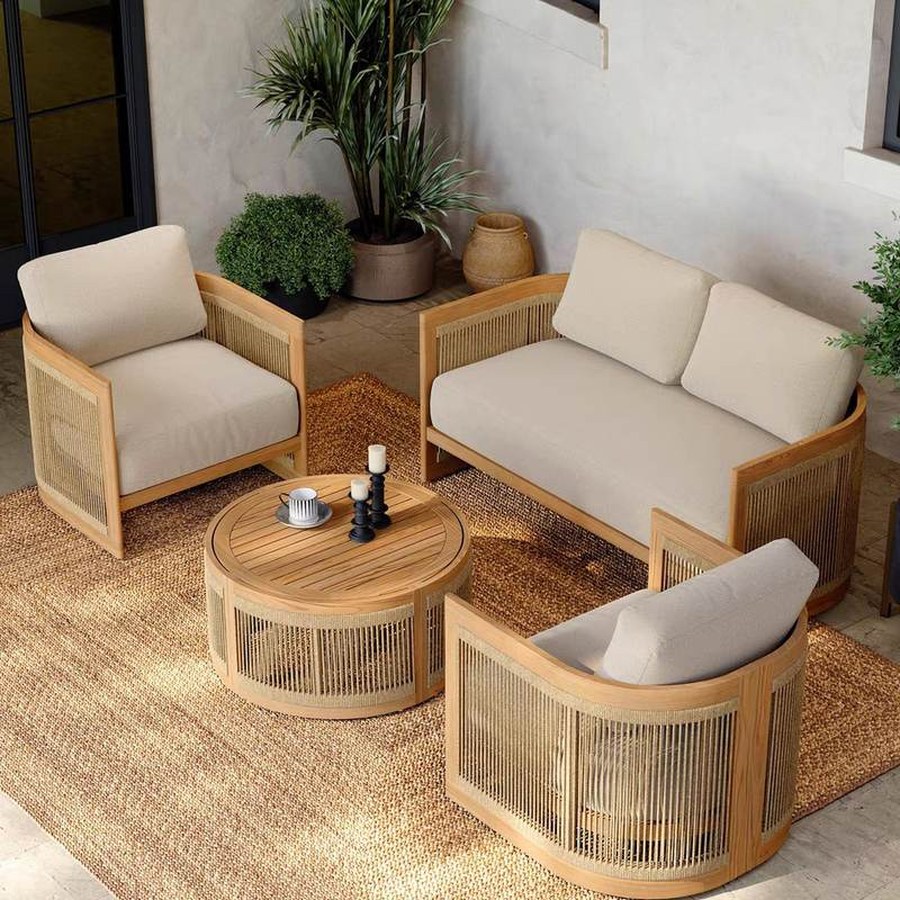
Villa orders rarely fill a container, and that is normal. Three routes cover almost every programme: a mixed pallet of catalogue models for one villa; phased deliveries as residences complete; or one container consolidating the programme, which our container loading guide works through. The MOQ on catalogue lines sits at five to ten sets per model — the honest way to clear it is a mixed load, not an inflated quantity of one model that sits in a warehouse.
Knocked-down or assembled matters more on a private site than buyers expect: a villa has no handling crew, and site labour plus defect risk usually tips the balance toward assembled seating at small quantities — the assembly-and-freight guide runs the comparison. Either way, order the soft parts with the furniture: cushion covers, a touch-up pen per frame colour and a spare cover per lounge set cost little at first delivery and are miserable to match later.
Delivery and installation on a private site
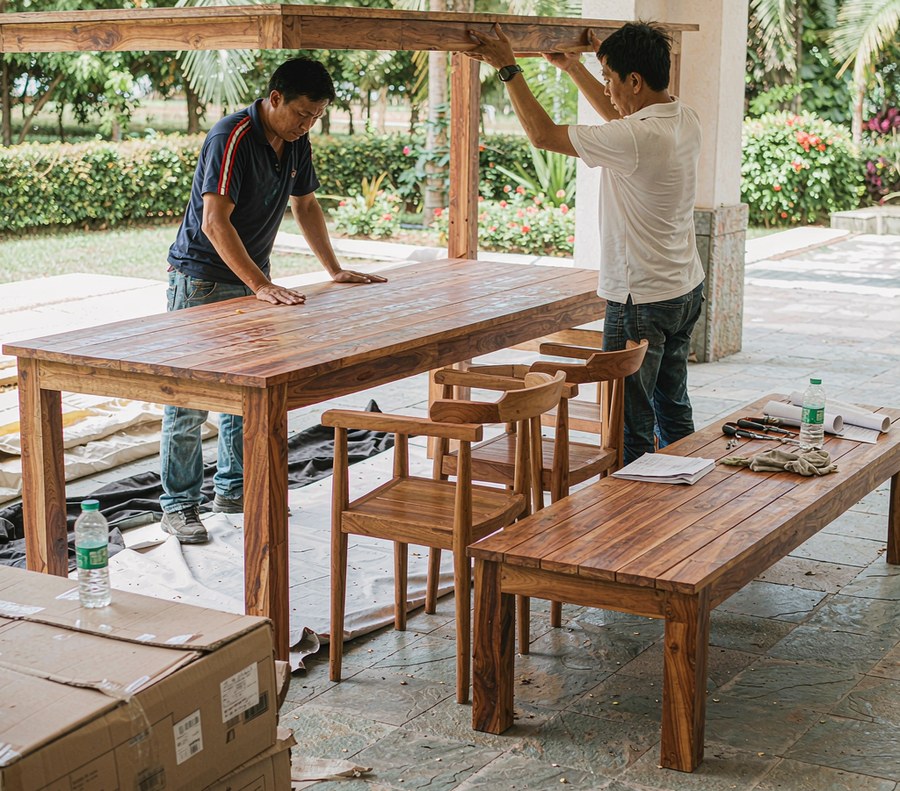
Treat every villa site as a construction site until the keys change hands. Cement dust, plaster splash and paint overspray stain teak permanently, and stained slats on a white-cushion terrace are a claim nobody wins. The protocol is simple: furniture arrives after wet trades finish, drop cloths down before unpacking, nothing stored outdoors before handover. Measure the access route — door widths, stair turns, lift dimensions — against piece dimensions before the truck is booked; a sofa set that fits the terrace but not the stair corner is the most expensive measurement in the project.
Assembly is the other handover risk. Knocked-down teak frames join with hardware, and a factory crew with the right jigs turns a two-day install into a half-day one with a signable result. Where local labour assembles instead, require the factory's assembly drawings and numbered hardware packs — a villa terrace missing four bolts is a warranty call, not a to-do.
Handover: what the owner needs to keep it looking new
The last deliverable is a handover pack, and it decides whether year two looks like year one: a care card per material, the teak oiling schedule, wet-season cushion storage, and the spares codes the owner needs at reorder time. Buyers who skip this pay in season three, when oil-starved teak and mildewed cushions turn a reference project into a cautionary one — hand over the commercial maintenance schedule with the furniture.
What to ask a factory
- Which catalogue models can be delivered as a mixed villa-scale pallet, and what is the MOQ per model?
- Can dining tables be specified with the Ø50 mm umbrella hole, and is a cantilever parasol available with a base sized to the canopy?
- Is the canopy daybed available in both teak and aluminium to the same design, and to what dimensional range?
- What stainless grade is used on poolside specifications, and is it stated on the specification sheet?
- Can delivery be phased per villa, and can cartons be labelled per residence rather than per container?
Buyer checklist
- Zones and sizing confirmed against the terrace drawing before the catalogue is opened
- Material chosen against the owner's real maintenance willingness, not the showroom finish
- All poolside hardware 316/316L stainless, confirmed in writing
- Shade designed in — umbrella hole, cantilever parasol or canopy daybed
- MOQ cleared with a mixed load, not an inflated single-model quantity
- Spares and covers ordered with the first delivery
- Access route measured; delivery scheduled after wet trades
- Handover pack — care cards, oiling schedule, spares codes — included
If you are specifying villa garden furniture for a residential project — a single terrace, a phased villa development, or a range for distributors selling garden furniture for private residences in Europe, the UAE or West Africa — send us the brief. We will map zones against your drawings, confirm models and MOQs, and put the loading and delivery plan in front of you before you commit.