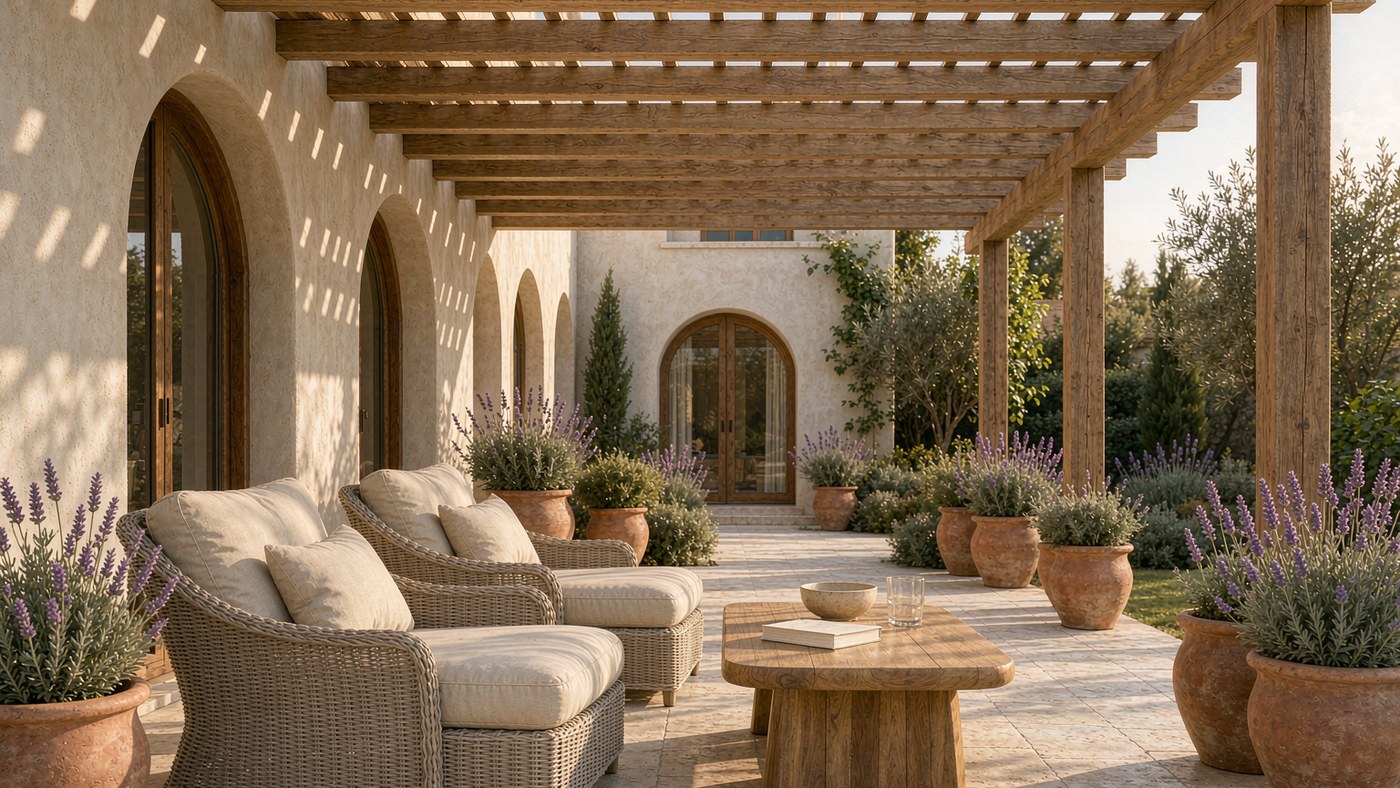
"Wicker" is one of the most abused words in the outdoor furniture trade. It describes a weave, not a material — and the two materials it gets applied to behave nothing alike outdoors. Natural rattan is a tropical climbing palm that has been hand-woven into furniture for centuries; the "wicker" on most modern outdoor sets is an extruded polyethylene strand woven over an aluminium frame. Teak is not woven at all: it is a solid hardwood whose performance comes from its oils and density rather than from any textile treatment.
So when a buyer asks "rattan or teak?", the real question is exposure. How much direct sun, how much rain, how many months a year — and whether the space is covered or open. This guide sets out what each material actually is, how to read the specifications behind the claims, and which one survives your specific site. It is written for the comparison buyers actually face: natural rattan versus PE (synthetic) wicker versus solid teak, with rope weave sitting in the synthetic family.
Wicker is a weave, not a material
Three products get sold under overlapping names, and the first job of any specification is to separate them:
- Natural rattan — the solid cane of climbing palms (mainly Calamus species), peeled and hand-woven. Warm, irregular, breathable, and genuinely beautiful. Also hygroscopic: it takes up moisture, and it does not belong in full weather.
- PE wicker — also sold as synthetic rattan, resin wicker or all-weather wicker. An extruded HDPE strand carrying pigments, antioxidants and light stabilisers, woven — usually over a powder-coated aluminium frame. Engineered for outdoor exposure; quality depends entirely on the formulation and the frame underneath.
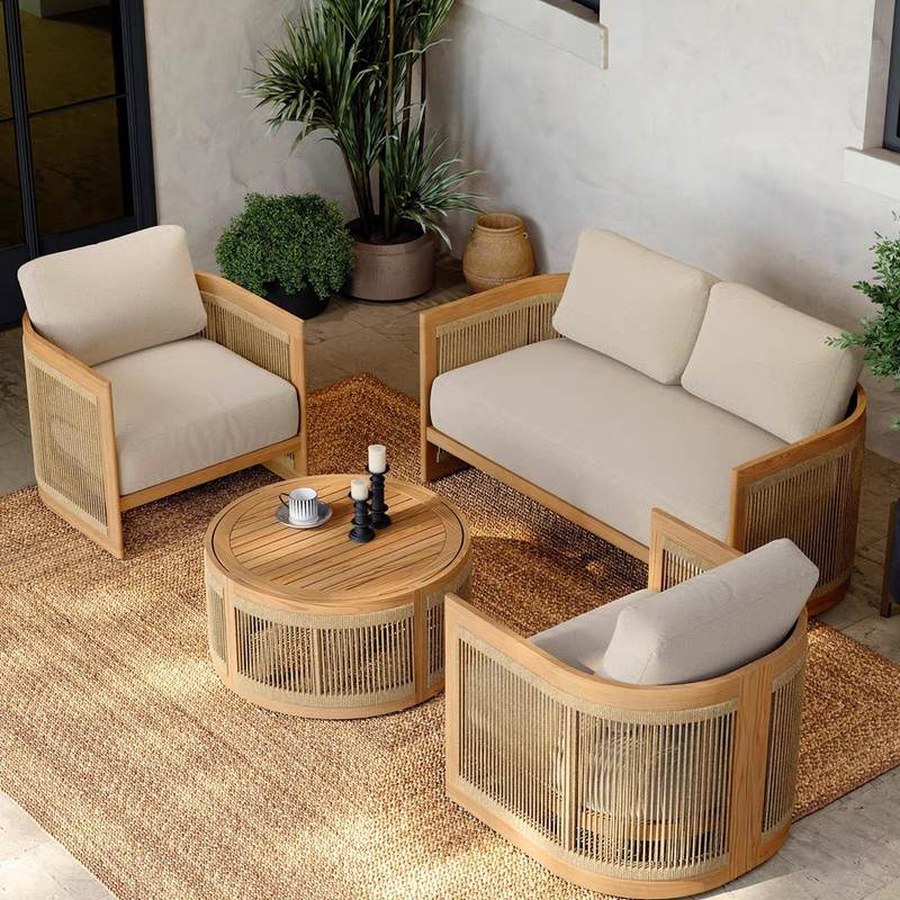
- Rope weave — the twisted synthetic cord used over aluminium frames in contract ranges, including our own. Same family as PE wicker in behaviour, different in hand and texture: softer, more sculptural, and usually specified with quick-dry cushion cores.
- Teak — solid hardwood. Not a weave at all, but it arrives in the same conversation because it is the default "natural" alternative to woven seating on terraces and pool decks.
What each material actually is
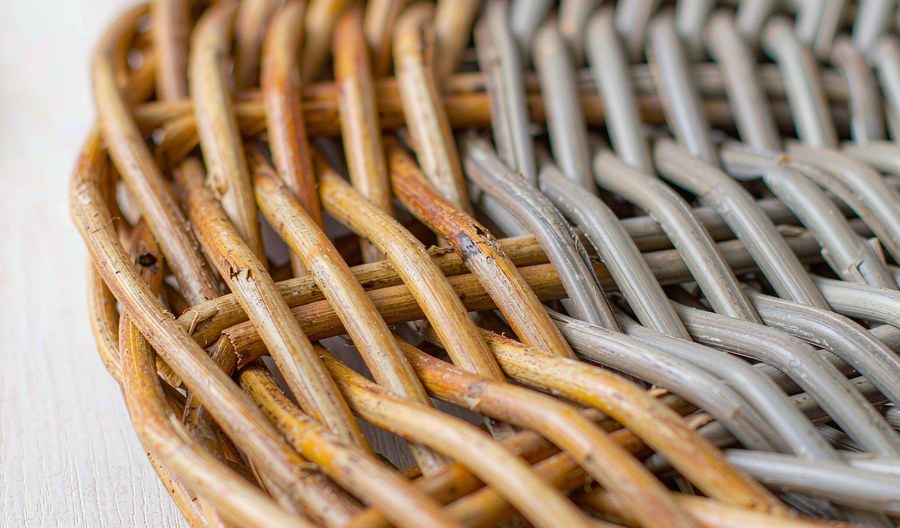
Natural rattan's appeal is real: the weave is made by hand, no two pieces are identical, and the material breathes. Its limits are equally real. Rattan fades under sustained UV, loses flexibility and embrittles in dry conditions, and grows mildew when it stays wet — which is why the traditional use cases are covered verandas, conservatories and interiors, and why furniture history is full of rattan that spent one perfect summer on a terrace and two seasons in a skip.
PE wicker exists because of that failure. The HDPE strand is extruded with a stabiliser package — UV absorbers and hindered amine light stabilisers are the standard chemistry — so the fibre resists the photo-degradation that destroys natural cane. It does not absorb water, it rinses clean, and modern tooling reproduces rattan's texture closely enough that most guests cannot tell at three metres. What the chemistry cannot fix is a cheap formulation: under-stabilised resin chalks and fades, and no amount of weaving skill compensates for it.
Teak needs no introduction to anyone who has sat on a ship's deck: the natural oils make it dimensionally stable and unpalatable to rot, it weathers to silver without failing, and it can be sanded back to honey-gold at any point in its life. Its costs are weight, price and a maintenance decision — you oil it to keep the gold, or leave it to grey.
Rattan vs PE wicker vs teak: the specification table
| Property | Natural rattan | PE wicker / rope weave | Solid teak |
|---|---|---|---|
| Full sun, uncovered | Fades, embrittles; not recommended | Designed for it, if UV-stabilised | Excellent; weathers to silver |
| Rain and humidity | Absorbs water; mildew risk if it stays wet | Hydrophobic; drains and dries fast | Dimensionally stable; the benchmark |
| Coastal salt air | Poor — salt and moisture combine badly | Good on aluminium frames with stainless hardware | Excellent |
| Weight | Lightest of the three | Light; frame carries the strength | Heaviest; a real consideration on decks |
| Maintenance load | Dust, protect from rain, periodic re-sealing | Hose-down and occasional soft brush | Oiling to keep gold, or nothing to silver |
| Repairability | Re-weaving is a craft repair; not always available | Weave panels can often be re-woven or replaced | Sands and re-oils; joints can be re-glued or re-doweled |
| Reorder consistency | Hand-woven, so no two batches match exactly | Colour is a batch decision — lot matching needed | Colour drifts by timber lot; sanding unifies |
| Best use | Covered loggias, conservatories, interiors | Uncovered terraces, poolside, coastal, contract | Anywhere permanence is wanted; premium terraces |
Where natural rattan still wins — and where it fails
Natural rattan has not been made obsolete; it has been pushed to where it belongs. In a covered loggia, a shaded courtyard restaurant or a boutique hotel's indoor-outdoor sunroom, its warmth and hand-made irregularity do something no extruded strand quite reproduces. The failure modes are all about exposure: a rattan armchair in full sun on an uncovered terrace will fade within a season or two, go brittle in the dry months, and mildew through a wet winter. If a project brief says "rattan look, fully exposed site", the honest answer is PE wicker — and if the brief says "authentic rattan, covered space", the honest answer is to specify drainage, a re-sealing schedule and a plan to bring it in during the wettest months.
How to read a PE wicker specification
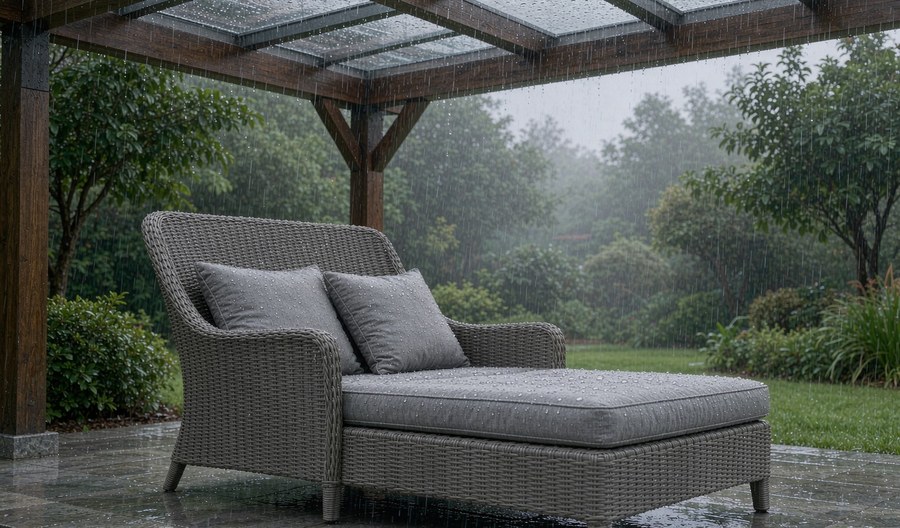
The gap between a PE wicker set that lasts a decade and one that chalks in three summers is invisible in a photograph. Four questions open up how the modules meet:
- The test report. "UV-resistant" on a spec sheet proves nothing. Ask for accelerated-weathering data — ASTM G154 or ISO 4892 are the usual standards — with exposure hours, the cycle used (UV plus condensation), and the pass criteria. A supplier who runs a real formulation will have this; a trader will change the subject.
- Strand spec. Thicker, heavier-gauge strand with a consistent cross-section holds tension and resists sag better than thin, cheap resin. Ask for the strand gauge and the weave density, and compare samples in the hand — a good weave is tight enough that it does not shift when you press it.
- The frame. The weave is the visible half; the frame is the structural half. Powder-coated aluminium with stainless or coated-steel hardware is the contract standard. A painted steel frame under good weave is a warranty claim waiting for the first chip.
- Colour batching. Like any produced-in-lot material, PE wicker colour varies between batches. Ask how reorders are matched to your original colour — a retained physical master and a written lot-matching rule, as covered in our private label programme guide.
How to read a teak specification
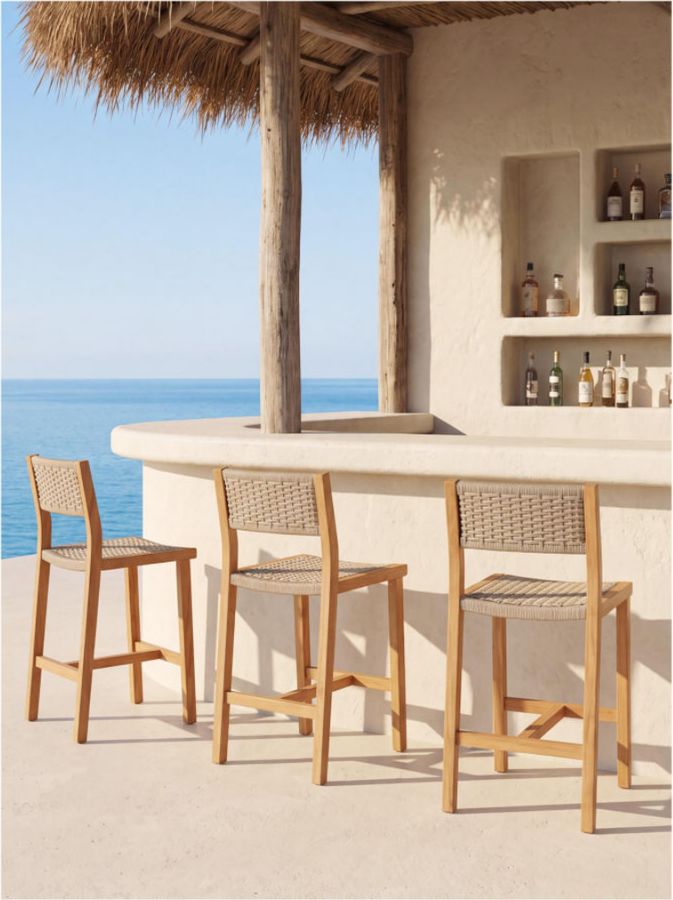
Teak quotes differ for reasons that never appear in the photo. Heartwood content — the dense, oily core — is what performs; sapwood-heavy stock fails early and is what sits behind suspiciously cheap "teak" offers. Kiln drying to the right moisture content decides whether frames check and twist in the first dry season. Joinery and hardware grade decide whether a chair is still tight in year five: proper mortise-and-tenon construction, dowelled and glued at the stress points, not just fastened into end grain. If you want the full construction walk-through, our teak dining sets guide and the teak vs aluminium comparison cover both in depth.
Choosing by exposure: a climate-based decision guide
| Site | Recommended | Why |
|---|---|---|
| Uncovered poolside or beach, high UV | Teak, or PE wicker / rope on aluminium | Full-weather materials; rattan fails within seasons |
| Coastal, salt-laden air | Teak or aluminium frame with 316 stainless hardware | Salt plus moisture is the harshest combination in the table |
| Covered loggia or courtyard restaurant | Natural rattan is viable; PE wicker is lower-risk | Shelter removes rattan's main failure modes |
| Gulf / desert climate | Teak and coated aluminium; shade is the priority | Heat and sand drive the spec — see our Middle East guide |
| Tropical, humid, year-round use | Teak or aluminium with quick-dry cores | Drainage and drying speed dominate — see the tropical climate guide |
| Conservatory or indoor-outdoor room | Natural rattan | Where its warmth and breathability are assets, not risks |
For contract projects the practical answer is usually a mix: teak where permanence and weight are acceptable, coated aluminium with rope or PE weave where weight, turnover or load limits matter. Our sun loungers and daybeds and aluminium sofa sets ranges show both approaches in production form.
Maintenance: hose-down versus oiling
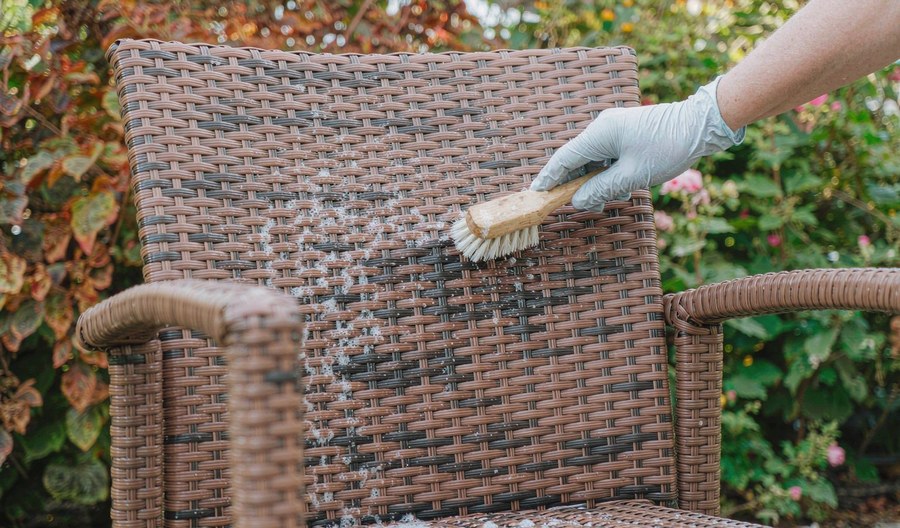
The maintenance difference is the one buyers underestimate. PE wicker and rope weave want a hose-down and an occasional soft brush in the weave — soap, water, done. Natural rattan wants gentle vacuuming, protection from rain, and periodic re-sealing, and it punishes soaking. Teak wants a decision: oil once or twice a season to hold the honey tone, or leave it alone and accept the silver-grey patina, which is a finish, not damage. All three want cushions stored dry and breathable covers through the worst weeks. Our commercial maintenance schedule has the week-by-week version.
What to ask a factory
- Is the weave natural rattan or PE/HDPE — and for PE, what UV stabiliser package and what test report?
- What is the frame material and hardware grade underneath the weave?
- For teak: heartwood content, moisture content at dispatch, and joinery detail at the joints?
- How are reorder colours matched to the original batch, and is a physical master retained?
- Can weave panels or cushion covers be replaced individually, and what is the lead time?
- What is the warranty, and does it distinguish weave fade from frame failure?
Buyer checklist
- Exposure classified honestly: covered or uncovered, coastal or inland, humid or dry
- Material chosen against exposure, not against the photograph
- For PE wicker: ASTM G154 or ISO 4892 report requested and reviewed
- For teak: heartwood grade, moisture content and hardware grade confirmed in writing
- Reorder colour-matching rule agreed before the first order
- Maintenance routine matched to the material — and written down for staff
If you are specifying a mixed-terrace project and want material samples in the hand — teak, rope weave and PE wicker side by side — send us the brief and we will put the relevant samples and test documentation in front of you before you decide.