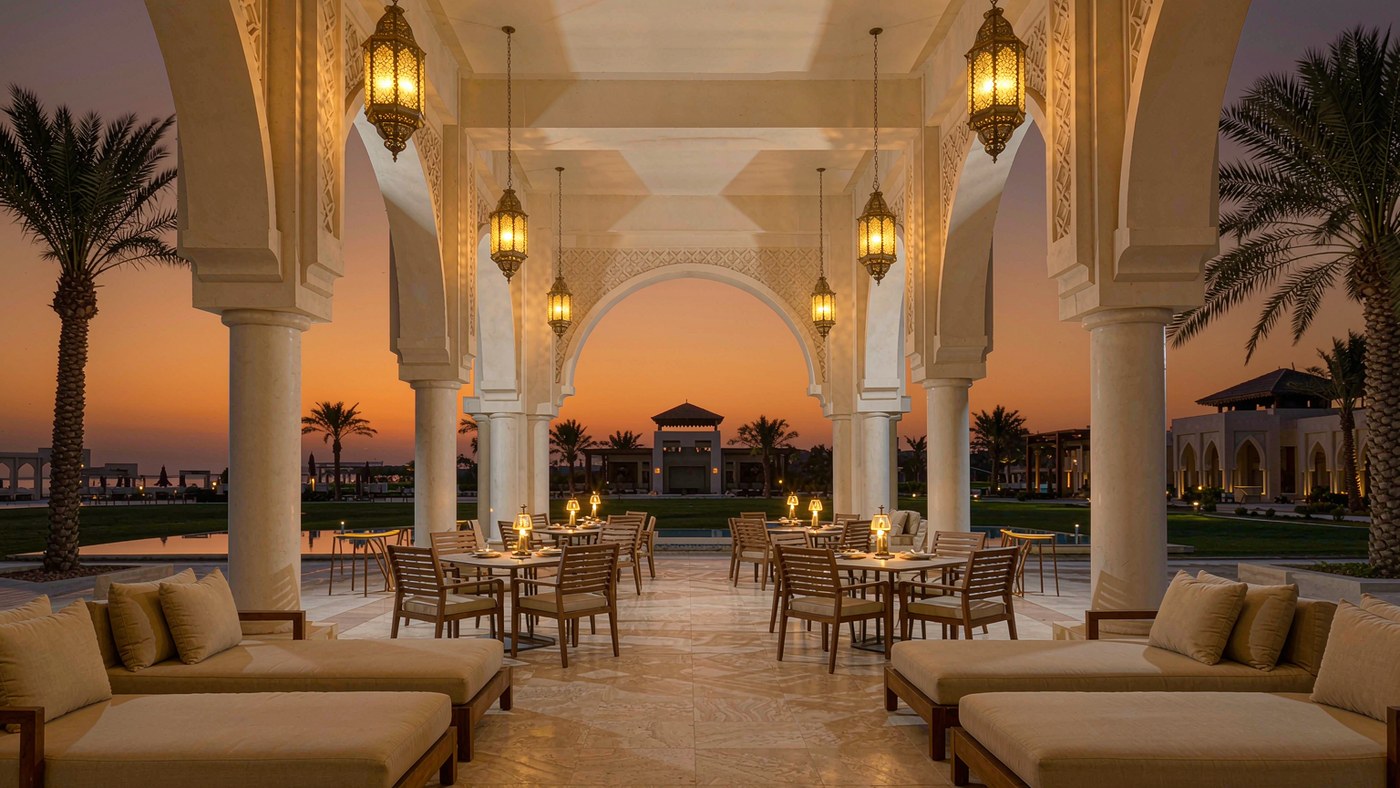
The Middle East is not a climate variation on a European terrace specification — it is a different set of physics. Ambient temperatures above 45°C for months at a time, fine abrasive sand, some of the highest UV loads anywhere, and a hospitality construction pipeline running at record levels. Furniture specified for a Provence courtyard fails here in a single season, and the failure is rarely dramatic: it is a weave that fades two tones lighter than the reorder, a metal armrest nobody can touch at 11 a.m., and cushions that spend their life being shaken out.
This guide is for FF&E buyers, specifiers and distributors furnishing hotel, resort and villa projects across the GCC: what the climate does to each material, the shade and layout decisions that decide guest experience, and the import math — the 5% duty, the 5% VAT, and the paperwork that decides whether a container clears in a day or a week.
Why the Middle East pipeline changes the furniture spec
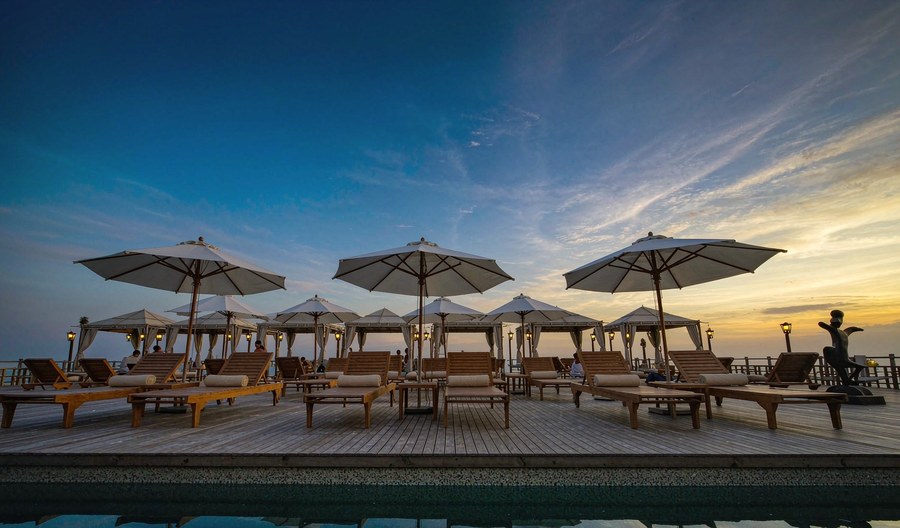
The demand side is not speculative. According to CoStar and STR data reported in early 2026, the Middle East and Africa region had 107,653 hotel rooms under construction at the end of March — up 4.5% year on year — and 231,941 under contract in total. Saudi Arabia accounts for 51,513 of those rooms under construction, nearly half of all active hotel development in the region, followed by the UAE with 16,072. The pipeline skews toward luxury and upper-upscale product — where outdoor furniture is a visible, guest-touched part of the FF&E budget.
Two practical consequences follow. Timelines are set by giga-project and hotel-opening schedules rather than retail seasons, so a late container holds up a commissioning date. And the specifications come from international brand standards and landscape architects, which means the questions you get asked are technical: wind ratings, UV test reports, hardware grades, fabric colour-fastness. A brochure answers none of them.
What the climate does to outdoor furniture
Heat. Summer ambient temperatures of 45°C and higher are routine across the Gulf, and surface temperatures on furniture run well above air temperature. Dark-painted steel and thin-gauge metal seating become unusable to the touch by mid-morning, as do dark cushion fabrics. Powder-coated aluminium and solid timber stay cooler, and light-toned fabrics reduce the radiant load. If a terrace is in use at midday — and in this market it is — surface temperature is a guest-comfort specification, not a footnote.
UV. The region's UV index sits in the "extreme" band for much of the year. UV fades cushion fabrics, chalks cheap powder coatings and embrittles poorly stabilised synthetic fibres. The specification question is not "is it UV-resistant?" — every supplier says yes — but "what test report proves it, and for how many hours?" Reputable mills supply accelerated-weathering data; the ones that cannot are asking you to accept their marketing as evidence.
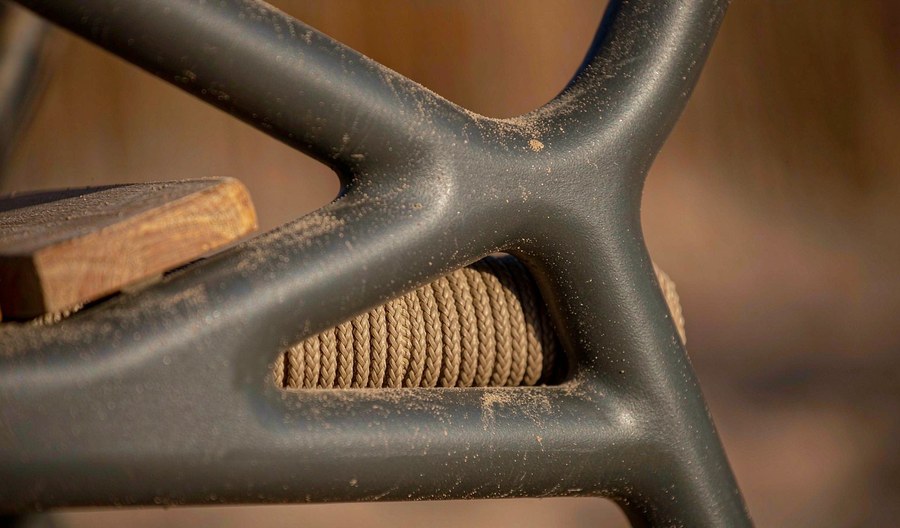
Sand and dust. Fine sand is abrasive: it scores tabletop finishes, works into woven seats and finds every glide and pivot point. The design responses are unglamorous and effective — replaceable feet and glides, open weaves that rinse through rather than trapping grit, and drainage that does not depend on a slot staying unblocked. Shamal winds can carry dust for days at a time, which turns covers and storage from optional into part of the specification.
Humidity and salt. Coastal Qatar, the eastern Arabian peninsula and island projects combine high humidity with salt-laden air. That combination attacks ordinary steel furniture within a couple of seasons, and it is why coastal specifications here converge on powder-coated aluminium with 304 or 316 stainless hardware — the same logic as our powder-coated vs anodised aluminium guide.
Materials that hold up in heat, sand and salt air
Four material families cover almost every Gulf project.
| Material | Heat behaviour | Sand & dust | Coastal exposure | Where it wins |
|---|---|---|---|---|
| Solid teak | Coolest structural option; dimensionally stable | Dense and wipeable; rinse slat gaps | Excellent — oils tolerate salt air; weathers to grey | Pool decks and terraces built to last a decade |
| Powder-coated aluminium | Light and relatively cool; the contract default | Open weaves rinse clean; glides are replaceable | Good with the right coating tier and stainless hardware | High-turnover hotel furniture, load-limited decks |
| PE wicker / rope weave | Warms in sun but far less than metal; cools in shade | Good when UV-stabilised; cheap resin chalks | Good on aluminium frames; verify the UV additive package | Lounge and cabana zones wanting texture |
| Painted or galvanised steel | Heats fastest; radiates heat into the seating zone | Chips at edges; corrosion follows | Poor — the commonest failure we are asked to replace | Little in this market; sheltered inland use only |
The honest summary: teak and powder-coated aluminium carry most Gulf projects, rope and PE weaves supply the texture, and painted steel is the specification mistake you make once. Our teak vs aluminium comparison covers weight, upkeep and reorder colour-matching in detail.
Shade, layout and guest experience
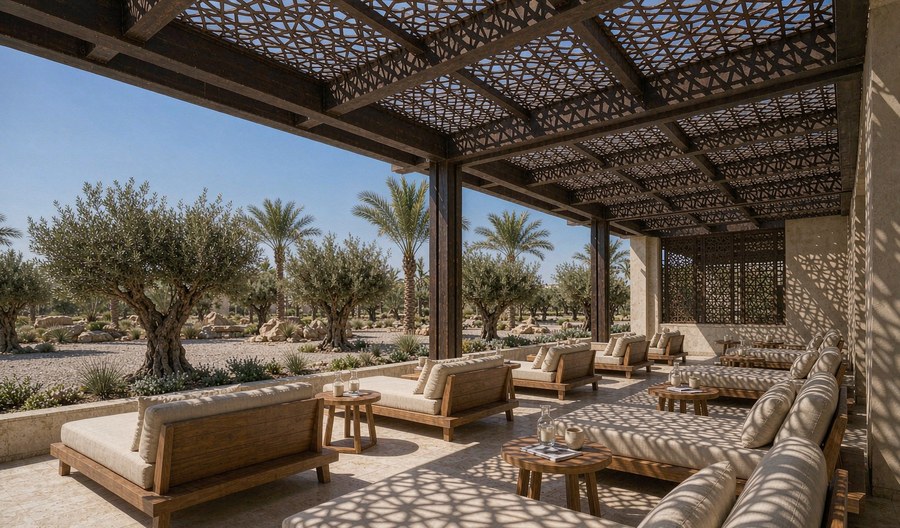
In this market shade is not an accessory bolted on after the furniture is chosen — it decides whether a terrace is used between 11 a.m. and 4 p.m. or only after sunset. Three rules hold across most projects.
Shade the furniture, not the floor plan. Pergolas, mashrabiya-style screens and tensile shade sails should be positioned against the sun path over the seating, not against the drawing's symmetry. A lounger under a dense screen stays usable at midday; the same lounger in open sun does not, whatever the cushion fabric.
Weight everything against wind. Parasols and shade sails are the first things to move in a shamal. Base weight has to be sized against canopy area and exposure — the same anchoring logic we set out for rooftop terraces applies at grade. Freestanding elements that are not anchored are a liability, not a feature.
Plan for rinse-down. Sand management is an operational routine, and the layout should make it easy: furniture light enough for two staff to move, hose access, and drainage that does not pond. Terraces designed for weekly washing age far better than terraces designed only for photography.
The import math: duty, VAT and paperwork for the GCC
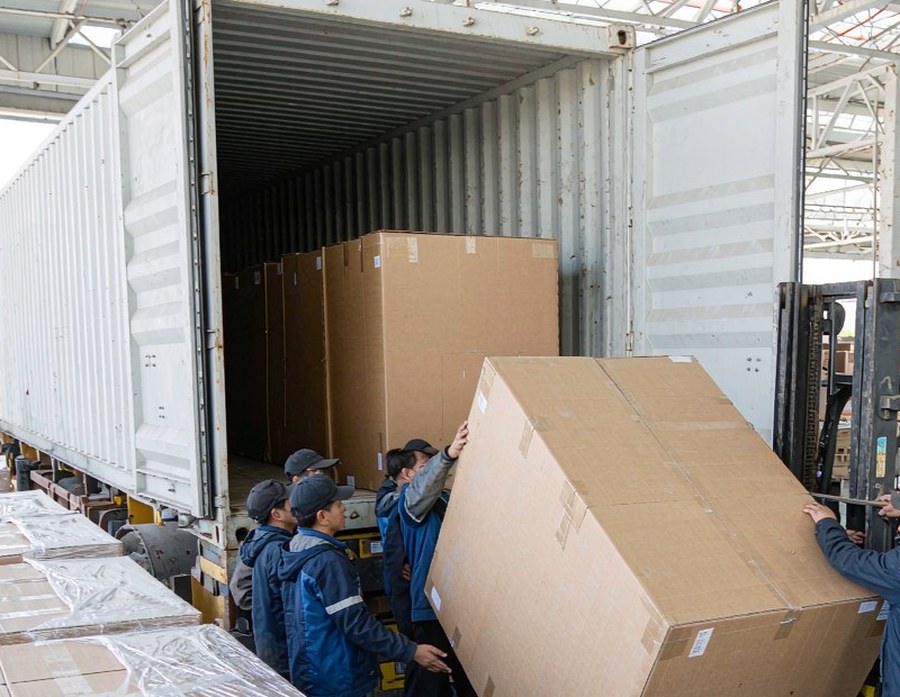
Importing furniture into the Gulf is refreshingly simple on paper — the details that strand containers are the ones nobody reads twice.
Duty. The GCC applies a common external tariff: a flat 5% customs duty on the CIF value — goods plus freight and insurance — for furniture under HS heading 9403. There is no stack of overlays to model the way there is for US imports; the 5% is the whole duty.
VAT. A 5% VAT applies on top of CIF plus duty, which works out at an effective 10.25% of CIF on a standard consignment. If your business is VAT-registered, import VAT is recoverable through your return — so for most project buyers the real cost of the tax layer is the cash-flow timing, not the amount.
Free zones. Goods landed into a UAE free zone have duty and VAT suspended until transfer to the mainland. For distributors supplying projects across the Emirates, that suspension is a working-capital decision worth modelling explicitly.
| Worked example — one 40HQ to Jebel Ali | Amount (USD) |
|---|---|
| FOB value, mixed order | 18,000 |
| Freight and insurance to Jebel Ali | 2,200 |
| CIF customs value | 20,200 |
| Customs duty at 5% of CIF | 1,010 |
| VAT at 5% of (CIF + duty) | 1,060.50 |
| Duty + VAT total (≈10.25% of CIF) | 2,070.50 |
Paperwork. Declarations are filed electronically — Mirsal 2 in Dubai, Bayan at the federal level — against a customs client code held under a UAE trade licence, and the GCC has moved to 12-digit HS codes, so your supplier's invoices and your broker must use the same classification. Four items decide whether clearance is smooth:
- Electrical conformity. Any furniture with built-in elements — LED-lit pieces, powered loungers, USB charging — needs an ECAS/ESMA certificate of conformity from an accredited laboratory, and the shipment must be registered on the SABER platform before it is loaded in China. This is the commonest reason a container of "just furniture" gets held.
- Wood packaging. ISPM-15 marking is mandatory on solid-wood pallets and crates; unmarked wood packaging is fumigated at your cost on arrival. Plywood and composite packaging sidesteps the issue.
- Certificate of origin. Straightforward from a factory, but it must match the invoice and the bill of lading exactly — mismatches between the three trigger physical inspection.
- New goods only. Used or refurbished furniture is effectively barred from mainland import; counterfeit-branded goods are confiscated outright.
Delivery, dust-season care and spares
There is no temperate-style "off-season" in the Gulf — the care cycle runs on dust events and peak heat rather than winter storage. Cushions come in during shamal season and are stored indoors; frames get rinsed rather than scrubbed, because scrubbing sand into a finish is how scratches are made; and covers are specified for dust and UV rather than rain. A short written care routine that survives staff turnover matters more here than in most markets — our commercial maintenance schedule is a workable starting point.
Spares deserve their own line in the purchase order. For a 200-key resort the practical kit is replacement cushion covers for the highest-turnover pieces, touch-up coating pens matched to the powder colour, replacement feet and glides, and spare hardware in the right stainless grade. Agree the list at order stage, not eighteen months later when reorder colours have drifted a batch apart.
What to ask a factory before you order
- What accelerated-weathering report do you hold for the rope and fabric — which standard, how many hours, which lab?
- What coating tier is the aluminium finished to, and what salt-spray test sits behind the claim?
- Is the hardware 304 or 316 stainless, confirmed in writing on the order?
- For teak: what moisture content, what heartwood grade, what joinery at the frame joints?
- Have you shipped ECAS/SABER-registered electrical furniture to the GCC before?
- What is the lead time against a fixed commissioning date, and what happens if it slips?
Buyer checklist
- Climate specification settled: surface temperature, UV test evidence, sand management, coastal hardware grade
- Shade and anchoring planned against sun path and wind, not the drawing
- Material mix agreed: teak for permanence, coated aluminium for turnover, weaves for texture
- Import model confirmed: 5% duty on CIF, 5% VAT recoverable, free-zone suspension modelled if relevant
- ECAS/SABER and ISPM-15 handled at origin; 12-digit HS codes aligned between invoice and broker
- Spare-parts kit and written care routine agreed at order stage
If you are pricing a Gulf project and want specification drawings, material samples or a landed-cost model against a fixed commissioning date, our team at PatioHue Outdoor works with hotel groups, contractors and distributors across the region — send us the project brief and we will come back with technical answers before you commit a container.