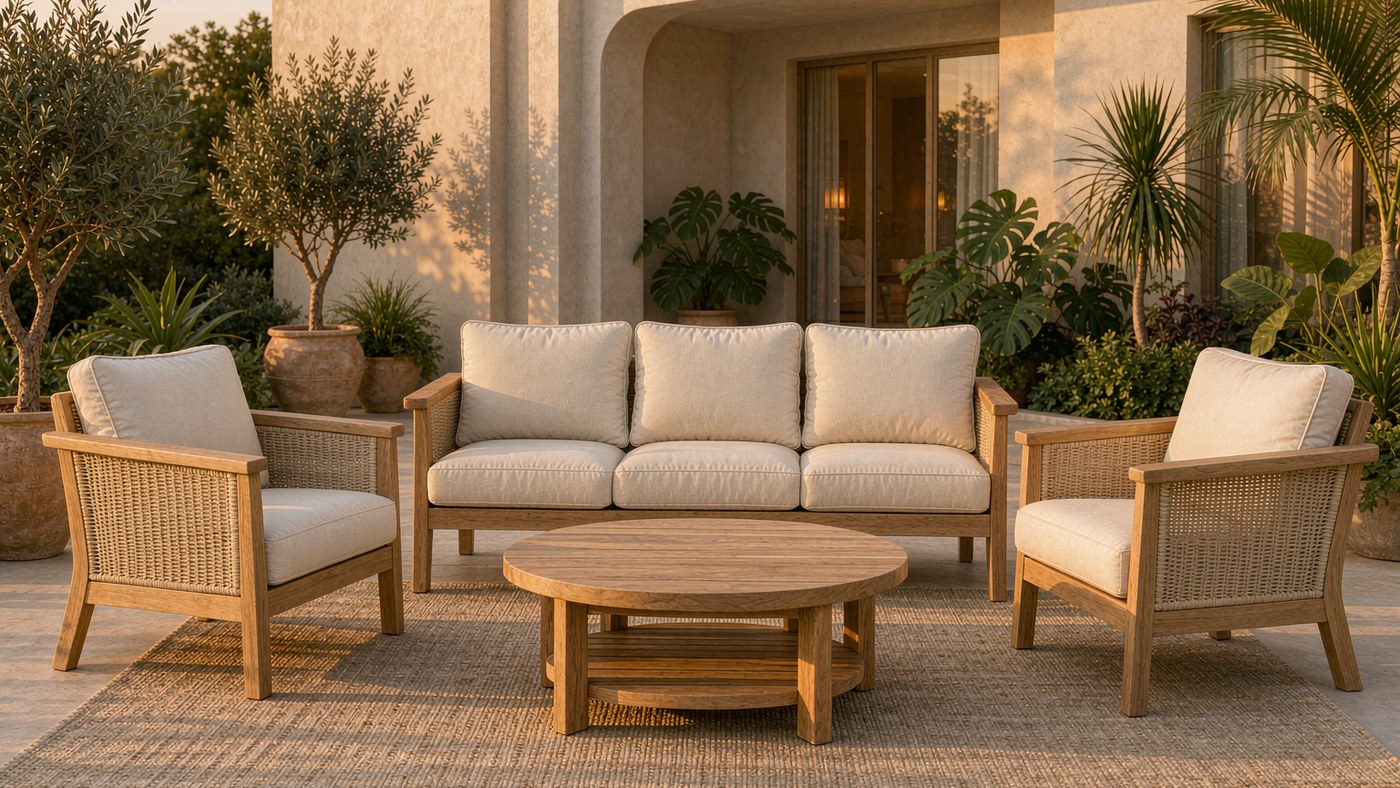
"Rattan sofa set" is two products wearing one name. One is a natural-cane sofa that belongs under a covered veranda; the other is a PE rattan sofa set built for full exposure. Most buyer complaints — mildew in the first season, weave that fades to grey in two summers, frames that rust at the base — trace back to a quote that never said which rattan it was. This guide covers the split, the weave specification to demand, the frame decision, the cushion system, and the commercial rattan sofa spec that survives hotel duty, so your rattan sofa set wholesale order arrives as the product you pictured.
PE rattan vs natural rattan: the split that decides everything
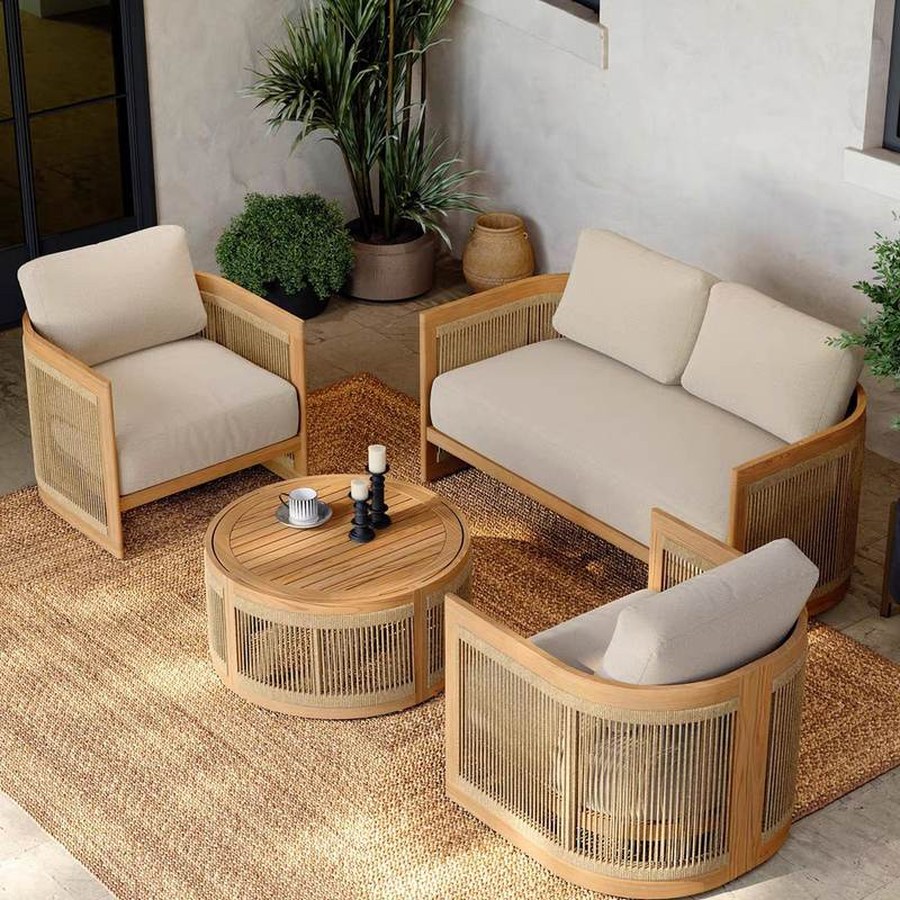
Natural rattan is the solid core of a climbing palm, harvested, dried and hand-woven. It is hygroscopic: field data from mills running both materials put natural cane's moisture uptake at 12–18% of its own weight above 80% relative humidity, against under 0.3% for extruded PE. That single number explains the failure pattern buyers see — weave that loosens as strands swell and shrink, mould in the gaps, and a warranty claim rate that runs 8–12% of units in the same markets where PE rattan claims sit at 2–3%.
| Property | Natural rattan | PE rattan (HDPE) |
|---|---|---|
| Core material | Solid palm cane, hand-woven | Extruded HDPE strand with UV stabiliser |
| Moisture uptake | 12–18% above 80% RH | Under 0.3% |
| Outdoor service life | 1–2 seasons before splitting | 5–10 years with correct spec |
| Best placement | Covered verandas, interiors | Uncovered patios, poolside, coastal |
| Cleaning | Dry wipe, periodic oil | Hose-down, mild detergent |
Accelerated testing separates the grades honestly. In QUV-A exposure (340 nm, 0.89 W/m²) run by a factory that produces both materials, properly stabilised PE held 85–90% of original tensile strength after 2,000 hours — roughly two to three years of subtropical outdoor exposure — while natural rattan dropped to 40–55% with visible fibre separation. Any factory claiming "UV-resistant" should be asked for an ASTM G154 or ISO 4892 report showing exposure hours, cycle and pass criteria; that request alone sorts the quote sheets.
How to read the weave spec
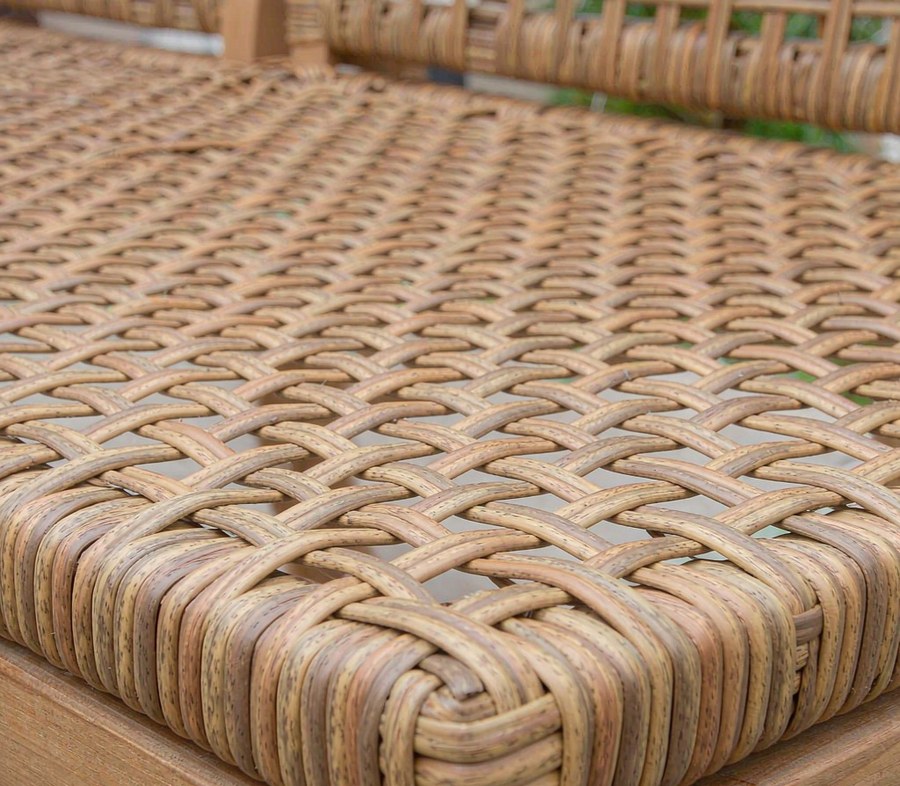
The weave is the part you actually see and the part you cannot judge from a photo. Three numbers tell you most of what matters:
- Strand dimension and tolerance — quality extrusion holds flat PE strand to about 8 mm width with a diameter tolerance near ±0.2 mm; loose tolerance shows up as uneven panels and fraying edges after one season.
- UV stabiliser package — virgin HDPE typically runs a 2–3% stabiliser concentration; recycled blends cut cost but fail UV testing after about 1,000 hours. This is the honest place to ask, because the difference is invisible in the finished weave.
- Weave tension and repair — hand-woven panels should sit drum-tight on the frame. Ask whether replacement weave panels are stocked as catalogue parts: a torn panel is a service item, not a write-off, if it can be swapped in the workshop.
Frame: teak, aluminium or steel
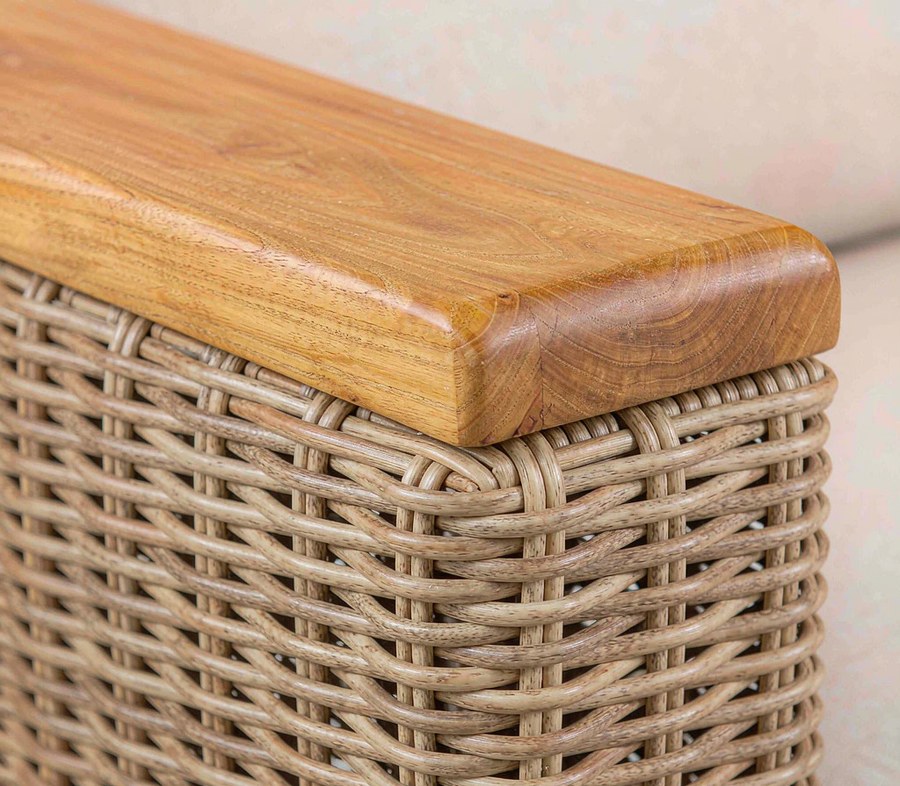
The weave hides the frame, so the frame is where corners get cut. A teak and rattan sofa set — solid teak frame with PE rattan panels, the configuration our WH-SF-1101 uses — buys the warmth and grain of wood with a weave that shrugs off weather. Powder-coated aluminium is the other contract default: lighter, maintenance-free, and the natural pairing where the same design is offered in both materials. The frame to refuse is painted steel tube: it rusts from the inside once the coating is chipped, and no weave quality compensates. Whatever the frame, insist the product ships fully assembled — one-piece welded joinery, nothing to bolt together on site.
The cushion system is half the product
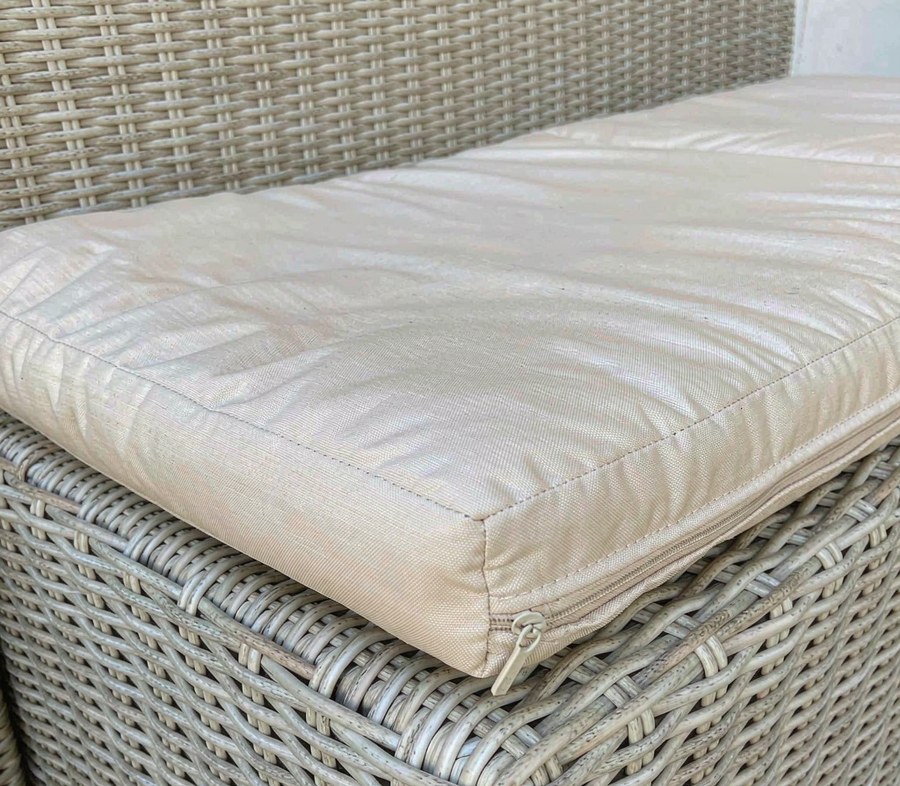
The product lives or dies on its cushions. Specify quick-dry, open-cell foam (around 10 cm on seat cushions in our range), solution-dyed acrylic or equivalent UV-stable covers, and — non-negotiable for commercial duty — zip-off covers the laundry can wash on a schedule. Two sets of covers roughly double cushion life at small cost. If the project sits in the UK or a commercial interior, the fire-retardant side of the cushion spec is a separate line; our flame-retardant cushion guide covers the standards. Read the cushion line of the quote as carefully as the weave line.
Commercial rattan sofa: the contract delta
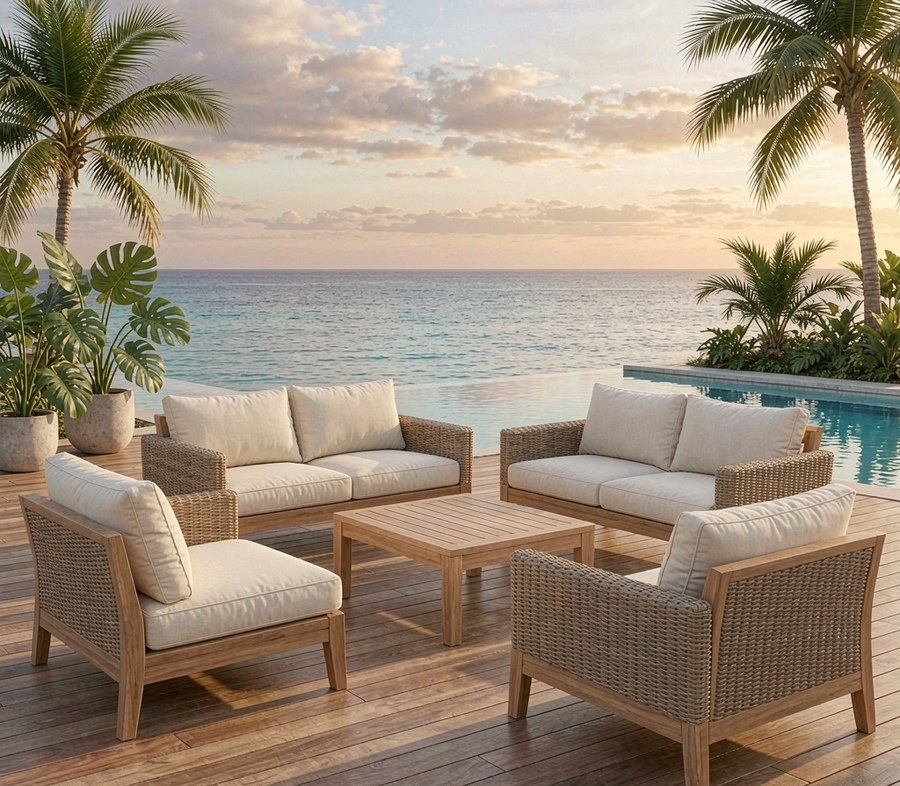
Hotel and resort duty changes three things. First, load: contract seating is rated higher than domestic equivalents, and a lobby or poolside terrace is a high-cycle environment. Second, parts: a resort with 40 sets needs replacement panels, cushions and covers available as catalogue items, not special orders. Third, zoning: rattan wicker earns its place on covered terraces, cabanas and F&B areas — full-exposure rows are better served by sling or rope-weave seating, as our poolside guide argues. For most hotel projects the winning pattern is a commercial rattan sofa in the lounge zones and harder-wearing seating at the water line.
Rattan sofa set MOQ, cartons and container math
Size the group before you price it. A three-seater in our range measures 200 × 82 × 74 cm with a 110 × 60 × 40 cm coffee table — a footprint of roughly 2.5 m that seats three adults with elbow room; the corner group runs 260 × 180 cm and anchors a lounge zone rather than a dining terrace. For hotel terraces, plan 1.2–1.5 m of clear circulation between groups so staff can pass with a tray, and keep parasol bases off the weave panels — a dropped base is the most common weave repair in the field.
These groups are bulky and light: our three-seater ships as 3 cartons per set, the corner group as 4, and factory MOQ starts at 5 sets per model. For rattan sofa set wholesale buyers, the practical maths: 5 sets × 3 cartons = 15 cartons, which nest well against other cartons in a mixed 40HQ — always ask for the packing dimensions rather than guessing the cube. Keep weave colour consistent across a container by confirming all panels come from the same extrusion batch; pigment lots drift, and a container with two tans reads as a quality problem in showroom light.
What to ask the factory before you order
- Is the weave natural rattan or PE rattan, and what is the strand spec (width, tolerance, stabiliser concentration)?
- Can you share the ASTM G154 or ISO 4892 report with exposure hours and cycle?
- What is the frame material and wall thickness — solid teak, aluminium tube, or steel?
- Does the product ship fully assembled, with no on-site assembly?
- Are replacement weave panels, cushion covers and cushions stocked as catalogue parts, and at what MOQ?
Answer those five and the quote stops being a photo and becomes a specification. A manufacturer that answers all five in writing is worth a sample order; one that dodges the weave spec is selling the two-products-one-name problem at scale.