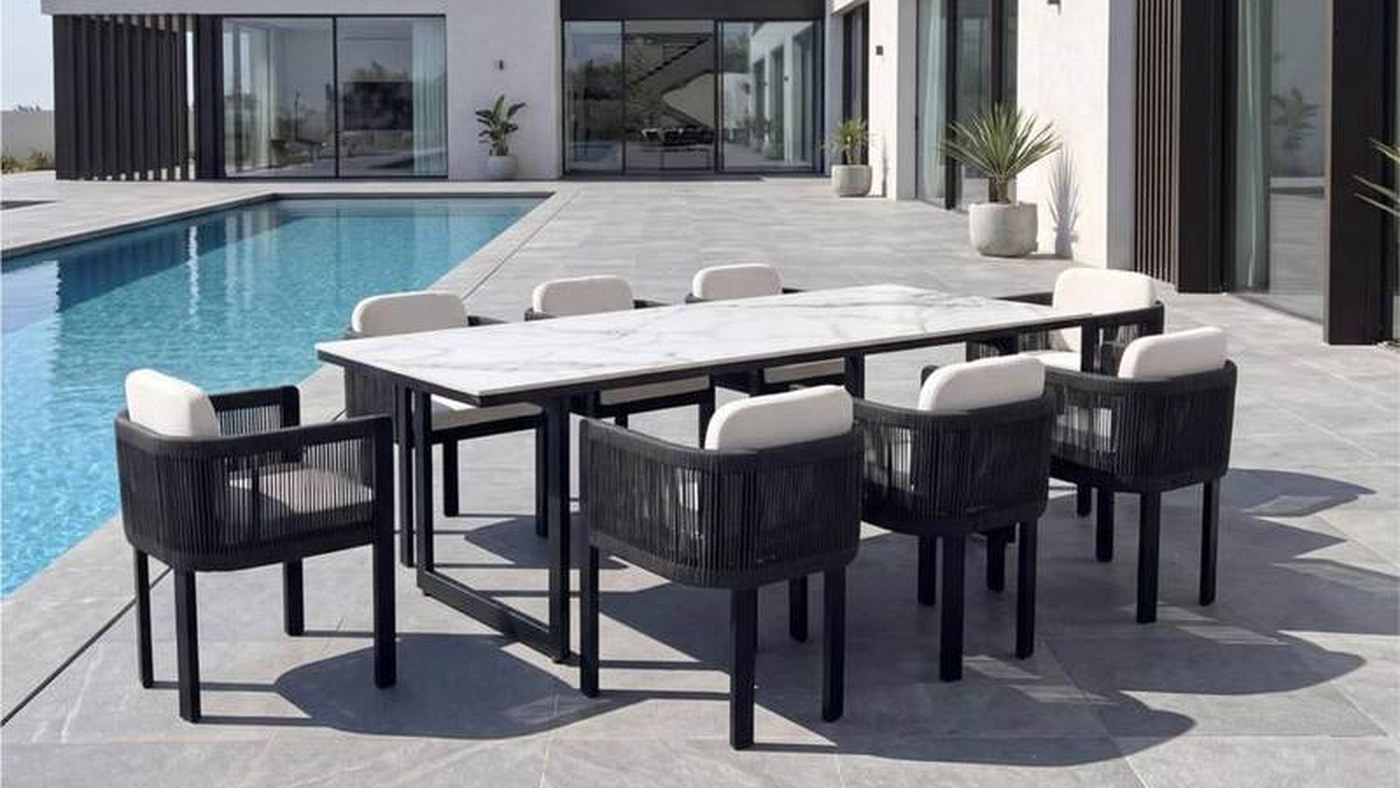
Why rope weave is more than a texture
Walk through any hotel poolside deck or rooftop restaurant and the seating will often be wrapped in cord rather than woven cane or left bare. Rope weave outdoor furniture has moved from a boutique detail to a default specification, and for a good reason: it softens the hard lines of an aluminium frame, adds grip under a guest, and dries far faster than an upholstered piece. Two chairs that look identical can age years apart; the difference is rarely visible in a photograph.
Written for the distributor, resort buyer or contract specifier choosing an olefin rope dining set, an HDPE rope sofa set or a full program. It covers fibre and frame, rope versus rattan wicker and textilene, sample tests, cushions and drainage, care, and the freight and MOQ numbers to settle before the deposit.
Know the fibre before you specify the weave
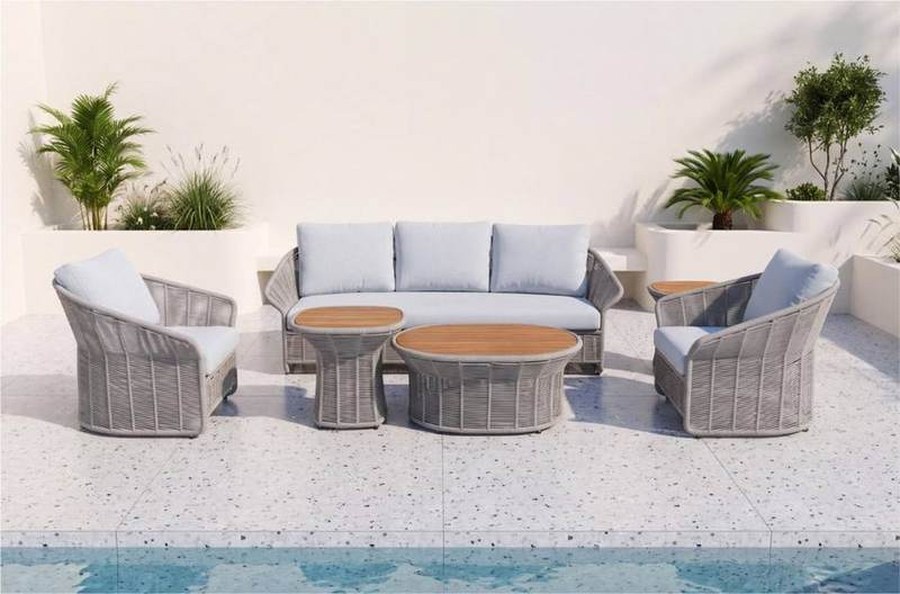
"Rope" is a marketing word, not a material. Ask which polymer the cord is extruded from: the fibre decides colour life, drying time and how the weave ages. Three families dominate contract work.
| Fibre | What it feels like | Where it earns its keep |
|---|---|---|
| Solution-dyed olefin (PP/PE) | Soft, close to natural paper cord | dining set, shaded terrace, boutique villa |
| UV-stabilised HDPE | Firmer, slightly waxy surface | poolside, coastal resort, high-turnover decks |
| Polyester (PET) | Crisp, high abrasion resistance | rooftop bars, heavy commercial seating |
Two numbers separate a contract cord from a garden-centre one. First, solution-dyed pigment: colour is mixed into the polymer before extrusion, so the fibre fades evenly instead of peeling. Ask for the accelerated-UV report, not a verbal "UV resistant" claim — quality olefin and HDPE reach roughly 1,500 to 2,000 hours before noticeable fade. Second, water absorption: hydrophobic olefin and HDPE take up under 0.1% of their weight, so rain runs straight through an open weave and the chair is usable within minutes. Natural paper cord absorbs many times its own weight, swells and sags — fine indoors, wrong beside a pool.
Also ask your supplier whether the cord is pre-stretched. A low-creep core resists sagging under repeated loads; untreated cord beds in within a season. Get the answer in writing on the custom OEM sheet.
Read the frame and the finish, not just the cord
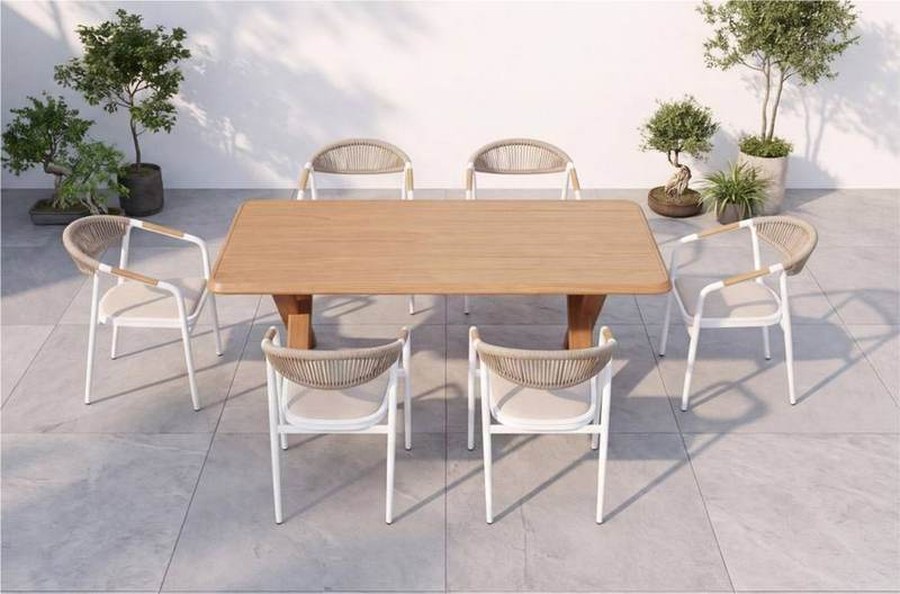
Rope is the skin; the structure underneath decides whether a piece survives five seasons or fifteen. For coastal and poolside work, specify a powder-coated finish over aluminium, not steel — it cannot bleed rust onto pale stone and stays light to move. On load-bearing sections, a wall thickness around 1.5–2.0 mm is the honest commercial range; thinner tube flexes, and flex works the weave loose.
Insist on a fully welded one-piece frame that arrives fully assembled. Rope furniture is not flat-pack: the cord is tensioned on the frame at the factory, so a knock-down design would undo the weave. Continuous welds at the arm and seat junctions are where a chair earns its contract life. For salt-air sites, ask what salt-spray benchmark the coating was tested to — 500 hours is a reasonable inland figure, 1,000 hours the number to request near the sea.
A solid teak top under a cord-wrapped aluminium frame adds warmth without all-timber upkeep. Confirm which parts are stock: a special cord colour usually lifts the MOQ and lead time.
Rope vs rattan wicker vs textilene: choose by site
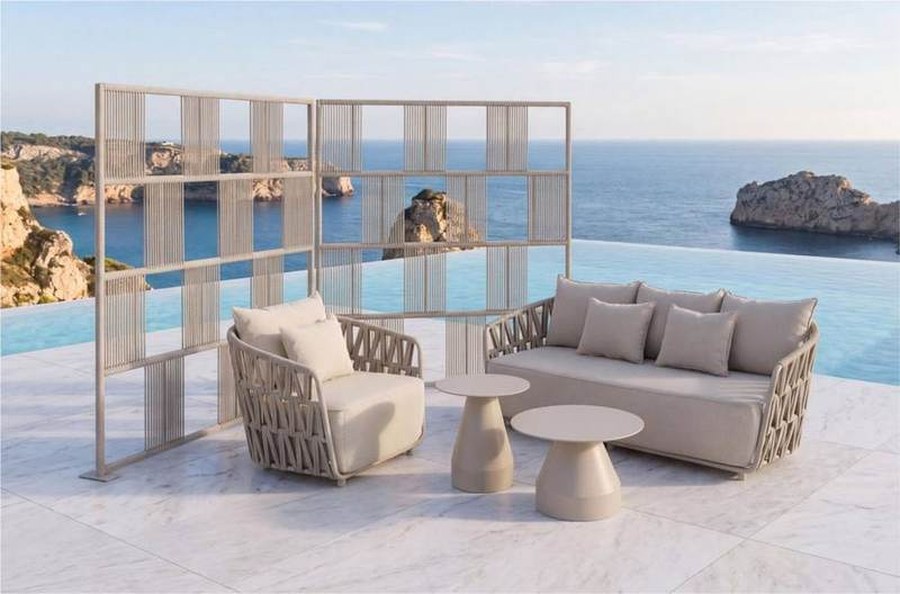
Buyers often treat these three as interchangeable. They are not — match the material to the site and the housekeeping reality.
| Material | Best for | Watch-out |
|---|---|---|
| Rope weave | Designer sofa set, sun lounger, pool and villa decks | Loose weave traps sunscreen; needs a brush |
| rattan wicker (PE) | Classic lounge groups, covered terraces | Poor weave cracks; heavy to ship |
| textilene sling | Stackable dining, pool dining set, high turnover | Less soft underarm; sling is replaceable |
For a shaded garden patio, PE rattan wicker still reads as premium and costs less. On a full-sun beach club or poolside deck, solution-dyed rope over aluminium dries quicker and weighs less. Where staff need to clear a restaurant terrace fast, a textilene sling chair that stacks is the pragmatic answer. Many projects mix them deliberately: rope on the feature daybed and sofa set, sling on the working dining chairs.
What the weave should feel like on a sample
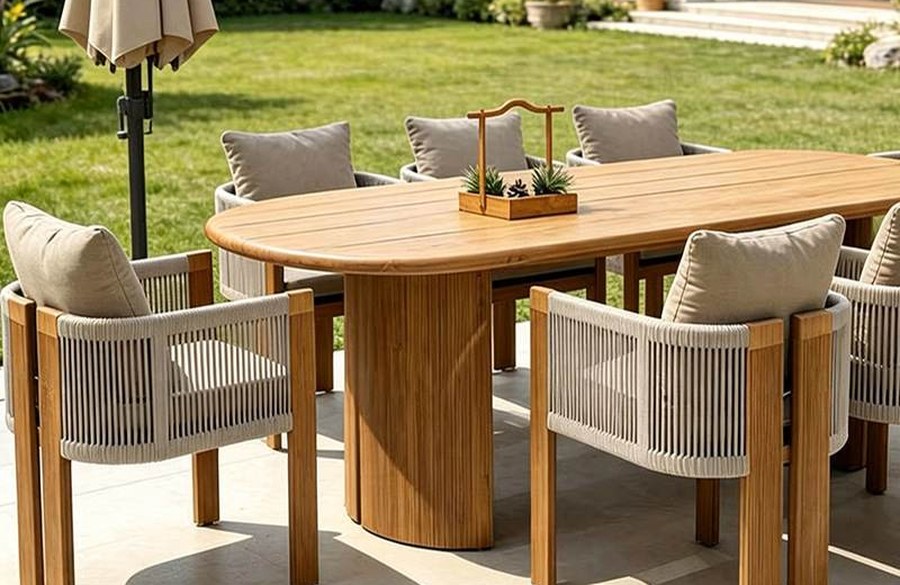
A photograph cannot show tension. Before you approve a program, handle a physical sample and run four checks. First, press the seat with a flat hand and release it: it should spring back without a lingering dip. A little bedding-in is normal; visible sag on a new sample is not. Second, run a finger along the weave and under the arm: ends should be tucked and the edge sealed, with no loose tails to snag a guest's sleeve. Third, look through the weave at an angle — spacing should be consistent, not tight at the top and slack at the bottom. Fourth, ask for the stated safe load per chair and keep the test report with your purchase order; 120 kg per dining chair is a common contract figure.
Keep a labelled cutting of the cord and a small swatch as your control sample, and compare repeat orders under the same light. This catches more shade and gauge substitutions than any invoice check, at no cost.
Cushions and drainage decide guest comfort
The cord sheds water, but a cushion can undo that in an afternoon. For any rope weave outdoor furniture with a seat pad, specify reticulated quick-dry foam — an open-cell structure that lets rain pass through instead of holding it. A density in the region of 28–32 kg/m³ is a reasonable hospitality reference; ask the manufacturer to state the figure and cut one cushion open at inspection to confirm it is not indoor foam in an outdoor cover.
The cover should be a solution-dyed acrylic in a colour-fast range, with removable, washable zips. Solution-dyed acrylic typically holds colour for five to ten years depending on exposure, while printed polyester can fade in a single summer near a pool. Order 10–20% spare covers at the first delivery: they are the first part to soil, and reordering later from a different dye lot is how a terrace ends up with mismatched cushions. If the property prefers no cushion at all, a tensioned rope or textilene seat is the lower-maintenance route.
A care cycle that keeps rope tight
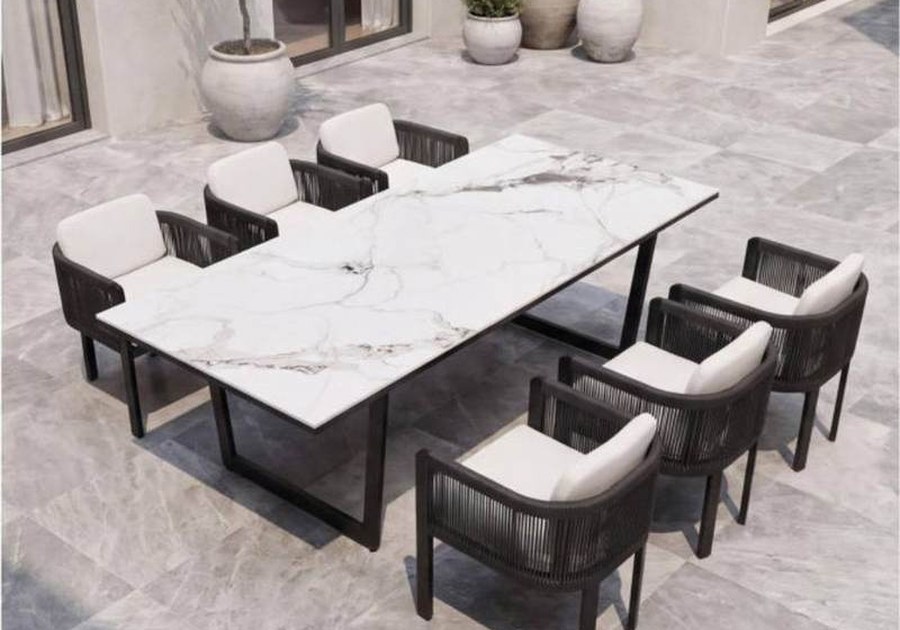
Put the routine in the handover pack using the products already on site. Housekeeping follows a short, specific schedule, not a generic leaflet.
| Frequency | Task | What it protects |
|---|---|---|
| After rain | Let the weave air-dry before covering | Prevents trapped moisture and mildew |
| Weekly | Brush cord with a soft bristle brush and pH-neutral soap | Weave colour and texture |
| Monthly | Check cord tension and frame welds by hand | Shape, stable seating |
| Seasonally | Wax the powder-coated frame; store cushions dry | Finish life, fabric colour |
Avoid solvents, chlorine bleach on the cord and close-range pressure washing, which scuffs coatings and splays filaments. This outdoor rope furniture care routine takes minutes per piece and is the biggest factor in a weave looking crisp at year five.
Freight, MOQ and the questions to ask before the PO
Rope seating is bulky. A cushioned rope sofa set or daybed occupies roughly 0.4–0.6 m³ per piece because it does not stack, so counting pieces as you would for stackable chairs under-orders container space. Ask the factory for a packing list with carton dimensions and a container loading plan before committing, and work out whether a mixed container of rope lounge pieces and stackable dining chairs makes better use of the cube. Lead time for a hand-woven program is typically measured in weeks rather than days — weaving is labour, and a special cord colour adds to it.
Five questions make a quote honest. Which polymer is the cord, and is it solution-dyed? What frame alloy, wall thickness and coating test sit behind the price? Is the frame fully welded and shipped ready to use? What foam density and fabric are in the cushion, and how many spare covers? Which parts — cord colour, weave pattern, a branded label — are custom OEM, at what MOQ? A wholesale buyer who settles these in writing rarely has a delivery-day argument.
PatioHue Outdoor builds fully welded aluminium and teak contract furniture in Foshan, including rope-woven dining set, sofa set and sun lounger lines for hotel, resort and wholesale programs. Send a floor plan and a target container; we will return a matched specification and packing list.