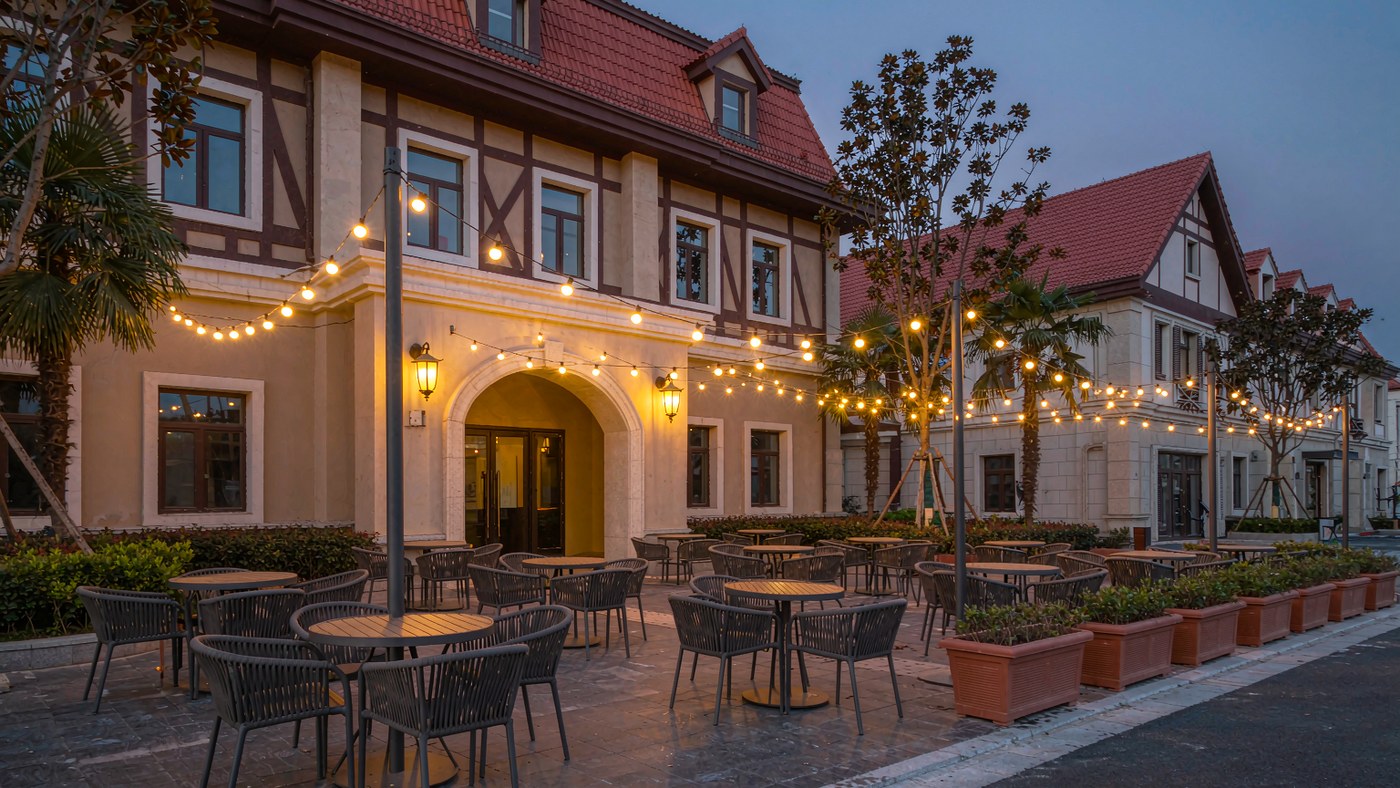
A restaurant terrace is not a patio with more chairs on it. The same table gets cleared six or seven times a night, the chairs are dragged and stacked by staff working at speed, and everything sits in weather with nobody watching it. Furniture that photographs well can still fail on those three counts — and the failure usually shows up as a table that rocks on uneven paving, a stack of chairs that no longer nests, or a surface that needs refinishing before the second summer.
This guide is about specifying for that duty cycle rather than for a look: the four numbers worth settling before you open a catalogue, the table-top decision that quietly sets your maintenance bill, and the questions that separate a terrace-grade product from a domestic one dressed up for commercial use.
Why a restaurant terrace is not a patio with more chairs
Three forces do the damage, and none of them appear in a product photo.
Turnover. A domestic dining set is used twice a day at most. A busy terrace table is set, used, cleared and reset four to eight times per service, and the chairs move with it. Wear concentrates on the joints and the feet, not on the middle of the tabletop. That is why frame construction matters more than surface finish on a commercial specification.
Handling. Staff move chairs by the arm or the back, not by lifting them. A chair designed to be carried by two hands will be dragged by one, and the failure point is the arm-to-frame joint. Chairs that are genuinely light enough to lift with one hand survive longer than heavy chairs that are too awkward to lift.
Unmanaged exposure. Nobody covers a restaurant terrace at closing time. Cushions stay out, parasols stay up, water sits in every recess. Anything that can trap water will trap water.
The practical consequence: on a terrace you are not buying a look, you are buying a maintenance load. Choose the material whose maintenance you are actually willing to run — and if you are not sure what that load looks like week to week, read our commercial outdoor furniture maintenance schedule before you commit to a finish.
Start with four numbers, not the catalogue
Before shortlisting products, settle these four figures. They decide what you can buy far more than any finish swatch will.
1. Covers at peak. Not average covers — the busiest Friday. Undersizing forces staff to improvise with folding tables; oversizing wastes floor area you are paying rent on.
2. Turns per service. This is the number that decides whether you need a lightweight chair or a heavy one. A three-turn terrace can live with heavier furniture; a six-turn terrace cannot.
3. Clear aisle width. Staff carry trays stacked two high, and guests need to reach seats without asking neighbours to stand. Measure the aisle you actually have, subtract the chair overhang when a guest is seated, and check the remainder against local accessibility and fire-egress requirements — those are set by your authority, not by your furniture supplier.
4. Storage footprint. Where do 40 chairs and 10 tables go at 23:00? If the answer is "stacked against the back wall", the stack height per chair becomes a hard specification, not a nice-to-have.
| Table size (cm) | Covers, comfortable | Covers, tight | Where it usually works |
|---|---|---|---|
| 70 × 70 | 2 | 4 (drinks only) | Bar-adjacent two-tops, narrow terraces |
| 80 × 80 | 4 | — | Standard four-top; the workhorse size |
| 120 × 80 | 4 | 6 | Flexible four; splits into two-tops when pushed together |
| 140 × 80 | 6 | — | Family tables, long lunch service |
| 180 × 90 | 6–8 | 10 | Group tables; check aisle drain on both long sides |
One note on rectangular tables: the number of covers a table seats comfortably is set by the perimeter, not the area. A 180 × 90 table and two 90 × 90 tables have similar area, but the long table seats two more people because it has more usable edge. On a tight terrace, perimeter is the metric that pays — which is why most of our terrace tables sit in the long rectangular outdoor dining sets range rather than in the square formats.
Table tops decide your maintenance bill
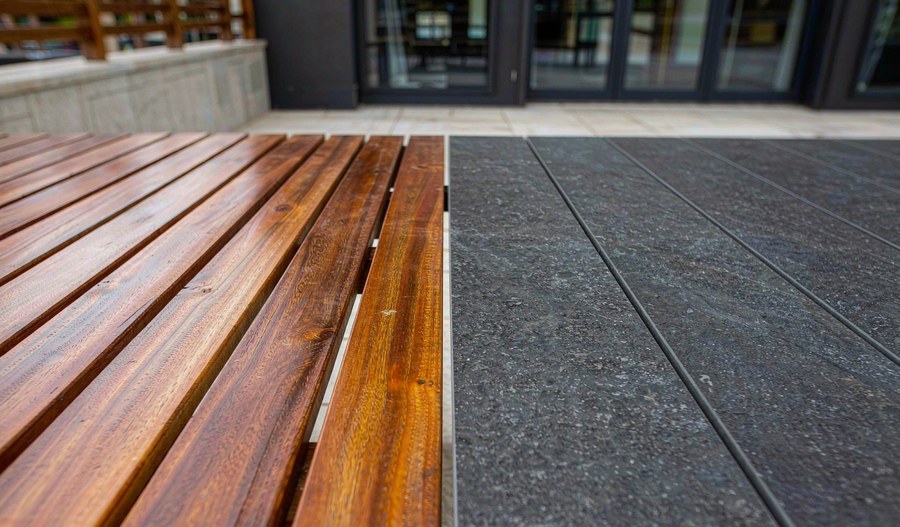
The frame is a one-time decision; the top is a recurring one. Four options dominate commercial terraces, and they are not interchangeable.
| Top | What it does well | What it costs you over time |
|---|---|---|
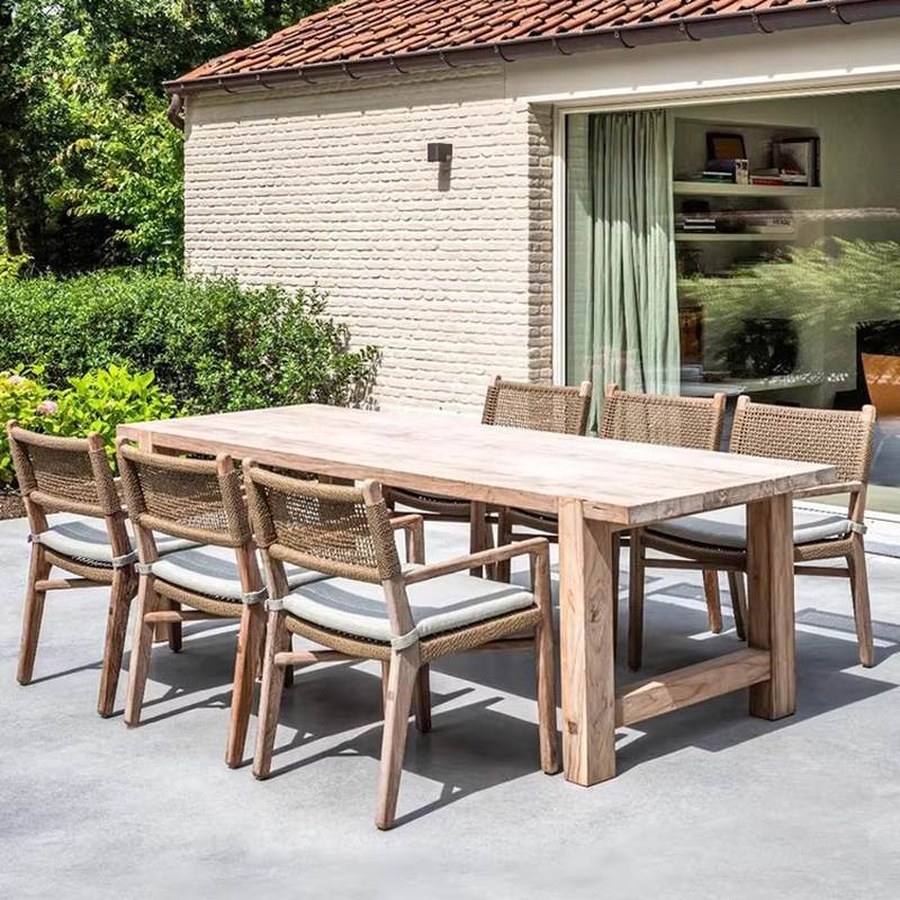
| Solid teak slats | Warm, repairable, sandable; ages to grey without failing; stands up to hot plates | Needs oiling to keep the honey tone; slat gaps trap crumbs and need brushing; heavier than composite tops |
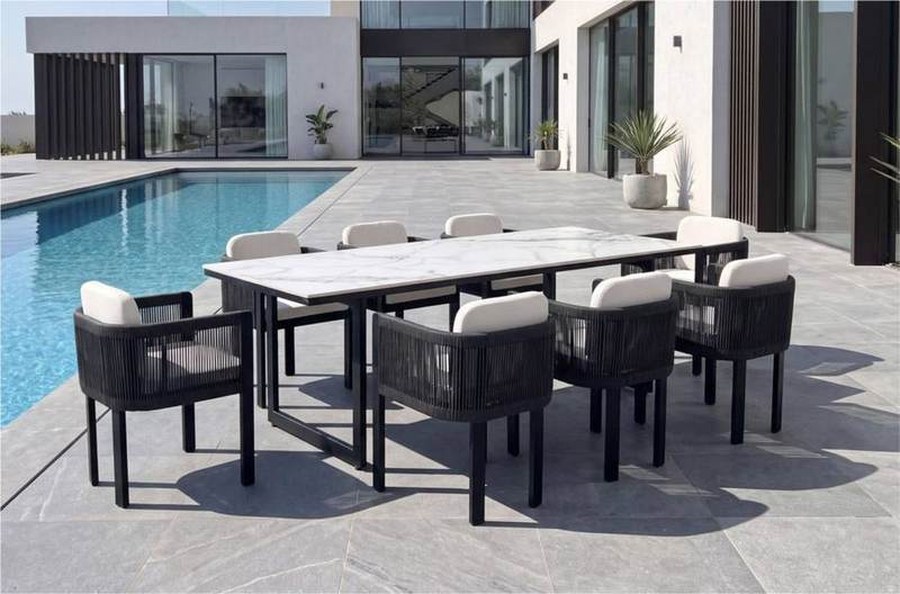
| Sintered stone | Non-porous, stain and heat resistant, no annual treatment, consistent colour on reorder | Chipping at edges if chairs are banged in; cold to the touch; heavier per square metre than it looks |
| HPL compact | Lightest cost per cover, wide colour range, fast to replace | Edge banding is the failure point; heat marks from chafing dishes; looks tired before it fails structurally |
| Tempered glass | Visually light, easy to wipe, reflects light at night | Fingerprints under evening lighting; edge chips are a replacement, not a repair; noisy with crockery |
For a terrace that runs lunch and dinner seven days a week, sintered stone on an aluminium base is usually the lowest-maintenance combination, and solid teak on a teak base is usually the most repairable. The two sit at different points on the same trade-off — our teak vs aluminium comparison sets out where each one wins on weight, upkeep and replacement cycle. What almost never works is mixing a heavy top with a light folding base — the two fight each other, and the table wobbles within a season.
Chairs: what stacking actually costs
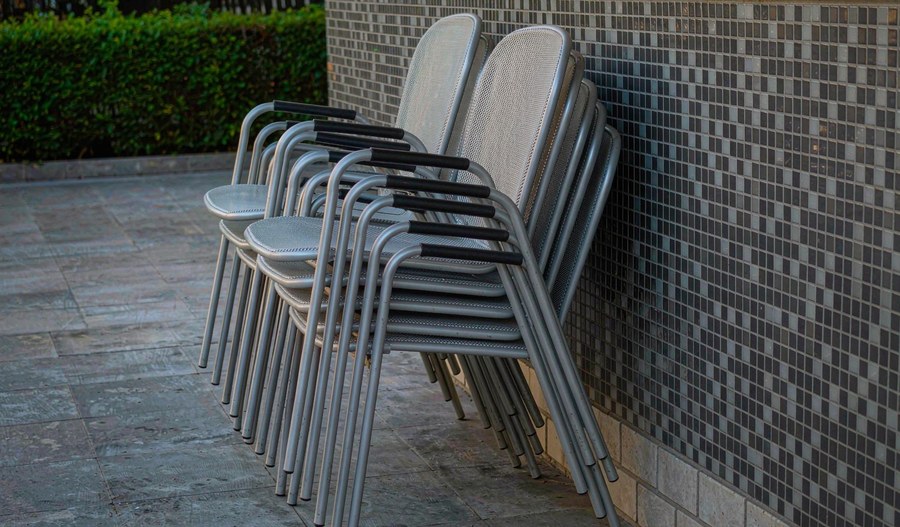
Stackability is quoted as a number ("stacks 6 high") but what matters is the pair: stack height and stack weight. A chair that stacks 8 high but weighs 6 kg means a 48 kg stack that one person has to move. A chair that stacks 5 high at 3.5 kg is easier on staff and on the chair.
Four chair details to check on a sample, in this order:
Seat height against your table apron. A 45 cm seat under a table with a deep apron traps knees. Sit at the actual table, not at a showroom bench.
Armrest clearance when stacked. Arms that catch on the chair below force staff to stack two-handed, which slows closing time and breaks arms.
Foot wear. Nylon glides wear through on rough paving; stainless or replaceable glides are worth specifying, and worth asking for as spares.
Frame joint. Welded aluminium joints fail at the weld; through-bolted or internally braced joints fail more slowly and can be re-tightened. On a high-turnover terrace, re-tightenability is the difference between a repair and a replacement.
Wind, shade and heat
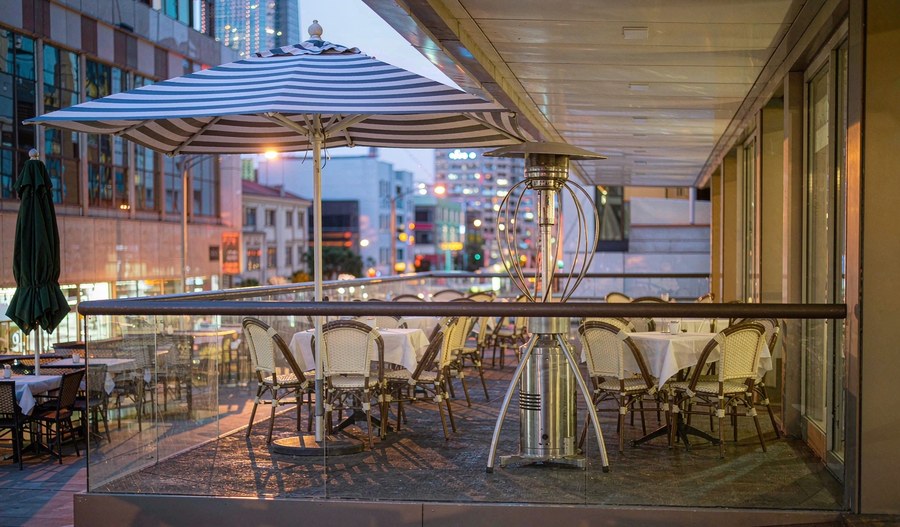
Shade on a restaurant terrace is not decorative. It extends usable hours, protects the furniture underneath, and on a south-facing site it is the difference between a table that turns and one that sits empty at 14:00.
Three specifications matter more than fabric colour:
Base weight against canopy area. The larger the canopy, the heavier the base has to be — and a cantilever parasol needs substantially more base weight than a centre-pole parasol of the same coverage, because the arm multiplies the load. Ask for the base weight required for the canopy size you are buying, in writing, and check it against your wind exposure. On an exposed site the honest answer is often "this parasol is not suitable here" — a fixed pergola or a retractable awning is the correct specification instead.
Closing routine in wind. Parasols must come down in gusts. If staff cannot close them in under a minute, they will not be closed, and the failure happens at the frame rather than the fabric.
Heaters and clearance. Standing patio heaters need clearance from fabric, canopies and guests, and they need a stable base on uneven paving. Plan heater positions at layout stage — retrofitting them usually means a cable run you did not budget for.
Storage, security and the nightly routine
The closing routine is a specification. Write it down, then buy furniture that survives it.
If cushions come in every night, they need somewhere dry to go and a way to be carried — a stack of 40 loose cushions is a ten-minute job done badly. If cushions stay out, they need drainage and quick-dry foam, and they will need replacing on a predictable cycle regardless of what the label says.
Security matters on street-facing terraces. Chairs and tables that can be chained together at closing survive better than furniture that has to be carried inside. Ask whether the frame has a point that a cable can pass through without marking the finish — it is a small detail that decides whether your staff actually secures the terrace or just hopes.
Compliance checks before you order
Requirements vary by city and by licence, and they are set by your local authority — not by your supplier. What a supplier can do is give you the documentation you will be asked for. Three areas are worth confirming early, because they can change the layout rather than the product:
Means of escape and aisle width. Fire egress and accessibility rules can set a minimum clear width that your layout does not meet once chairs are occupied. Check before you fix the cover count.
Licensing conditions on the terrace footprint. Many licences specify the permitted area and sometimes barrier or planter requirements. Planters used as barriers need to be heavy enough to stay put and light enough to move for cleaning — a genuine specification conflict worth resolving on paper.
Fixings and surface penetrations. Anything bolted into paving needs permission and, on a leased site, a reinstatement plan. Freestanding furniture with adequate weight is often the cheaper answer.
A specification checklist for your RFQ
Send these with your enquiry and most of the specification conversation is over before it starts:
1. Covers at peak, and the table sizes you want to run
2. Turns per service, and whether staff stack or carry
3. Storage space available, and whether it is covered
4. Surface: paving, decking or tile — this decides foot wear and table stability
5. Wind exposure: sheltered courtyard, street frontage, or open waterfront
6. Rain: does the terrace stay open in rain, and do cushions stay out
7. Table-top preference and the maintenance you are willing to run
8. Local licensing or accessibility constraints you already know about
9. Spares required at handover: glides, chair arms, parasol ribs, touch-up
10. Whether you need the container phased against an opening date
Working with a factory on a terrace project
PatioHue is a Foshan factory-direct manufacturer of solid teak and powder-coated aluminium outdoor furniture, exporting to Europe, the Middle East, North America and Australia. Restaurant terraces sit between our hotel and residential work: the frame needs commercial joint construction, but the specification is usually driven by a floor plan and an opening date rather than by an FF&E schedule.
If you send the ten points above along with your table and chair mix, we will come back with a specification, a loading plan for the container and a production slot — and we will tell you where a request will not survive the duty cycle rather than quote it anyway. Samples take around 15 days — the process is set out in our sample ordering guide; production runs 25–35 days. If you are furnishing a terrace alongside other areas of the same venue, ask for the whole order to be loaded as one container plan so nothing arrives after opening.