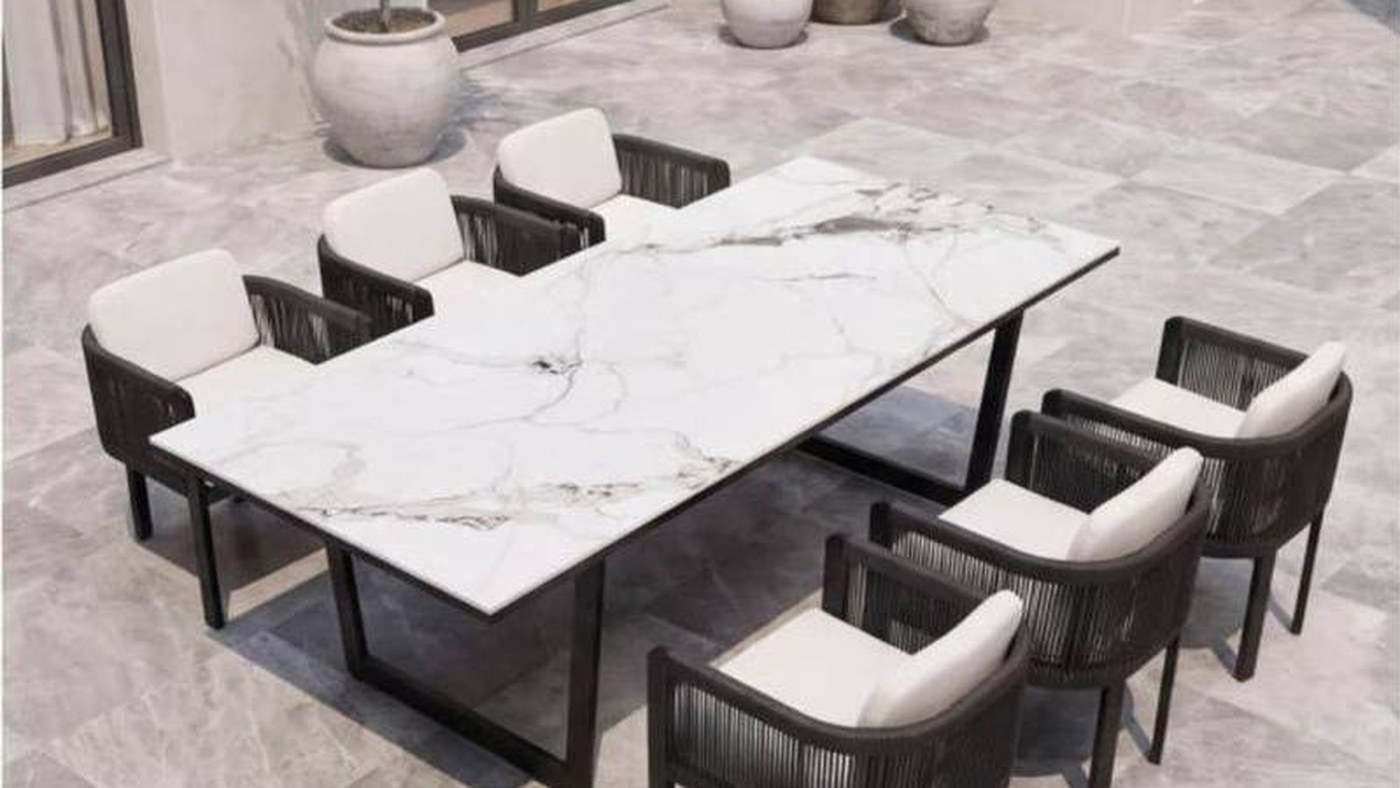
The tabletop is the surface guests actually touch. It takes the sunscreen, the citrus, the wine, the hot plate and the cleaning cloth, every service. Yet in most outdoor furniture quotes the top is a single line — "HPL top" or "teak top" — with no thickness, no grade and no edge detail. That is where warranty claims start. This guide is about specifying an HPL outdoor tabletop properly: what compact laminate is, which exterior grade to demand, what thickness a contract dining table needs, and how it compares with solid teak and sintered stone on the same frame. It is written for buyers choosing an outdoor dining table top material for hotels, restaurants, resorts and wholesale distribution programmes.
What HPL is, and what "compact" changes
HPL stands for high-pressure laminate: layers of resin-impregnated paper — a decorative face in melamine resin over kraft cores in phenolic resin — pressed under heat and high pressure into one sheet. Standard decorative HPL is thin and must be bonded to a substrate such as particleboard or plywood. Compact laminate is the same technology pressed into a thick, self-supporting panel with no substrate at all. That difference removes the most common outdoor failure mode: a bonded top delaminating once moisture reaches the glue line through a chipped edge or unsealed cut-out.
For a buyer, "compact" also means the material is the same all the way through. A scratch goes into a homogeneous panel instead of cutting through a thin decorative layer into a different core, and a sealed cut edge reads like the face — which is why compact panels dominate outdoor dining tables, bistro tops and bench seats that stay outside year-round.
The one spec line that matters: EN 438-6 exterior grade
Not every laminate is built for outdoors. Interior-grade HPL fades, crazes and swells in weather, and no amount of edge sealing saves it. The line to demand in writing is the EN 438-6 classification — the European standard covering exterior-grade compact laminates of 2 mm and greater. It grades panels by exposure: EGS or EGF for moderate conditions, EDS or EDF for heavy exposure, with the F suffix marking flame-retardant versions. A quotation that only says "HPL, waterproof" has not answered the question.
EN 438-6 also gives you screening numbers to hold a supplier to. Exterior compact laminate is specified at a density of at least 1.35 g/cm³, flexural strength of at least 80 MPa, a mass increase of no more than about 5% after immersion for panels 5 mm and thicker, and artificial-weathering contrast rated grey scale 3 or better. Those are test values, not marketing — a supplier without data against them is selling an interior panel with an outdoor label.
Compact laminate tabletop thickness: what to specify
Outdoor compact laminate tops are made in 6, 8, 10 and 12 mm panels, with 12 mm the sensible default for a table seating six to eight. Thinner tops flex under a leaning elbow and drum when plates land; thicker tops mainly add weight — compact laminate is roughly twice as dense as teak. What matters more is the support grid: ask for the under-rail spacing and the maximum unsupported span, and keep spans beyond roughly 160 cm supported at thirds rather than the ends alone.
Edges are the weak point, so specify them. Require all edges sealed, external corners radiused rather than sharp, and every cut-out — parasol holes, cable ports, speaker pass-throughs — sealed on the raw core after machining. Compact panels still move with temperature — plan roughly 0.4 mm per metre for every 10 °C swing — so specify slotted or oversized fixing holes that let the top expand without binding.
HPL vs teak outdoor tabletop: the honest comparison
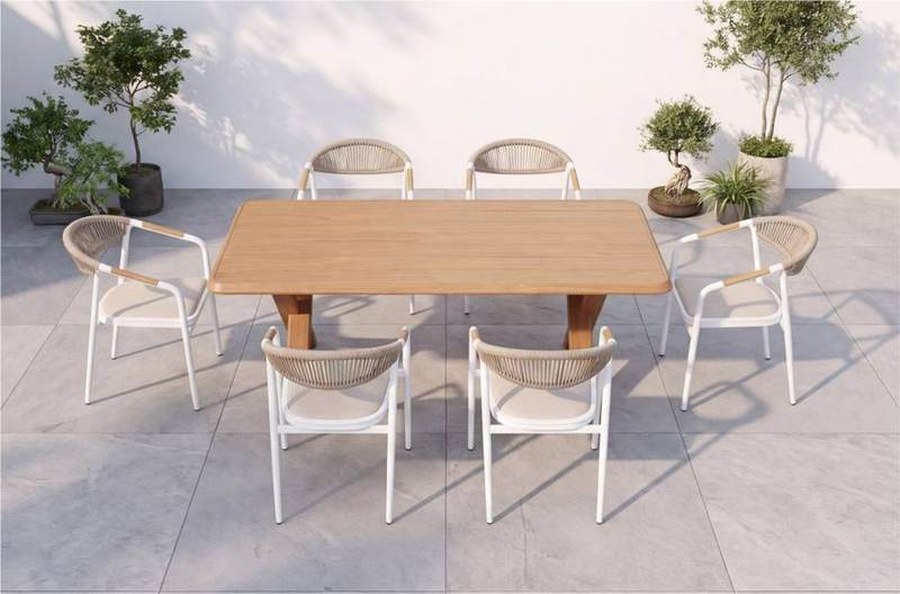
On a contract terrace, the HPL vs teak outdoor tabletop decision usually comes down to who maintains the furniture and how hard the surface works. HPL is the low-intervention choice: wipe it down, done. Teak is the high-touch choice that rewards attention and punishes neglect — or forgives it, if you accept the silver-grey patina.
| Decision factor | Compact HPL top | Solid teak top | Sintered stone top |
|---|---|---|---|
| Typical thickness | 6–12 mm | 30–40 mm | 12 mm |
| Weight per m² | ~16–17 kg | ~25 kg | ~30 kg+ |
| Daily upkeep | Damp cloth | Brush + soap, 2×/yr | Damp cloth |
| Hot dishes direct | Use a trivet | Tolerated | Tolerated |
| On-site repair | None — replace | Sand and re-oil | None — replace |
| Colour ageing | Stable, exterior grade | Silvers in 6–12 months | Stable |
| Best fit | Restaurants, poolside bars | Villas, premium residential | Statement terraces |
Where an HPL outdoor tabletop wins
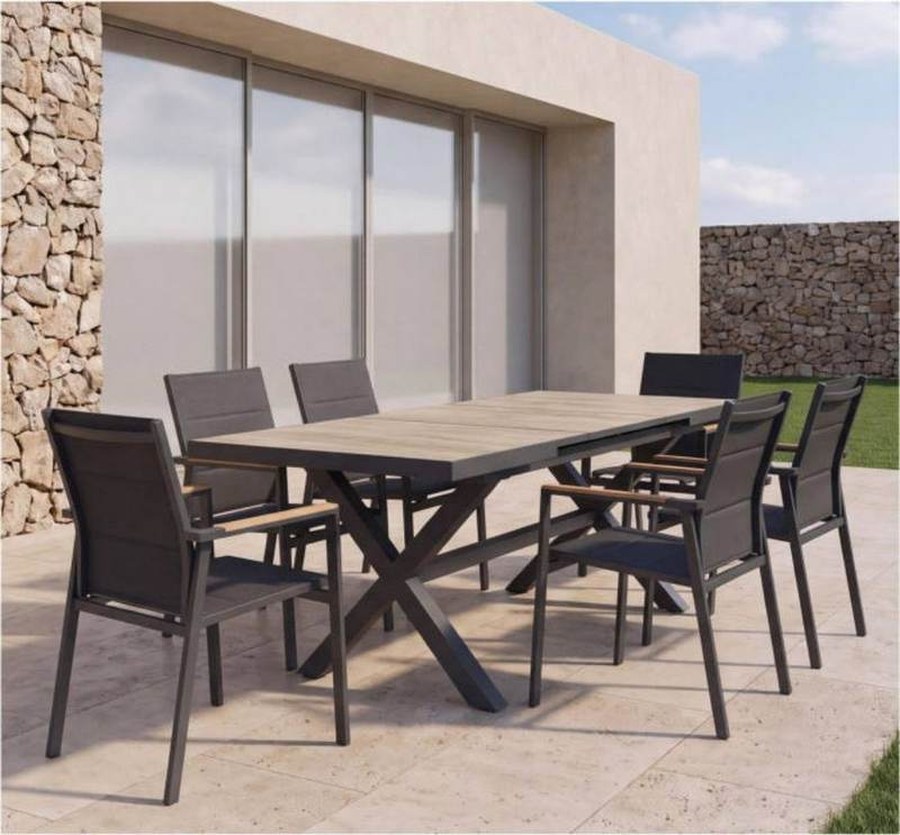
High-traffic hospitality is where an HPL outdoor tabletop earns its place. A restaurant terrace turns tables twelve times a day; a poolside bar fights sunscreen, citrus and chlorine splashes; a hotel courtyard takes room-service trays and housekeeping carts. Compact laminate shrugs all of that off with a cloth, needs no seasonal oiling, and keeps one consistent colour across a 200-table order — something solid timber never quite manages, because every board has its own tone. Pair it with stackable textilene sling chairs or HDPE rope-weave seating and the terrace resets between services with a cloth and a rinse.
Weight is the trade-off. At roughly twice the density of teak, a 12 mm compact top makes a two-person lift for a large table, so check terrace access before ordering 240 cm tops. The same density is also why HPL survives being dragged, stacked and carted by staff who treat furniture as equipment, not heirlooms.
Where teak still wins
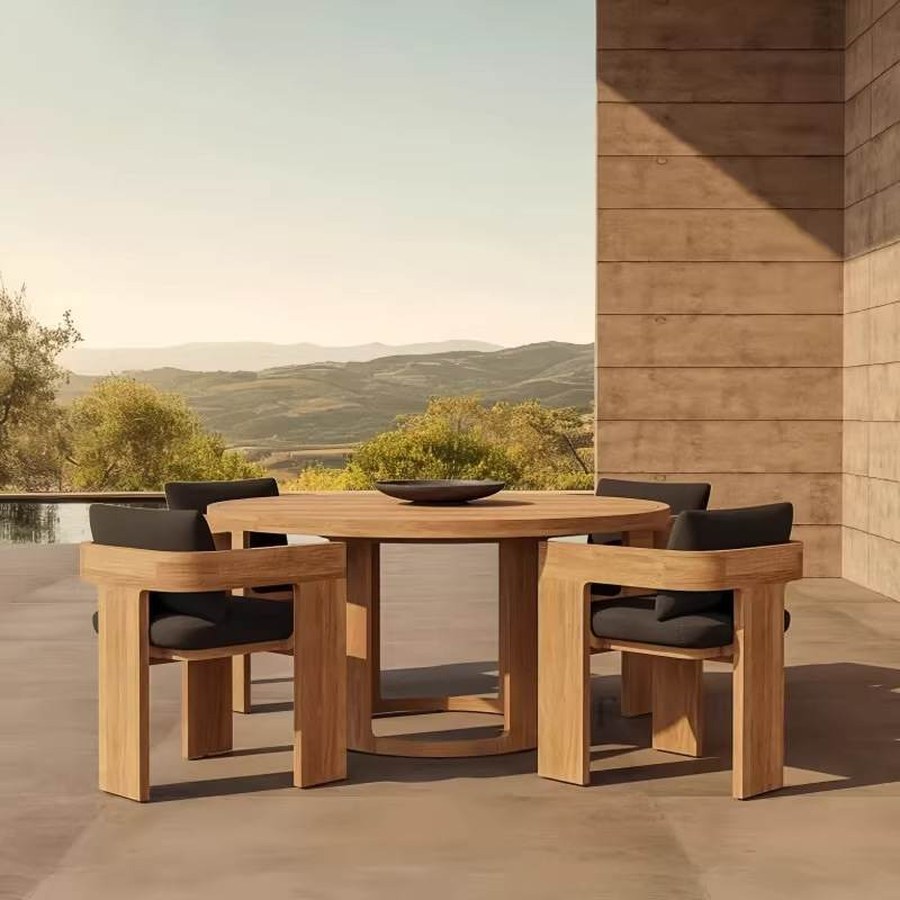
Teak earns its price on surfaces that work like indoor furniture. It takes a hot pan without a trivet, a knife mark can be sanded out, and a tired top can be renewed on site instead of scrapped — real advantages for a private villa or an owner-managed guesthouse where a 40 mm solid top is part of the architecture. The honest cost is maintenance: an untreated top silver-greys within six to twelve months, keeping the golden tone means a water-based protector once a year, and teak oil or varnish outdoors invites mildew and peeling. Teak's natural oils also migrate into cushions, so specify removable, washable cushion covers wherever teak tops meet upholstery.
Write the tabletop into the PO
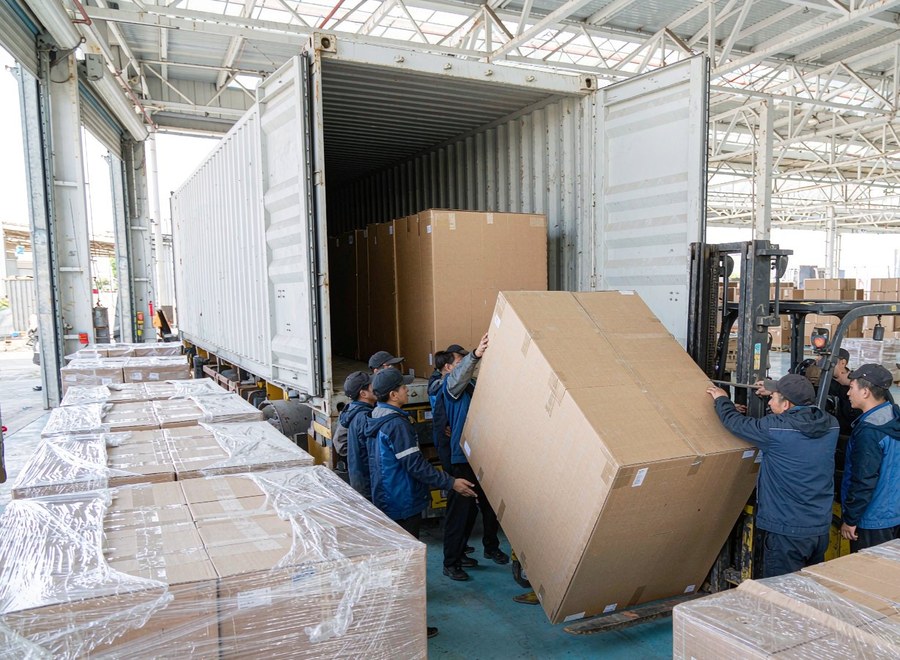
Two more lines belong on the same page. First, packing: tops should travel face-to-face with foam or edge protectors, because a chipped edge on arrival is the start of a moisture claim six months later. Second, replacement: agree the MOQ and lead time for a single replacement top before the first container loads, so a cracked top in year three is a reorder, not a redesign.
HPL tabletop care and cleaning
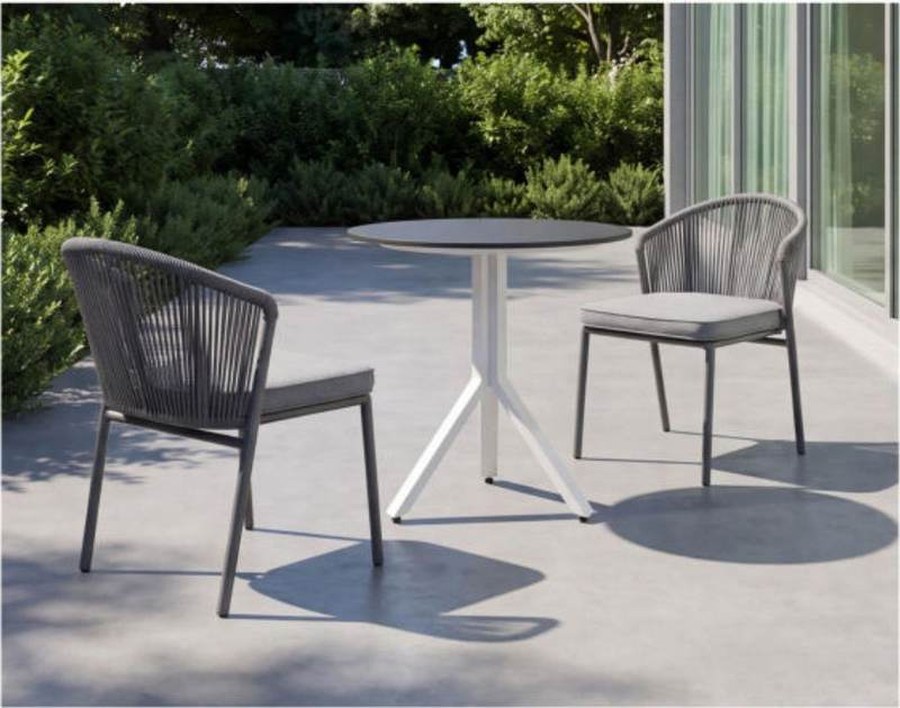
Care is deliberately boring, which is the point. Wipe with a soft, damp microfibre cloth and mild detergent; deep-clean the whole set two or three times a year; never use abrasive pads, scouring powder or steel wool, which scratch the surface permanently. Clear spills promptly — coffee, wine and citrus left standing turn a stain into a dispute — and use trivets under hot dishes rather than gambling on heat resistance.
Two details survive from workshop to terrace. Dark edges lighten with sun exposure; a light wipe of linseed oil restores the depth. And while compact laminate tolerates standing water far better than wood, do not let water pool at seams and cut-outs — a wipe after rain keeps sealed edges doing their job for the full warranty period. In winter, a breathable cover or indoor storage avoids the freeze-thaw cycle that stresses every outdoor material.
Questions to ask your manufacturer
Five questions separate a real compact-laminate supplier from a trader reading a datasheet. Which EN 438-6 grade is this panel, and can you send the test report? What is the standard thickness and its tolerance? Are all edges and cut-outs sealed at the factory, and with what? What under-rail spacing do you use on a 240 cm top? And what is the MOQ and lead time for replacement tops in a later batch?
A factory that answers all five with numbers is describing a process. One that answers with adjectives is describing a hope. For context, our own aluminium dining programme runs teak-slat, compact HPL and sintered-stone tops on the same welded, fully assembled frames — no on-site assembly, no visible fasteners — so a project can standardise on one frame family and still choose the top per zone. Ask us for the spec sheet, and we will send it with the panel grade on it.