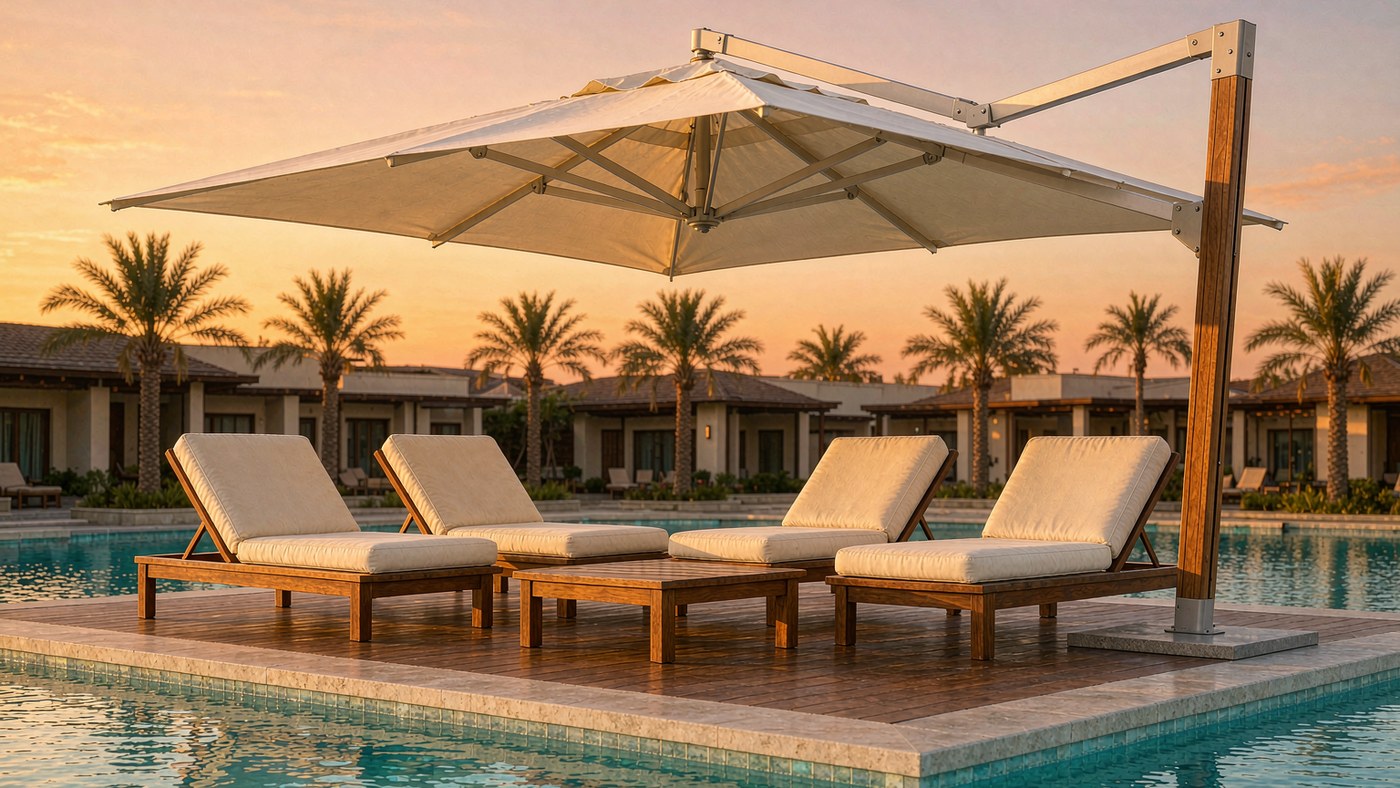
A parasol is the piece of outdoor furniture guests notice first — and the one most likely to fail in its first season. A tipped cantilever on a windy terrace is a safety incident, not a warranty claim. Yet most shade decisions are still made from a catalogue photo and a price per unit.
This guide is for buyers specifying commercial outdoor parasols for hotels, resorts, restaurants and pool decks: the formats that work, the fabric numbers that matter, the base-weight math that keeps a canopy upright, and what to ask a factory before the container is booked.
Shade is a specification, not an accessory
Shade is a performance requirement, not decoration. As a planning rule, size the parasol coverage to seat roughly 80–90% of the terrace under shade at peak hours, and place the units where the sun actually tracks — not where the floor grid happens to fall.
Specify the parasol together with the furniture it serves. Our teak and aluminium dining sets carry a Ø50 mm centre umbrella hole; a parasol ordered with a dining set should match that pole diameter so the table stays stable when the canopy catches wind. The patio umbrella for hotel poolside use is doing a different job than a terrace model: it must rotate with the sun, survive chlorinated splash, and stay upright in the wind corridors that open water creates.
Four commercial formats and where each wins
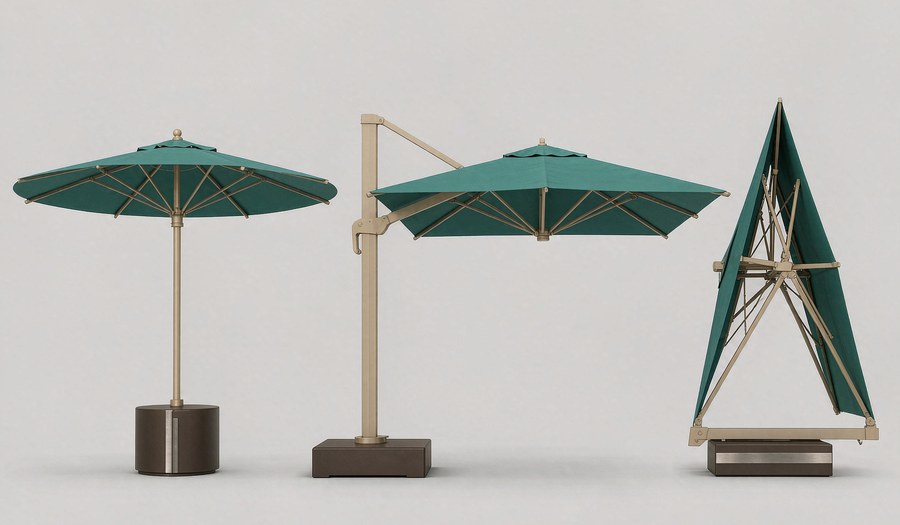
Four formats cover almost every commercial terrace. Choose by the furniture group and the fixing you can get away with.
| Format | Best for | Watch-outs |
|---|---|---|
| Centre pole through a table | Dining terraces with a fixed table — the table acts as ballast (a 2.5–3 m parasol through a heavy table needs roughly 20 kg of base, about half the freestanding figure) | Pole sits mid-table; the hole must match the pole diameter |
| Freestanding centre pole | Lounge runs, spa lawns, layouts that change with the season | Base weight climbs fast with canopy size |
| Cantilever (offset) | Pool decks, daybed runs, any view or walkway a pole would block | The offset arm multiplies wind leverage — heaviest bases or ground fixing |
| Wall-mounted / pagoda | Terraces attached to a building; smallest footprint | Permanent fixing; shade angle is fixed |
Round canopies shade a table; square canopies shade a lounge run. Match the shape to the furniture group, not the other way round.
Canopy fabric: what the gsm number buys
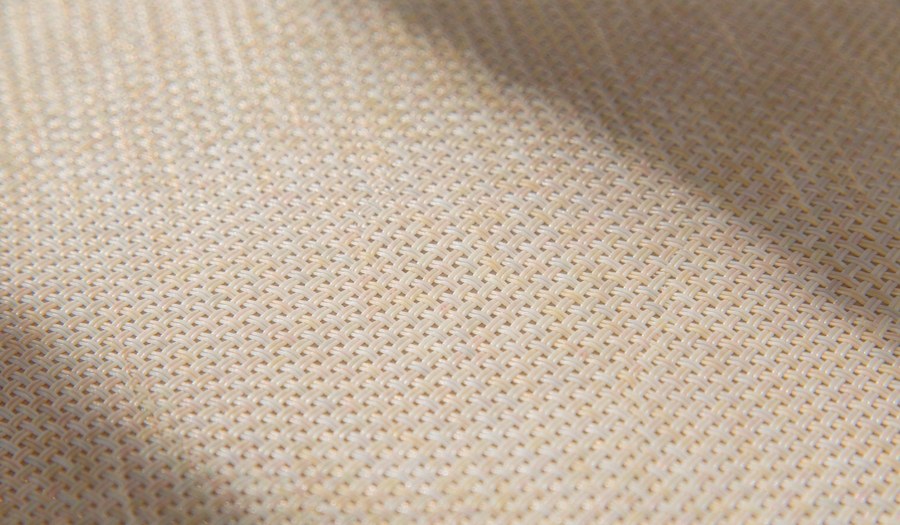
The canopy is the part the sun eats. Three fabric families cover the commercial market:
- Solution-dyed acrylic — the premium shade choice. Colour is dyed into the fibre before weaving, so it fades slowly. Shade-grade acrylics run 270–305 g/m²; Dickson's Origin Sépia U941, a 50% recycled solution-dyed acrylic, is 278 g/m² with a solar factor of 0.07. Acrylics in this class are rated UPF 50+ (about 98% of UV blocked) and stay breathable, which is what keeps mildew down between washes.
- Olefin (solution-dyed polypropylene) — around 200 g/m², typically UPF 40 (~95% UV blocked). Lighter and cheaper, and it shows wear sooner.
- Heavier SDP polyester — around 240 g/m², a middle option for price-sensitive projects.
A useful industry line sits at 240–300 g/m²: below it, you are buying a domestic parasol for a commercial job. When you evaluate commercial parasol canopy fabric, ask for the gsm figure, the weave, the UPF rating and the fade-hours test — plus a swatch, because the mill and the batch decide more than the brand name on the spec sheet.
Wind rating and base weight: the safety math
Commercial parasol wind rating is the first spec to verify and the one most often fudged. In Europe, parasols are commonly referenced against EN 13561, the retractable-awning standard, which grades wind resistance into classes 0 to 3 by the maximum speed the canopy withstands when open. Ask for the test report behind the class, not the adjective in the brochure.
The base is where wind safety becomes arithmetic. A canopy is a sail; the base is the counterweight. Published commercial guidance for freestanding parasols:
| Canopy | Minimum base weight (commercial) |
|---|---|
| Centre pole, up to 2.5 m | 30–40 kg |
| Centre pole, 2.5–3 m | 50 kg |
| Centre pole, 3–4 m | 60–80 kg |
| Cantilever, 3 m | 80–100 kg |
| Cantilever, 3.5 m and up | 100 kg+ with ground fixing strongly recommended |
Through-table installations cut the requirement roughly in half because the table itself is ballast. For permanent sites the strongest fix is in-ground: a hole about 80 cm deep, filled with concrete around a steel ground sleeve, cured at least seven days before the parasol goes in. Where a terrace cannot be dug — rooftops, tiled decks — a bolted deck plate gives near in-ground stability. Wheeled bases around 35 kg belong to sheltered venues only.
Put the operational rule in the SOP, not just the spec: staff close the parasols at the first storm warning. A class rating describes a tested condition, not a forecast.
Frame, mechanism and hardware
Under the canopy, commercial frames use thick-wall aluminium — a typical cantilever mast is a 120 × 83 × 3 mm profile with a 65 × 55 × 3 mm support arm and eight telescopic ribs around 20 × 35 × 1.2 mm, which tension the canopy evenly instead of letting it sag. For poolside and coastal sites, specify stainless hardware (SUS304 or better) over plated steel, and a powder-coated or anodised finish.
Mechanism choice is a labour question. A hospitality parasol is opened and closed more than 1,000 times a year; a light pulley or cheap crank will not survive that. Hand cranks are the dependable default; winding or motorised systems earn their cost only on large cantilevers that staff open daily. Treat canopies and ribs as consumables and order spares with the first container — a replacement canopy is a line item, not an emergency.
Siting poolside, terrace and restaurant layouts
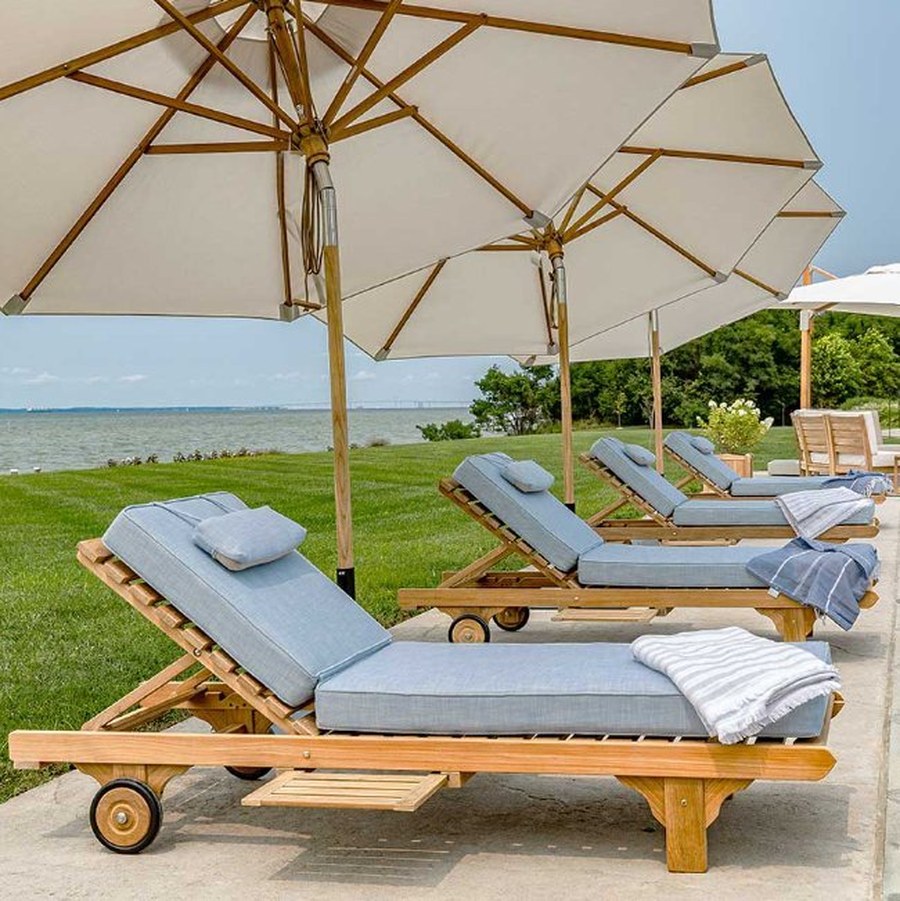
Five layout rules keep a commercial outdoor parasol program working:
- Space canopies so a fully rotated canopy never overlaps its neighbour.
- Map the wind: gaps between buildings funnel air across terraces, and pool decks build their own afternoon breeze.
- Shade the seats people use at peak — the sun lounger run and the dining set, not the empty edge of the deck.
- Through-table parasols keep poles out of walkways; cantilevers free the pool deck entirely.
- Assign daily rotation to a named staff role — shade that tracks the sun is shade that gets used.
At a resort or beach club, the pattern that works is a rhythm of parasols over the lounger run, sized to the deck, with the dining set shaded separately.
Sourcing commercial parasols from a factory
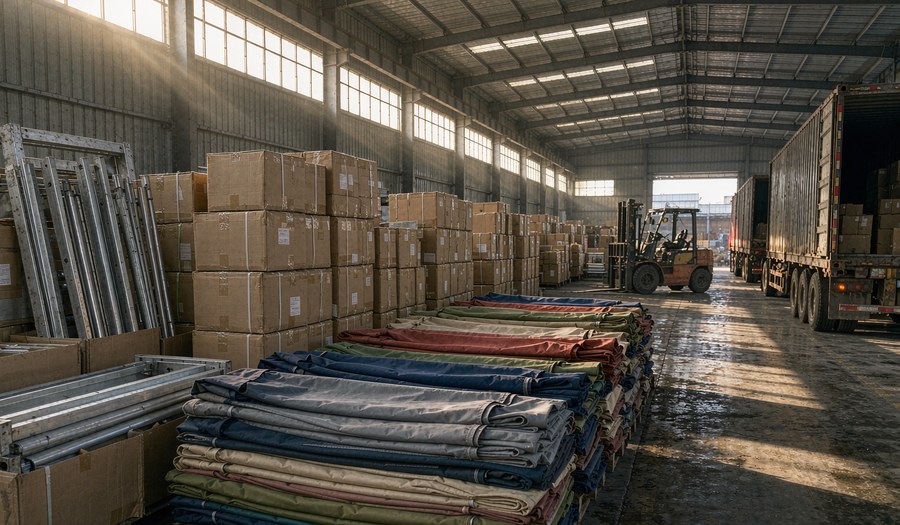
Commercial parasol wholesale programs run on the same mechanics as furniture orders. Expect MOQs set per model rather than per piece, mixed containers that consolidate parasols with dining sets and sun loungers, and custom OEM options — canopy colour matched to a brand palette, logo printing on the valance.
Five things to settle before the order is confirmed:
- Request a canopy swatch and one full unit for site testing before the container ships.
- Confirm pole diameter and umbrella-hole fit against your furniture spec — our sets use Ø50 mm.
- Get the packing list early: canopies fold into cartons, frames bundle, and 40HQ volume planning needs fixed carton dimensions.
- Lock spare canopies and ribs into the same order.
- Ask the manufacturer, in writing, what wind class the unit is tested to and what cantilever parasol base weight they recommend for your sizes.
Buyer checklist
- Coverage plan: 80–90% of peak-hour seats shaded, canopies tracked to the sun path
- Format chosen per furniture group: through-table, freestanding, cantilever or wall-mounted
- Fabric spec on paper: gsm ≥ 240 (270+ for premium acrylic), UPF 50+, fade-hours test, swatch approved
- Wind class per EN 13561 with the test report attached
- Base weights matched to canopy size; ground fixing or deck plates specified where digging is impossible
- Stainless hardware and marine-grade finish for poolside and coastal sites
- Mechanism rated for 1,000+ open/close cycles a year
- Pole diameter matched to the dining set's umbrella hole (Ø50 mm on our tables)
- Spare canopies and ribs in the first order; packing list and carton dimensions confirmed
- Storm SOP assigned to staff, with parasols closed at first warning
Commercial outdoor parasols specified this way stop being an accessory line and start behaving like infrastructure: safe in wind, cool at peak, and replaceable piece by piece for the next decade.