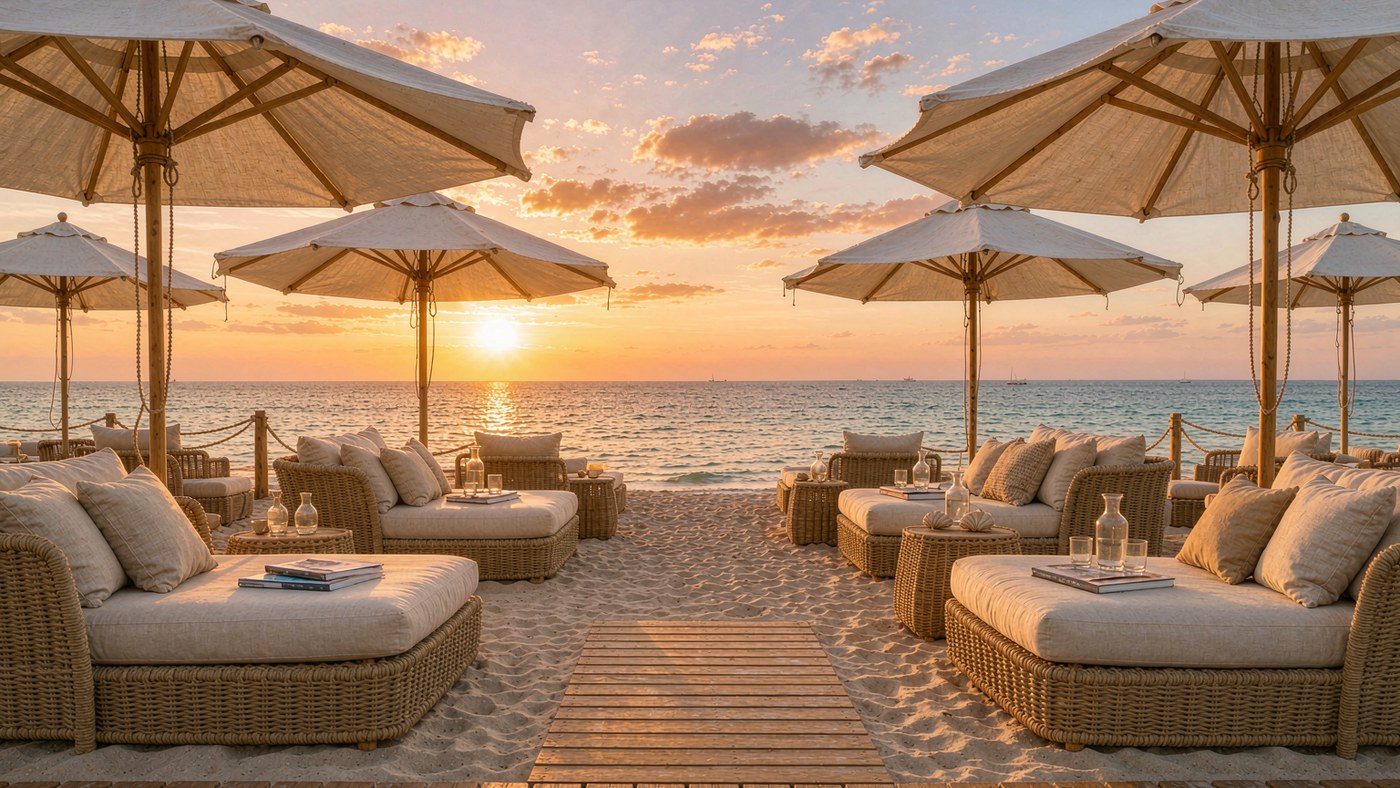
A beach club is the harshest furniture environment in the hospitality business — harsher than a pool deck, harsher than a rooftop, harsher than a garden terrace. Sand abrades every surface, salt spray settles on every joint, UV runs all day at full intensity, and the furniture is reset by staff dozens of times a week between spilled drinks, wet towels and salt water. Furniture that lasts eight years on a hotel patio can look finished in two seasons on sand.
This guide is the beach club furniture specification from a buyer's seat: the four stressors to design against, which materials actually survive sand, how to write sand management into the maintenance routine, how to anchor against coastal wind, and how to lay out for turnover. It follows our poolside guide — where the enemy was water chemistry, here the enemies are sand, salt and service. Furniture that lasts eight years on a hotel patio can look finished in two seasons on sand; the buyers who get this right treat sand resistant outdoor furniture as a system — frame grade, seat surface, cushion strategy and rinse routine — rather than as a product photo.
The four stressors, and what each one does
| Stressor | What it does to furniture | Specification response |
|---|---|---|
| Salt spray and salt-laden air | Chloride pitting on hardware; tea staining; powder-coating edges attacked first | 316 stainless hardware throughout; marine-grade coating spec; rinse schedule |
| Sand abrasion | Open weave fills with grains; sling surfaces scour; cushions trap grit that grinds fabric | Textilene sling or tight weave at the sand line; no cushions in the splash zone; daily rinse |
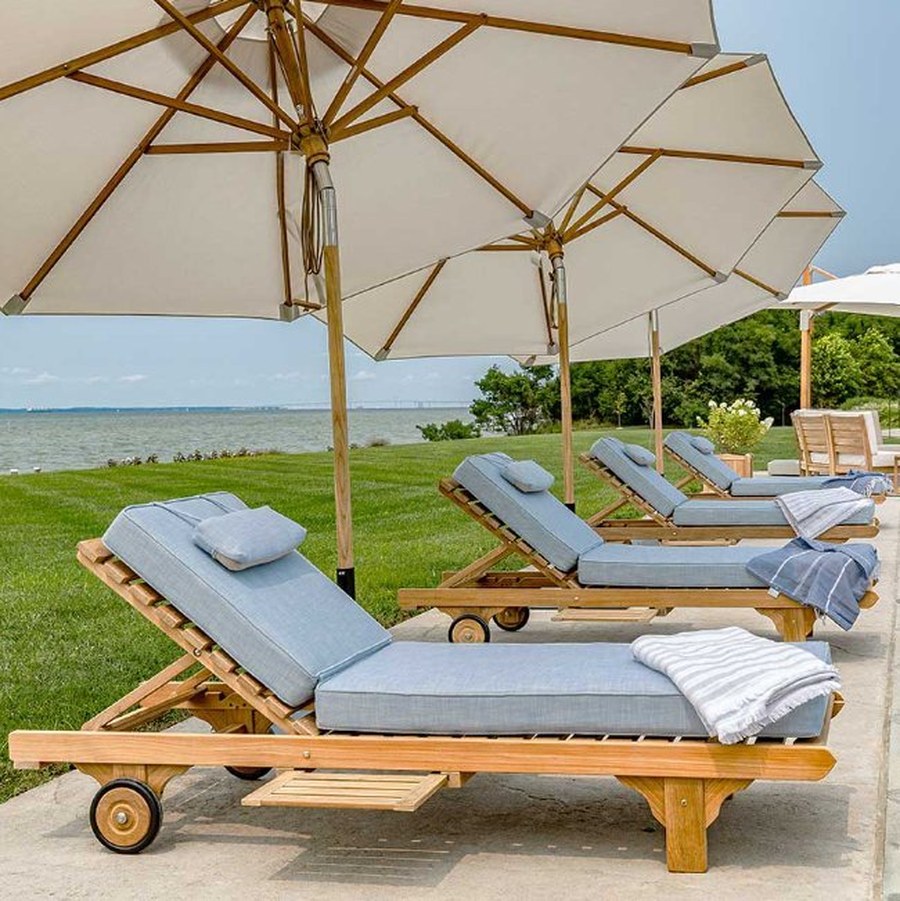
| UV and heat | Fabric fade, foam breakdown, timber silvering, deck-surface heat on bare metal | Solution-dyed acrylics; quick-dry open-cell foam; teak accepted to silver grey |
| Turnover and spills | Reset damage, dropped frames, F&B stains, sunscreen and oil on cushions | Stackable ranges; replaceable cushion covers; removable, washable fabrics |
Design for all four at once and the beach club furniture specification stops being a style choice. The first cut is zoning: decide which furniture sits directly on sand, which sits on decking, and which never leaves the shade.
Materials that survive sand
Powder-coated aluminium is the default frame material for commercial beach club seating, and for good reason: it carries the highest static-load ratings of the common contract materials — contract-use seating is typically rated around 1,600 N on the seat against roughly 1,300 N for domestic equivalents — and it tolerates salt air when the coating spec and the hardware are right. Pair every aluminium frame with 316 stainless fasteners; a beach club is exactly the chloride environment where A2 hardware starts pitting within months. Our stainless grade guide covers the hardware side in detail.
Teak earns its place in the dining sets, bar tops and shade structures rather than the lounger field. It handles salt air better than almost any timber, but on open sand it silver-grey quickly and grit works into the grain; both are cosmetic, not structural, but they change how the furniture photographs mid-season. Where teak sits on sand, plan for a monthly wash and an annual light sanding on touchpoints.
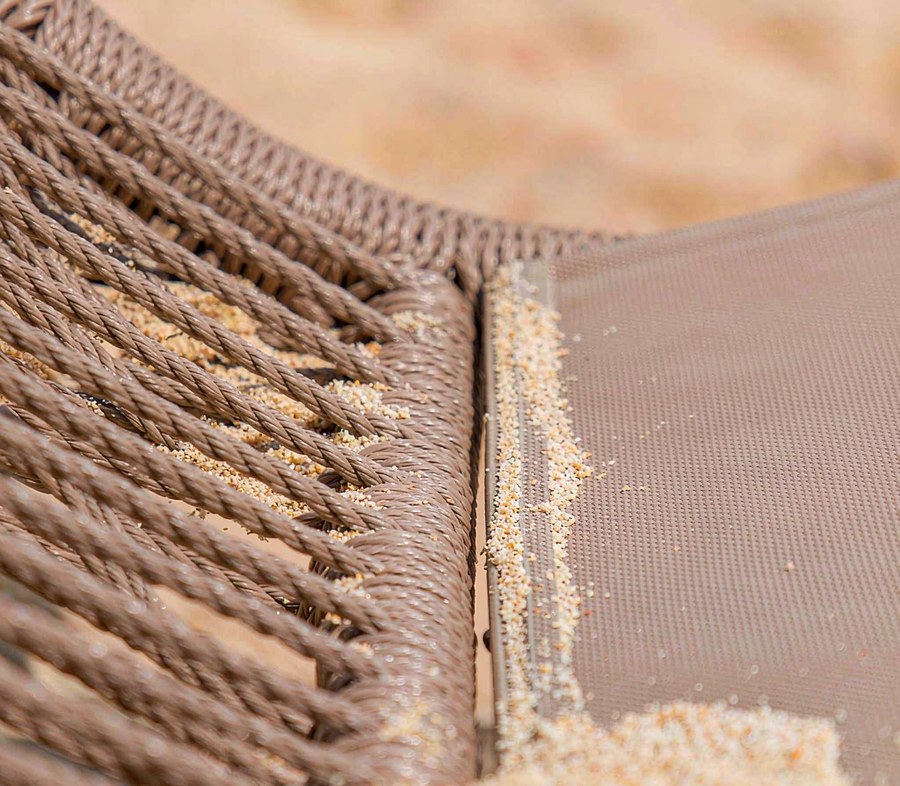
The seat surface is where sand is won or lost. Open rope weave traps grains — every strand is a pocket — and guests feel it. Textilene sling sheds sand: grains rest on the surface and rinse straight off. For outdoor furniture for beach clubs, the practical pattern is sling or tight-weave seating at the sand line, rope weave reserved for decked zones and shaded cabanas, and rattan wicker panels kept to back-of-house and F&B areas where traffic is controlled.
Cushions are the consumable. Specify solution-dyed acrylic or equivalent UV-stable fabric, quick-dry foam with open structure, and — non-negotiable — zip-off covers that the laundry can wash on a schedule. In the splash line, skip seat cushions entirely and use back cushions only, or none at all: a beach club that buys cushion-free loungers for the first row and cushion-equipped cabanas behind it is buying with the environment, not against it.
Sand is a maintenance spec, not a material problem
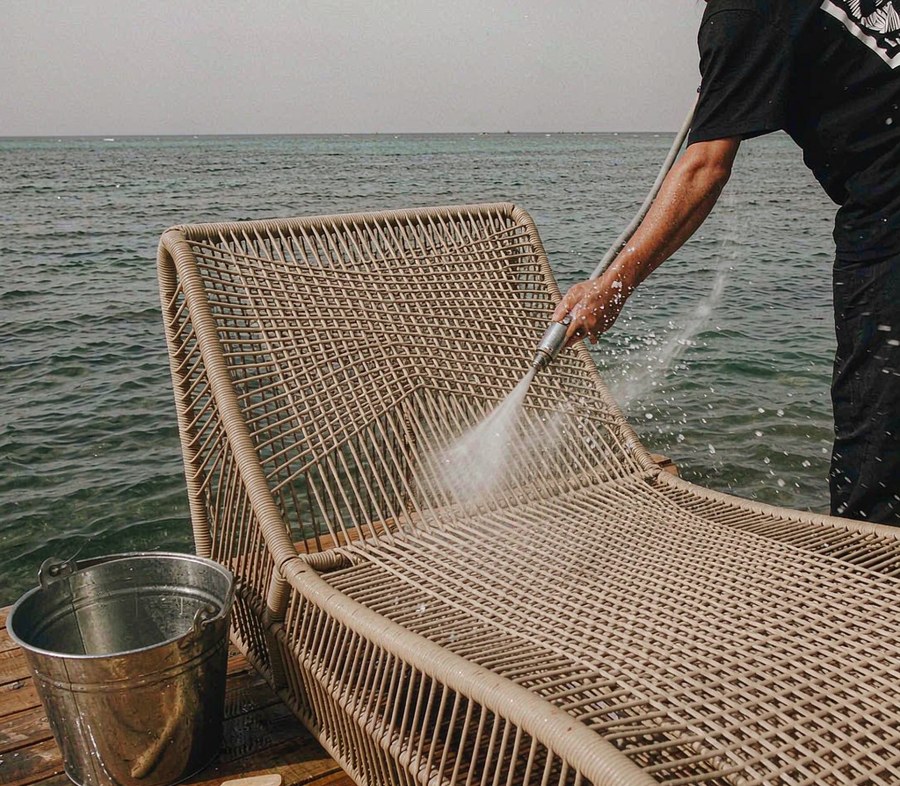
No material wins against sand once it is ground in; the specification that wins is the one that gets sand off the furniture every day. Build the routine into the opening checklist:
- Daily rinse — fresh water over seats, backs and frames at close of service, before sand dries into weave.
- Soft brush pass — a soft-bristle brush along rope weave and sling channels, not across them, to lift grains without fraying.
- pH-neutral cleaner only — no solvents, no bleach, no degreasers on powder coating or fabric; salt film lifts with water.
- Weekly cushion rotation — swap in spares, send used covers to the laundry; two sets of covers double cushion life at small cost.
- Monthly weave inspection — check rope ends, sling seams and fastener heads; a fraying sling is a replacement part, not a repair job.
Sand-resistant outdoor furniture is therefore less about a miracle material and more about the rinse habit plus parts availability. Before signing, confirm the factory stocks replacement slings, rope sections and cushion covers as catalogue parts — the club that cannot re-sling a lounger in week three of the season turns a maintenance item into a write-off.
Wind, anchorage and the storm protocol
Coastal wind is the other quiet killer: it lifts parasol canopies, walks unweighted daybeds across a deck, and loosens anything that is not tied down. Contract parasols are rated by wind class (EN 13561 runs from class 0 to 3), and a beach club on an exposed shore should sit at the top of that scale with the base weights to match — as a reference, centre-pole parasols of 3–4 m span typically need 60–80 kg of base, and 3 m cantilevers 80–100 kg. Anything on sand needs anchoring to the deck or to buried ground anchors, not to the sand itself.
Write the storm protocol into the spec: parasols closed and lowered at a stated wind speed, loungers stacked and strapped, cushions into storage. The furniture order should include the stacking and storage hardware that makes the protocol executable — stackable sun loungers that lock in stacks of six, and side tables light enough for one person to move.
Layout and turnover
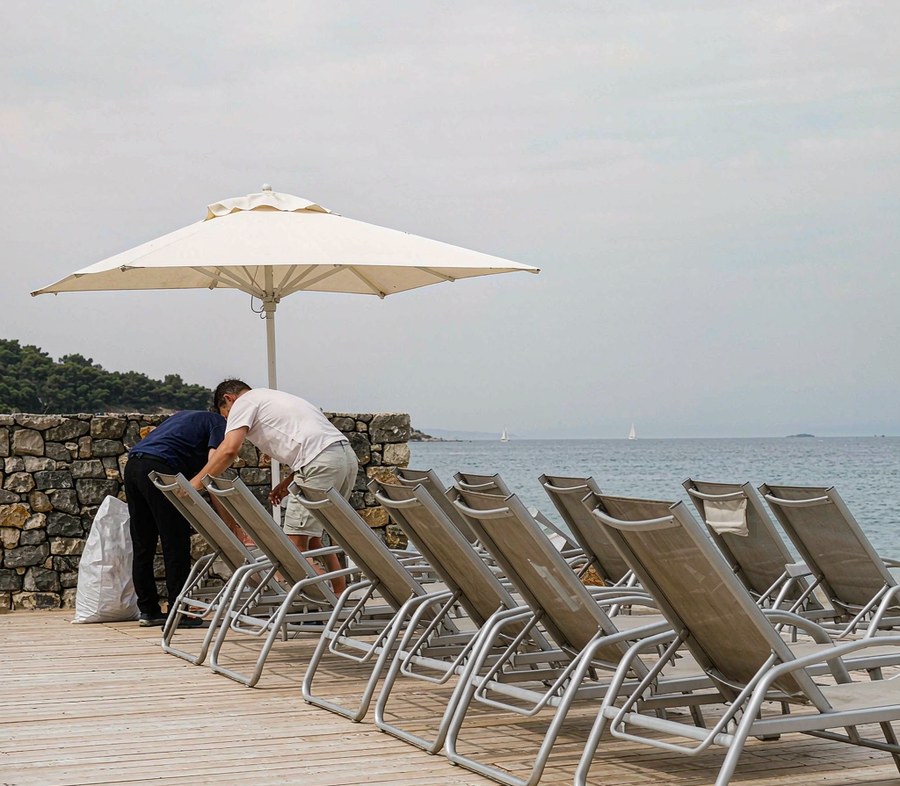
Beach clubs live on reset speed. Guests leave a lounger; staff need it back in service in minutes, not hours. Three layout rules do most of the work:
- Zones with different specs — lounger field on sand, daybeds and cabanas on decking, dining set and bar under structure. Each zone buys a different furniture spec, and the quote should show them as separate lines.
- Service paths that staff can actually use — 1.2–1.5 m between rows minimum, wide enough for a tray and a cleaning cart; a beautiful layout that blocks service gets rearranged by staff anyway, badly.
- Stackable by default in the lounger field — stackable sling loungers reset in minutes and store flat in the off-season; fixed daybeds stay in the premium rows where they earn their footprint.
The buyer's checklist
For resort groups running several properties, the same specification should roll out as a standard: one hardware schedule, one cushion spec, one parts list. A manufacturer shipping identical replacements to every site — and pricing the whole estate at group MOQ rather than property by property — turns a single club's specification into a group-wide maintenance asset.
- 316 stainless hardware on every frame, anchor and caster — with mill test reports available.
- Sling or tight-weave seating at the sand line; rope weave on decked zones only.
- Cushions with zip-off, washable covers; spare-cover sets ordered with the first container.
- Replacement parts — slings, rope, covers, feet — confirmed as stock items before the deposit.
- Parasols at the wind class and base weight the site deserves, with a written storm protocol.
- Stacking hardware and storage plan for the off-season agreed before production.
The short version
Beach club furniture fails from the hardware out and the weave in. Specify 316 stainless, sling seating at the sand line, washable cushion covers, stackable loungers, and a daily rinse routine — then treat the factory as a parts supplier for the life of the club. Beach club furniture wholesale programs that quote the whole package — furniture, spares and hardware schedule in one document — are the ones still standing in season five.