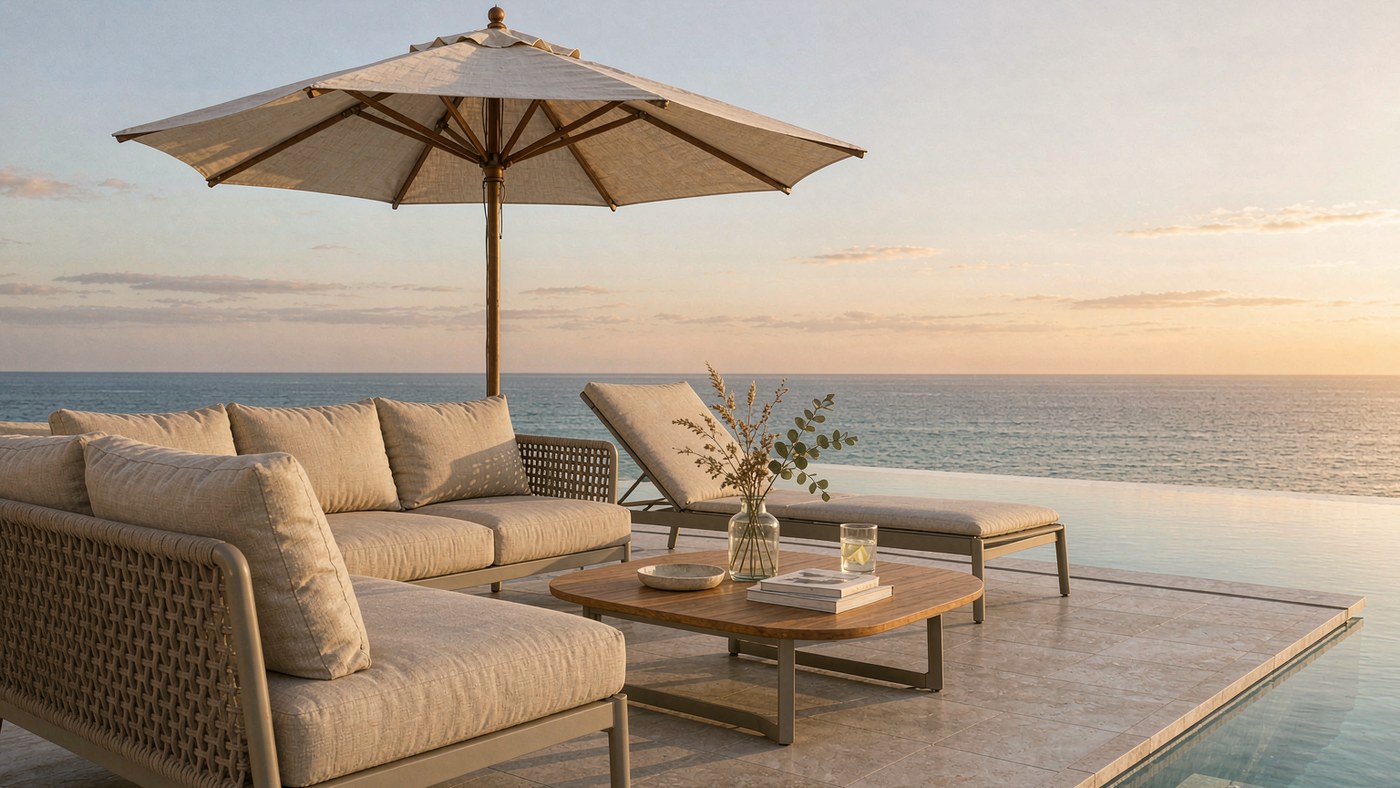
Every January, hospitality buyers sit down with a design trend report and a capital plan, and the two documents rarely talk to each other. The useful version of a trend is not a colour name — it is a specification decision you can put in a purchase order. This guide reads the hospitality outdoor furniture trends 2027 season the way a procurement team should: each trend translated into what to specify, what to ask, and what to refuse.
It is written for hotel, resort and restaurant buyers planning next season's terrace, poolside and rooftop programmes — the outdoor furniture trends for hotels and resorts that will actually reach your site in 2027, not the ones that only survive a lookbook. The short version: the palette is warming, the frames are getting lighter, the seats are getting deeper, and the durability bar that started in hospitality is now the baseline everyone else copies.
Warm neutrals replace the grey era
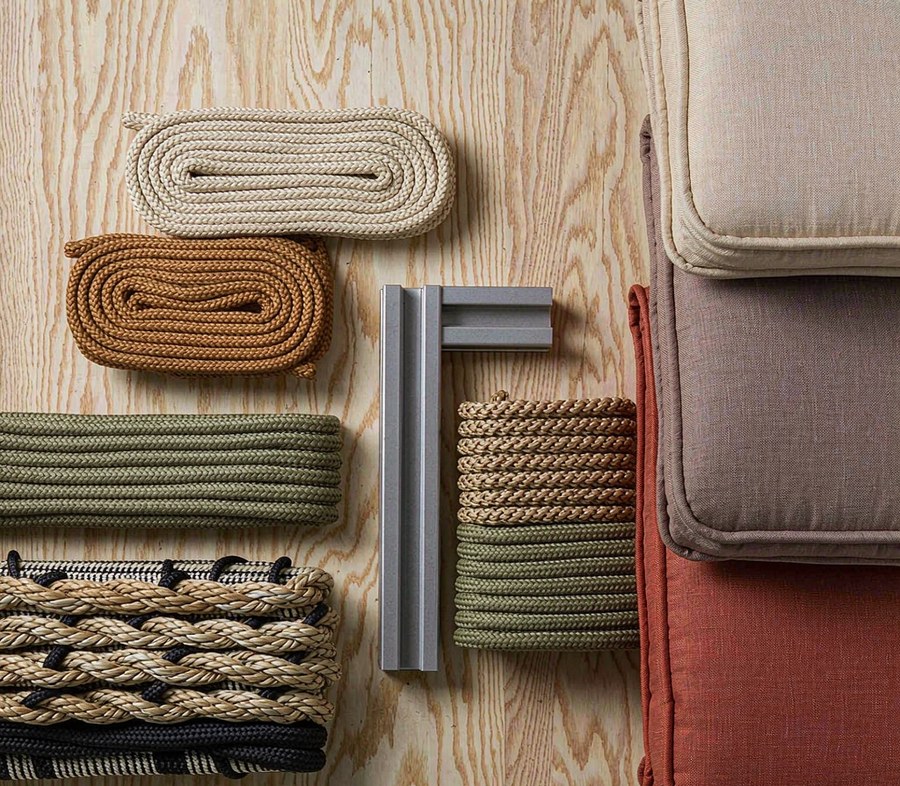
The grey cascade of the mid-2020s is ending. The 2027 palette runs to warm neutrals — sand, taupe, terracotta accents — and muted botanical greens, in both rope weave and cushion fabrics. For a buyer this is the cheapest trend on the list to act on, because colour lives in the soft layer: cushions, parasol canopies and accent pillows, not frames.
Specify solution-dyed acrylic or an equivalent solution-dyed outdoor fabric for cushions — the pigment sits in the fibre, so fade resistance is a property of the yarn rather than a surface treatment that washes out. Then do the discipline that saves the programme later: order 5–10% spare cushions and canopies with the first order, retain a master sample, and require the factory to hold the dye-lot reference so a year-three reorder matches the year-one terrace. Where frames are still sound, re-cushioning in the 2027 palette refreshes a whole zone for a fraction of a replacement budget.
Rope weave over powder-coated aluminium
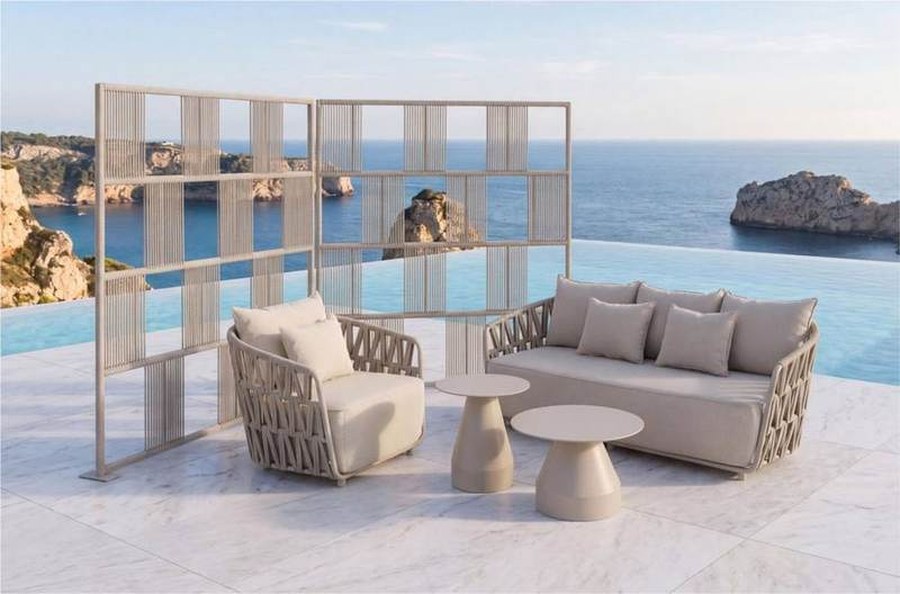
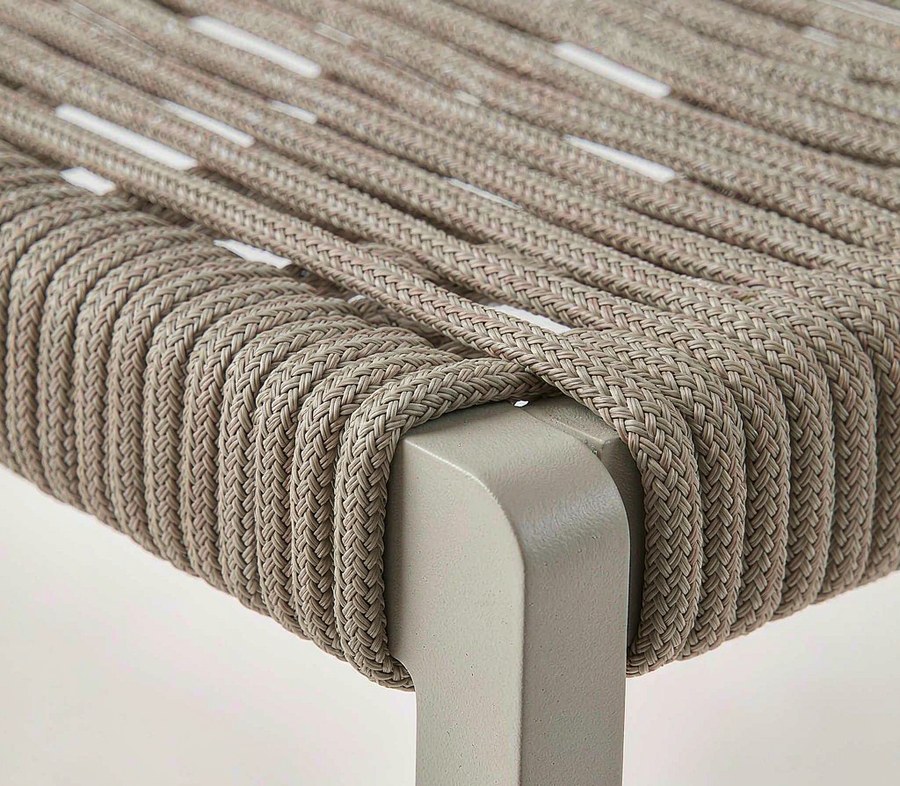
The frame story of 2027 is rope weave over powder-coated aluminium. Flat, textile-style rope gives a slimmer, more architectural silhouette than traditional round wicker, and aluminium keeps taking share from steel in premium programmes — corrosion-resistant by nature, lighter in freight. Hybrid builds are the other direction worth watching: rope seating surfaces paired with teak or hardwood tops and arm caps, so one set carries texture and warmth at once.
What to specify: rope that is UV-stabilised and dyed through rather than surface-coated, an aluminium system with a documented powder-coat process, and concealed joinery. Our teak and aluminium lines ship fully assembled, with no visible screws and nothing to assemble on site — your PO should state that expectation explicitly. For coastal sites, ask for 316-grade stainless fasteners at every frame joint; inland, 304 is the accepted floor. Rope weave is a wear surface, not a structural one, so confirm that replacement rope and sling sections are stocked as service parts before you sign: a weave refresh in year five costs a fraction of a frame replacement.
Comfort-first: deeper seats and modular layouts
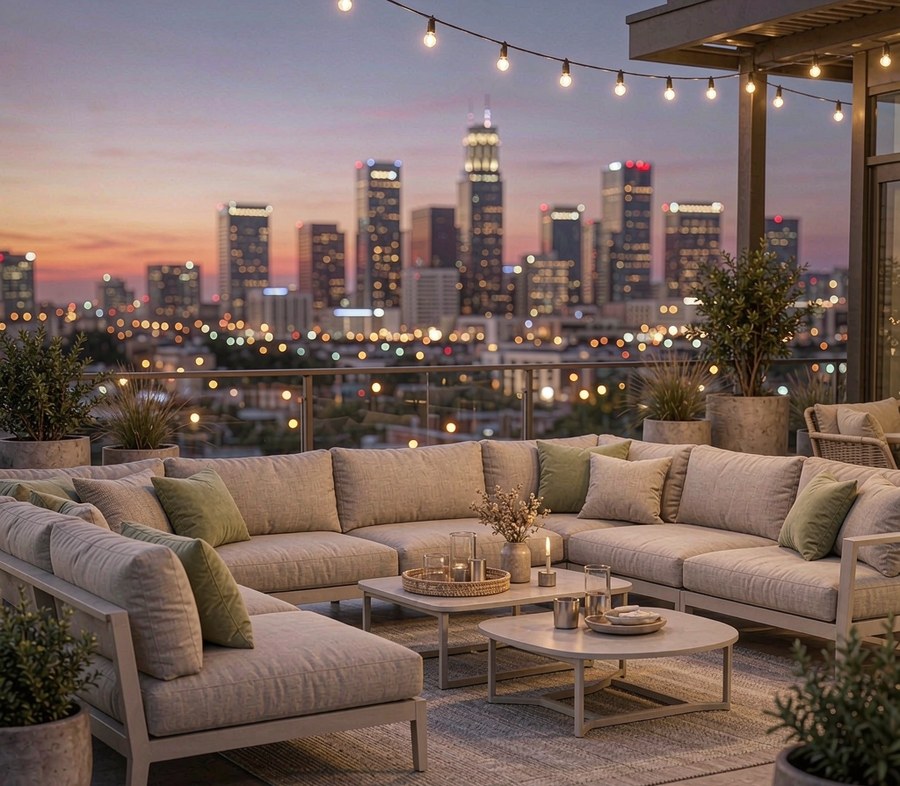
The terrace has become an outdoor living room, and the furniture has followed: deeper seats, thicker cushions, lower-slung profiles and modular corner systems that reconfigure as the occasion demands. Among hospitality terrace furniture trends, this is the one guests feel within thirty seconds of sitting down, and it is where lookbook photography hides the most risk. Corner dining builds — part lounge, part dining — keep growing because they mirror how guests actually use a terrace.
Translate the look into numbers before you order. Seat height for dining configurations typically runs 400–450 mm; lounge-depth seating sits deeper, around 700–800 mm, and a set marketed as "deep-seat" without a stated depth is a marketing word, not a specification. For modular programmes, ask for the module grid — centre module, corner and ottoman dimensions — and check it against your zone dimensions on paper before the container is loaded. Reconfiguration hardware is the question buyers forget: how do modules connect, can a guest undo them by accident, and can staff re-lay a lounge in ten minutes between events?
The hospitality durability tier is the new baseline
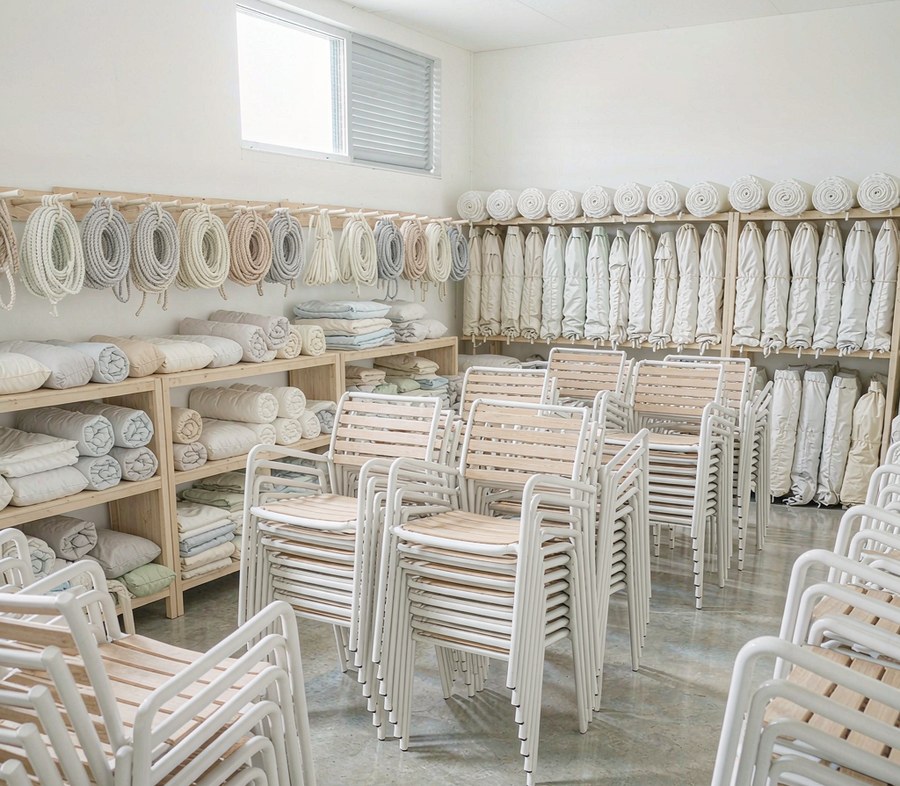
The clearest of the contract outdoor furniture trends heading into 2027 is that hospitality-grade requirements are leaking into every other segment. Commercial-grade frames, stackability, quick-dry cushions, spare-parts availability and finishes that survive sunscreen and pool chemistry were contract-only concerns five years ago; now they are the entry ticket. Buyers who understand the hospitality spec sheet gain an edge, because products engineered for contract use over-deliver in domestic settings.
Turn that into a checklist your supplier answers in writing: stack height and stack count for every stacking chair; cushion fill that drains and dries rather than soaking up a spilled cocktail; textilene or mesh slings that shed pool water instead of holding it; a frame finish rated for the cleaning chemistry your housekeeping team actually uses; spare-part pricing held for reorders; and lead-time commitments for replacement cushions and canopies mid-season. A manufacturer that publishes wholesale reorder pricing on spares is telling you something about the next decade of the programme.
Sustainability now means evidence
Sustainability questions have moved from brochure boilerplate to purchasing criteria. The credible answers are concrete: durable frames that resist replacement, weatherproof weaves that extend product life, repairable designs with available spare parts, and packaging that shrinks. Longevity itself is the environmental argument — furniture that survives five seasons outdoors beats any brochure claim. For teak programmes, ask for origin documentation: EUDR obligations begin phasing in from December 2026 for large operators, and a factory that can already supply origin paperwork is de-risking your European orders rather than promising to catch up.
Freight efficiency is a design requirement
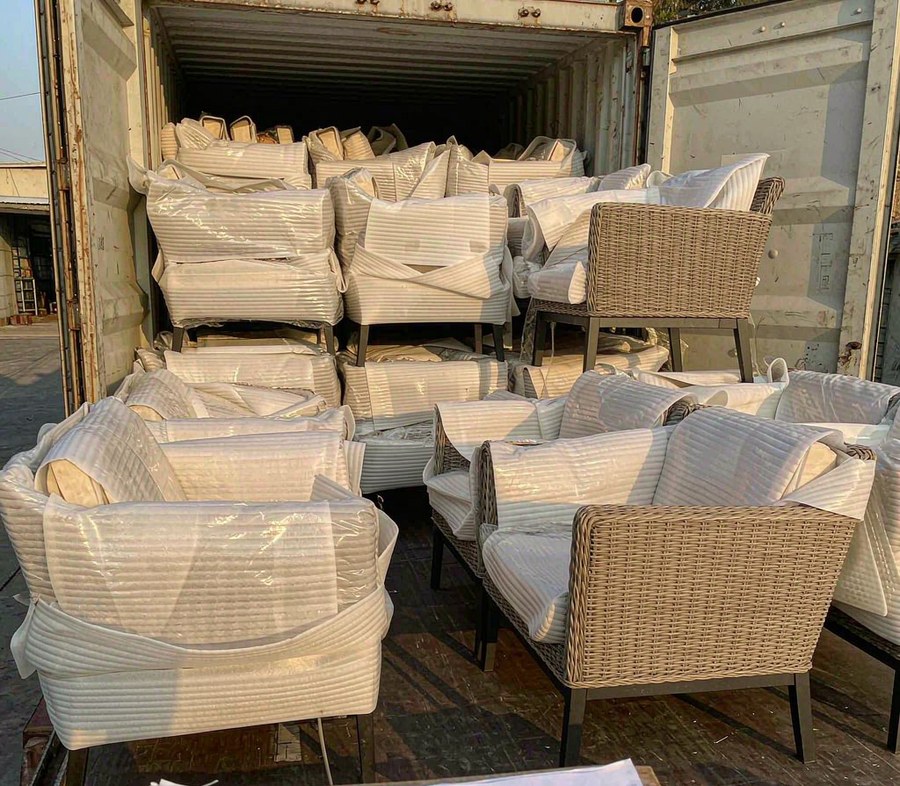
Packed volume has become a design constraint, not an afterthought. For a buyer the arithmetic is simple: fewer cubes per set means more sets per container loading and a lower landed cost per unit. Ask how each set nests and stacks — sun lounger stacking height, chair stack count, whether coffee tables nest — and what the carton dimensions are, because that is what the freight forwarder prices. Fully assembled, non-KD furniture can still pack efficiently when the design nests; what you should refuse is a set that ships forty percent air. Agree MOQ and reorder terms for later phases in writing before the first container sails, and note that a factory planning container loading by zone — loungers in one bay, dining sets in another — cuts your installation labour on arrival.
Turning 2027 trends into a spec sheet
A trend you cannot put in a PO is decoration. Use this table to convert the season into specification lines, then send the question column to your supplier before you request a quotation.
| 2027 trend | What to specify | Question to ask the factory |
|---|---|---|
| Warm neutral palette | Solution-dyed cushions and canopies; dye lot held for reorders; 5–10% spares | Will a year-three cushion reorder match the original dye lot? |
| Rope weave over aluminium | Dyed-through UV-stabilised rope; documented powder-coat process; concealed joinery | Are replacement rope sections and slings stocked as service parts? |
| Deeper seats, modular layouts | Seat depth and height in mm; module grid checked on paper; reconnection hardware | Can staff re-lay the lounge in ten minutes, and can guests undo it? |
| Durability tier as baseline | Stack counts, quick-dry fill, finish rated for your cleaning chemistry | What is the spare-part price list, and is it held for reorders? |
| Evidence-based sustainability | Origin documentation for teak; repairability; spare-parts availability | Can you supply origin paperwork for EU-bound teak today? |
| Freight efficiency | Nesting and stacking dimensions; carton cube per set; zone-planned loading | How many sets fit one 40HQ, and how is the load planned by zone? |
None of these trends requires a new supplier relationship to act on. They require a specification that states the palette, the frame system, the seat dimensions, the durability tier and the packing plan — and a factory that answers the question column in writing. That is the difference between following 2027 outdoor furniture design trends and buying furniture that still performs in 2029.